
Loading, please wait...
LOT 0022
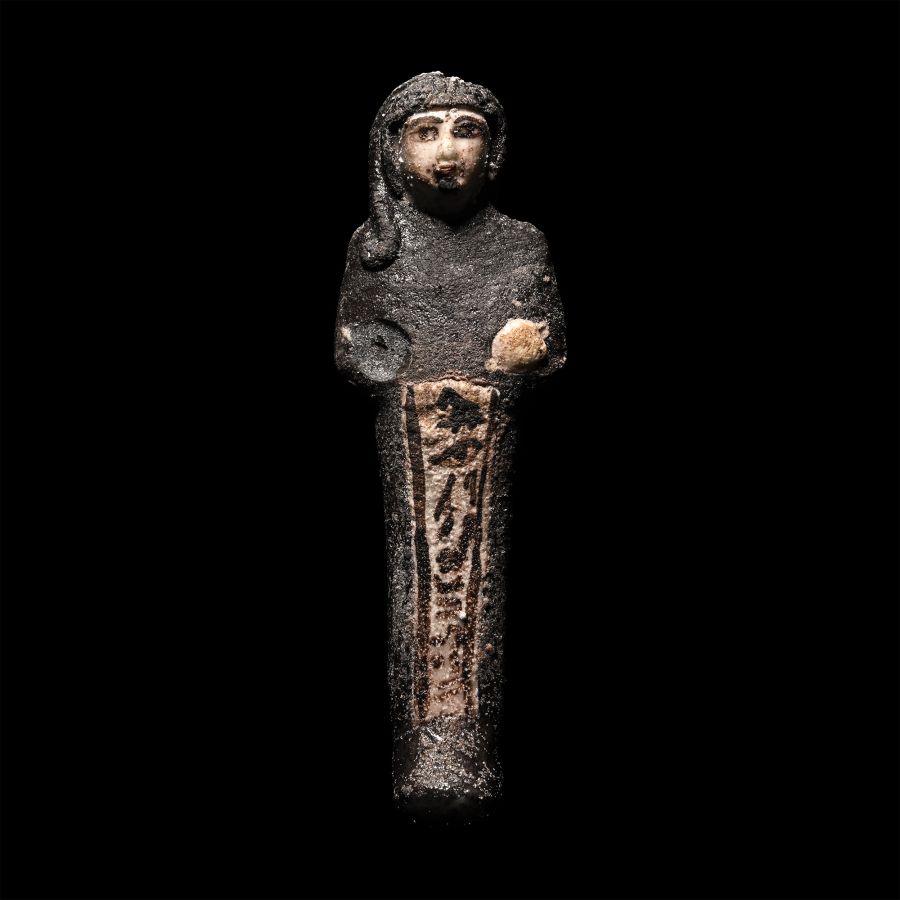
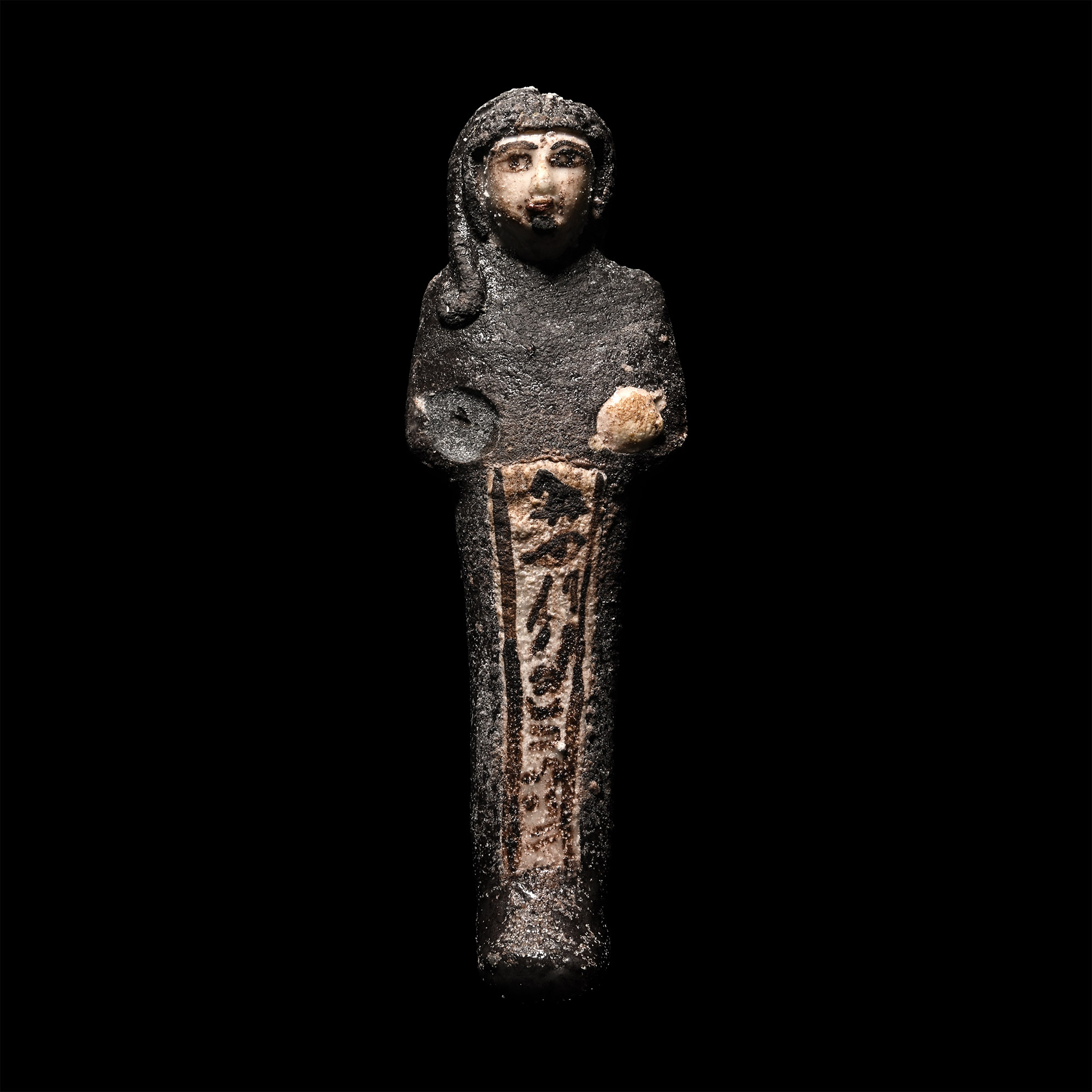
Egyptian Faience Shabti for the Fourth Son of Ramesses II, Prince Khaemwaset
NEW KINGDOM, 19TH DYNASTY, 1279-1213 B.C.
5 in. (103 grams, 12.7 cm).
In brownish-black and white faience with black detailing, depicted wearing a round wig featuring a side-lock, the white face displaying eyes, eyebrows, nostrils, and a short beard in black; the arms crossed, and the white-glazed hands (one missing) holding hoes; a slightly raised white-glazed frontal panel containing a column of hieroglyphic text reading: 'The Osiris, the sem (priest), the King's Son, Khaemwaset, True of Voice'.
ProvenanceAcquired on the UK art market, 1990s.
Private collection, New York, USA.
This lot has been checked against the Interpol Database of stolen works of art and is accompanied by search certificate no.13431-225468.
Cf. Bovot, J-L., Les serviteurs funéraires royaux et princiers de l’Ancienne Égypte, Paris, 2003, pp.230-301, for the substantial collection of Khaemwaset shabtis in the Louvre.
FootnotesKhaemwaset was the fourth son of Ramesses II, born to Queen Iset-Nofret. In addition to serving as the Sem-priest of Ptah at Memphis from an early age, he held various titles related to the Memphite cult, including High Priest of Ptah. The side-lock featured on all of Khaemwaset's shabtis is associated with his priestly role. Many shabtis of the prince are known, with the largest single group coming from the Serapeum at Saqqara; however, others have been found in numerous other locations. Since Khaemwaset's tomb has yet to be discovered, it appears that most of the known shabtis may have served as votive offerings in the sacred areas of the Memphite necropolis. His faience shabtis come in various colours, including green, blue, white, and black, and range in size from just under 10 cm to 15 cm in height. The distinctive glaze combination of this example, featuring a raised white-glazed panel contrasting with the darker body colour, is also found on some other 19th Dynasty shabtis (Cf. Janes, G., The Shabti Collections 3: Rochdale Arts & Heritage Service, Cheshire, 2011, pp.1-5, for those of Userhat from Sedment).
CONDITIONTimeLine Auctions follows a vetting process to ensure the authenticity and legality of all items, reinforcing our commitment to integrity and responsible trading. Each antiquity, antique, and coin lot undergoes thorough examination by a vetting committee of at least ten external specialists, professional trade association members, scientists, and archaeologists: Our Vetting Process
AUCTIONS:
TimeLine is a leading auction house specialising in antiquities, ancient art, collectables, natural history, coins, medals, and books. Our auctions offer museums, collectors, historians, and enthusiasts the opportunity to acquire unique and historically significant pieces.
LOT 0022
Egyptian Faience Shabti for the Fourth Son of Ramesses II, Prince Khaemwaset
Sold for (Inc. bp): £1,950
-
.jpg)
Egyptian Black Steatite Eye of Horus Amulet
Late Period, 664-332 B.C.Sold for (Inc. bp): £819
Carved unifacial amulet with hatched eyebrow and ribbed suspension loop. 1.45 grams, 19 mm
From a 20th century UK collection.
The wedjat-eye amulet is a representation of the healed eye of the god Horus, featuring both human and falcon elements. The name Wedjat in ancient Egyptian means ‘the one that is sound.’ According to Egyptian mythology, Horus' eye was wounded or taken by the god Seth and restored by Thoth. The wedjat-eye amulet was thought to protect its wearer and bestow the power of recovery and regeneration onto them. It was very popular and used by both the living and the dead. -
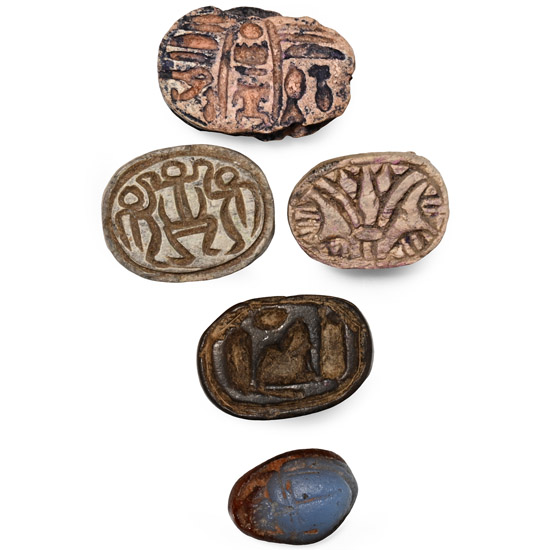
Egyptian Stone and Faience Scarab Group
2nd-1st millennium B.C.Sold for (Inc. bp): £338
Comprising: a blue glazed scarab with the cartouche of Thutmosis III (Men-kheper-Ra) on the underside flanked by other signs; a scarab with three schematic human figures; a scarab with an open lotus flower; another with motifs on the underside; and a blue and black glass scarab with a plain underside. 6.02 grams total, 10-16 mm
From the private collection of a European gentleman (1942-2024), formed since the 1970s. -
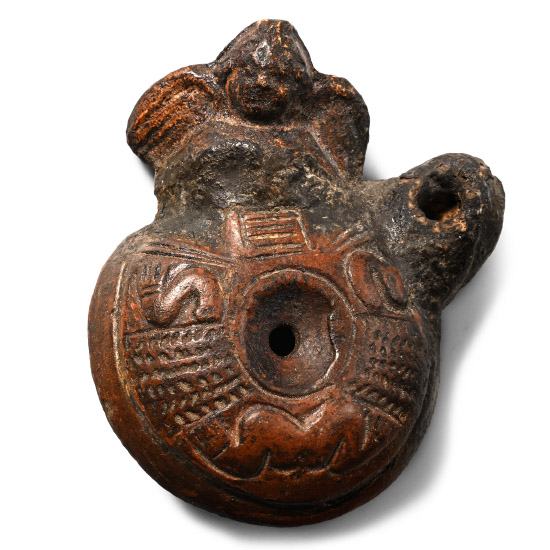
Romano-Egyptian Terracotta Oil Lamp with Eros
Roman Period, 1st-3rd century A.D.Sold for (Inc. bp): £228
Domed body with a small filler hole surrounded by bands of herringbone decoration and zoomorphic motifs, a projecting winged bust of Eros flanking the nozzle, inked collector's number '179' on the base. 68 grams, 85 mm
Ex important German collection, 1960-1990.
