
Loading, please wait...


LOT 0043
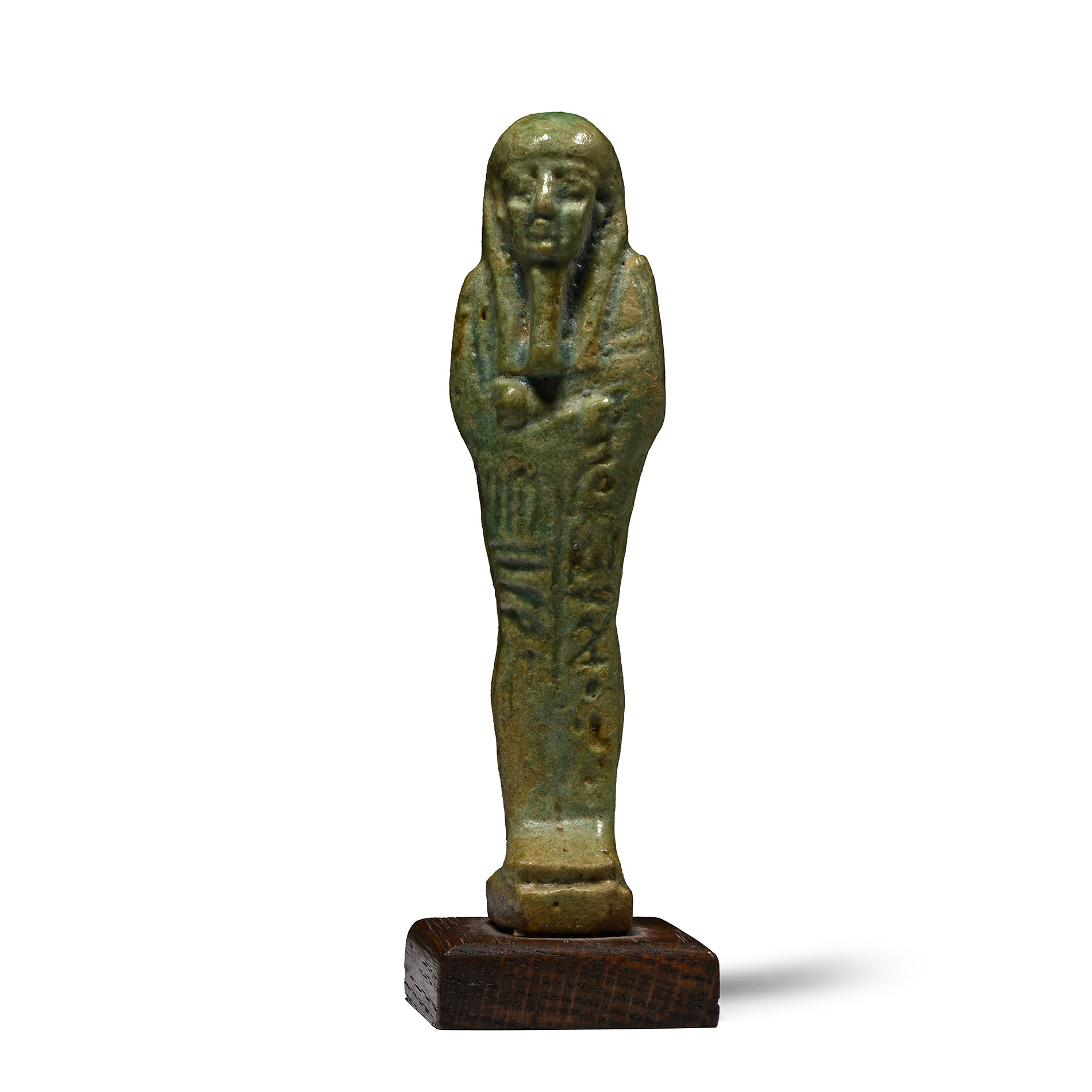
Egyptian Faience Shabti for Hor-sa-Iset
LATE PERIOD, CIRCA 4TH CENTURY B.C.
6 in. (124 grams, 15.2 cm).
Of mummiform type, wearing a tripartite wig and long plaited divine beard; holding a pick in the left hand, a hoe in the right, and the cord of a seed bag hanging over his left shoulder; standing on an integral plinth, a plain back pillar terminating at the base of the wig; two vertical panels of hieroglyphic inscription to the front, including dedication: sḥḏ wsỉr ḥr sꜢ Ꜣst, ‘The illuminated, the Osiris, Hor-sa-Iset’; mounted on a custom-made display stand.
ProvenanceJacques René Fiechter, Switzerland (1920-1950).
with Auction Martin, Egyptian collection of André Bircher, 1949.
with Cahn Auktionen AG, Basel, 5 November 2011, no.20.
Private collection, Europe.
Accompanied by copies of the relevant Cahn catalogue pages.
Cf. Janes, G., Shabtis: A Private View, Paris, 2002, pp.175-176, no. 91, for a shabti of similar style.
CONDITIONTimeLine Auctions follows a vetting process to ensure the authenticity and legality of all items, reinforcing our commitment to integrity and responsible trading. Each antiquity, antique, and coin lot undergoes thorough examination by a vetting committee of at least ten external specialists, professional trade association members, scientists, and archaeologists: Our Vetting Process
AUCTIONS:
TimeLine is a leading auction house specialising in antiquities, ancient art, collectables, natural history, coins, medals, and books. Our auctions offer museums, collectors, historians, and enthusiasts the opportunity to acquire unique and historically significant pieces.
LOT 0043
Egyptian Faience Shabti for Hor-sa-Iset
Estimate £1,000 - 1,400€1,160 - 1,620 (for guidance only)$1,350 - 1,890 (for guidance only)
-
.jpg)
Egyptian Gold Uraeus Amulet
Late New Kingdom, 1070-900 B.C.Estimate: £250 - 350 (+bp*)
Opening Bid: £125
Depicting a rearing cobra sporting a sun disc with its coiled body below resting on the hieroglyphic neb sign. 0.38 grams, 11 mm
From an early 20th century French collection. -
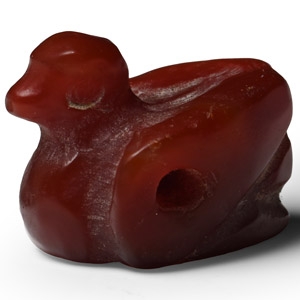
Egyptian Red Jasper Bird Amulet
Late Period, 664-332 B.C.Sold for (Inc. bp): £78
The seated figure of a duck(?), its small carefully rendered head with internally detailed eyes; a transverse suspension hole through its folded wings. 1.35 grams, 13 mm
From the collection of a gentleman, acquired on the London art market in the 1990s. -
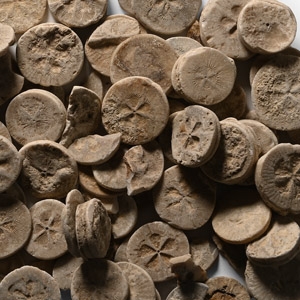
Egyptian Limestone 'Floral' Inlay Group
Roman Period, 30 B.C.-323 A.D. or earlierSold for (Inc. bp): £104
Group of discoid inlay plaques or gaming counters, crinoids with cinquefoil motif. 79 grams total, 8-18 mm
From a central London ADA dealership, 1980-1990.
Flowers were symbolic of rebirth due to the daily reopening of their petals after nightfall. As a result, they were widely used in domestic settings, religious and funerary contexts, and as adornments. Similar rosette discs, like those recovered from the Ramesside Period palace at Qantir, were used as decorative elements in royal palaces.
