
Loading, please wait...
LOT 0028
Egyptian Faience Ptah Amulet
PTOLEMAIC PERIOD, 4TH-3RD CENTURY B.C.
2 5/8 in. (29.6 grams total, 66 mm high including stand).
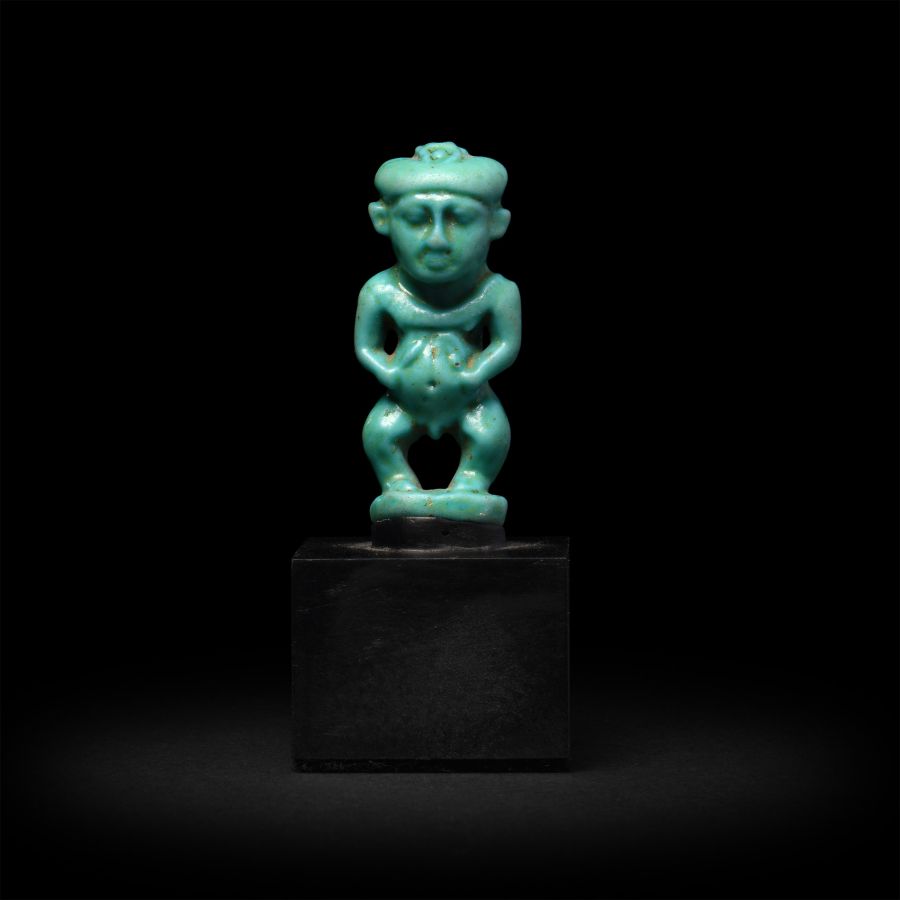
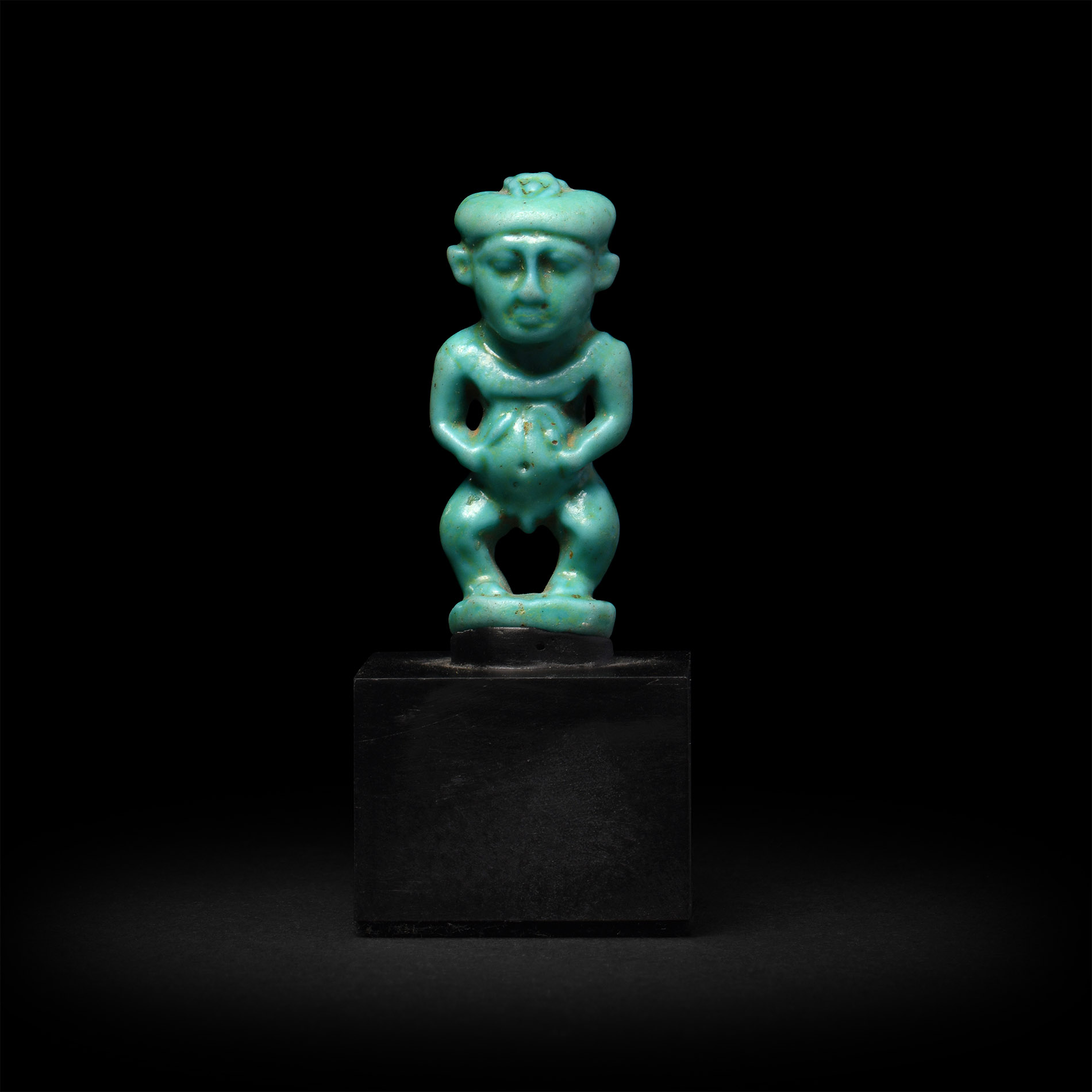
A blue-glazed faience amulet of the creator god Ptah in the form of the dwarf god Pataikos, modelled nude with stylised anatomical detailing, holding two knives to his stomach, squatting on an oval base; a scarab on the top of his cap; ribbed suspension loop to reverse; mounted on a custom-made display base.
ProvenanceEx private French collection.
with Thierry Maigret, Hotel Drouot, Paris, 12 July 2005, 76.
Cf. The V&A Museum, accession number 5480-1901, for a comparable figure of this date.
FootnotesThe Egyptian deity Pataikos is a special manifestation of the creator god Ptah, and the dwarf-like appearance symbolises his magical power. As a protective deity, amulets of Pataikos were worn for their apotropaic qualities; Pataikos was often depicted subjugating poisonous animals such as snakes and scorpions, and Pataikos amulets were probably worn to protect the wearer from such animals.
Ptah was the god of Egypt's capital city Memphis and master craftsman of the gods, known for his benevolent and approachable character. Ptah is attested from the beginning of ancient Egypt’s dynastic history and was a creator god, a god of craftsmen, and the patron deity of the Memphite region. The principal temple of the god was located in the city of Memphis. The fragmentary back pillar on this statuette indicates that it was most probably a temple offering, originally inscribed with an invocation to Ptah together with the donor’s name. Such votive figurines with back pillars naming the god and the dedicator occur in various materials, including faience and stone.
TimeLine Auctions follows a vetting process to ensure the authenticity and legality of all items, reinforcing our commitment to integrity and responsible trading. Each antiquity, antique, and coin lot undergoes thorough examination by a vetting committee of at least ten external specialists, professional trade association members, scientists, and archaeologists: Our Vetting Process
AUCTIONS:
TimeLine is a leading auction house specialising in antiquities, ancient art, collectables, natural history, coins, medals, and books. Our auctions offer museums, collectors, historians, and enthusiasts the opportunity to acquire unique and historically significant pieces.
LOT 0028
Egyptian Faience Ptah Amulet
Estimate £1,200 - 1,700€1,390 - 1,970 (for guidance only)$1,620 - 2,300 (for guidance only)
-
Egyptian Ceremonial Mace Head
Predynastic Period, 4th millennium B.C.Sold for (Inc. bp): £143
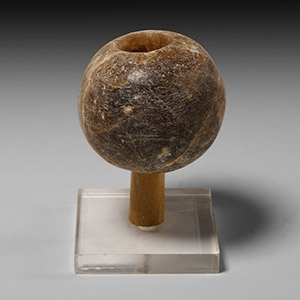
A spherical ceremonial stone mace head; centrally drilled; mounted on a custom-made display stand. 322 grams total, 87 mm high including stand
From an old UK collection. From the private collection of Alf Baxendale (1941-2016) part 2, keen Egyptologist, member of the Egyptology Society, trustee of the Amarna Trust; thence by descent. Accompanied by an identification display card. Accompanied by a copy of his obituary published in Horizon, The Amarna Project and Amarna Trust newsletter, Issue 18, 2017, p.21, by Barry John Kemp, CBE, FBA, Professor Emeritus of Egyptology at the University of Cambridge and directing excavations at Amarna in Egypt.
Mace heads were prized to such a degree that they were carried by chieftains as sceptres. -
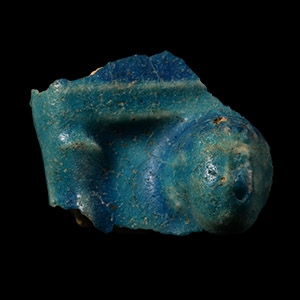
Egyptian Blue Faience Plaque Fragment
Ptolemaic Period, 332-30 B.C.Sold for (Inc. bp): £33
A fragment of a glazed composition frieze with corner-angle frame and head wearing a tripartite wig, possibly from a divine triad group; set within a kiosk with supporting papyrus columns. 4.68 grams, 31 mm
From a UK private collection, 1975-1978. -
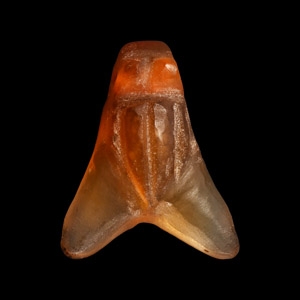
Egyptian Fly Amulet
Late Period, 664-525 B.C.Sold for (Inc. bp): £143
A carnelian fly amulet with simple head and body detailing, the eyes doubling as the suspension loop. 0.43 grams, 12 mm
From an early 20th century UK collection.
