
Loading, please wait...
LOT 0023
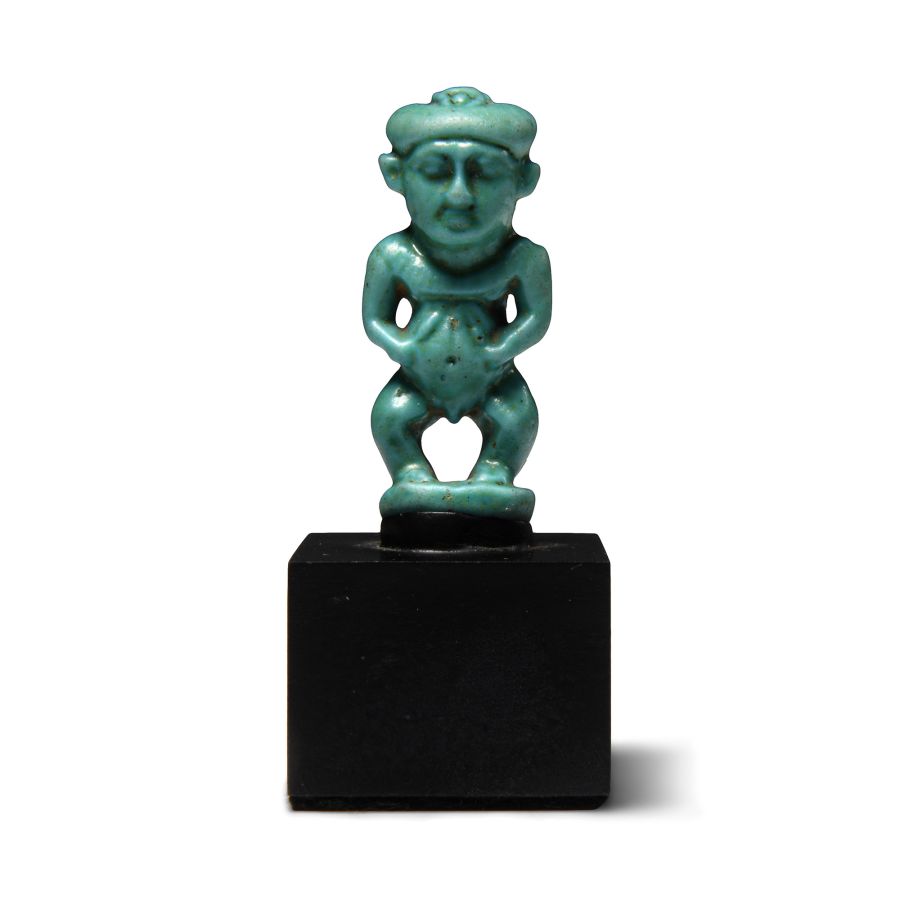
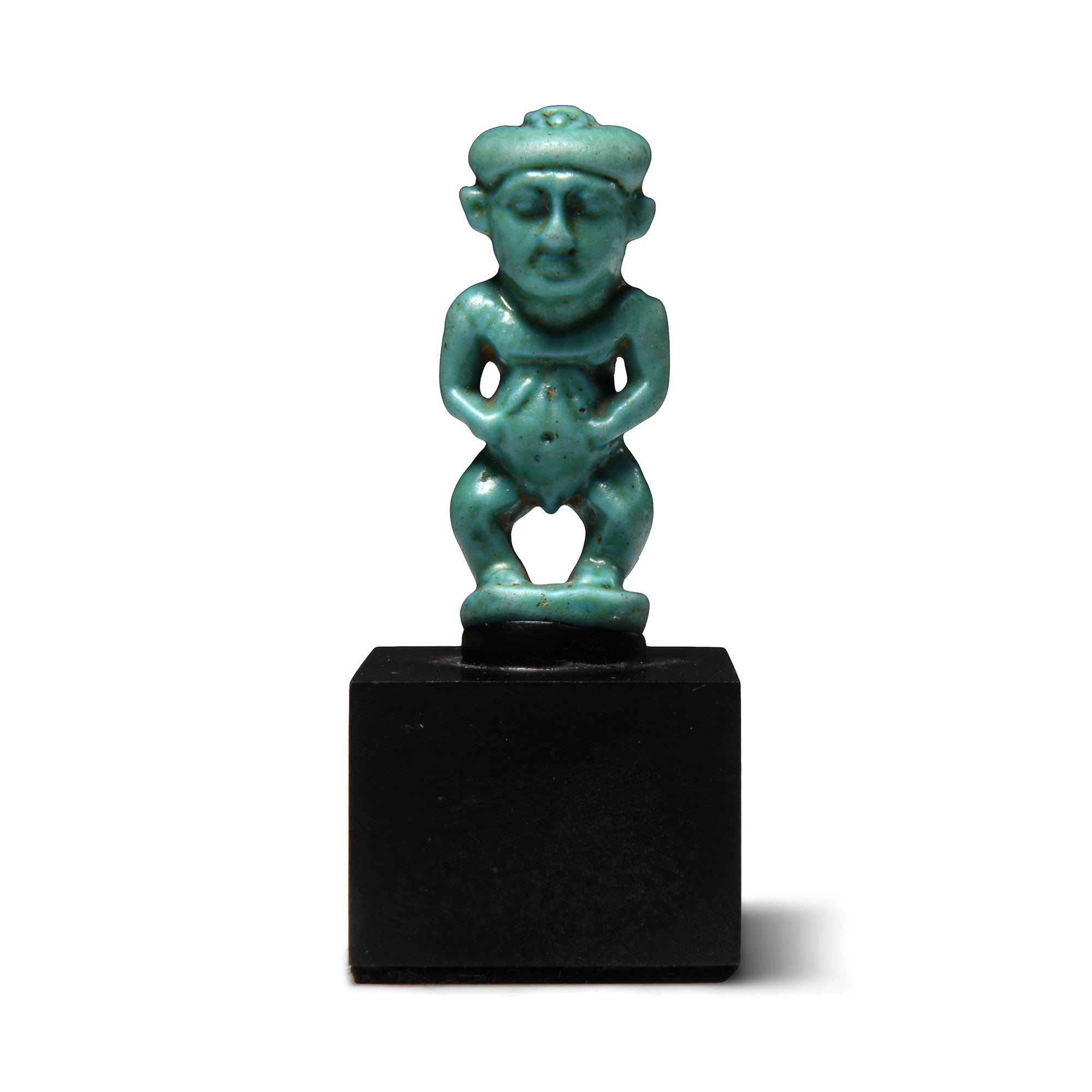
Egyptian Faience Pataikos Amulet
PTOLEMAIC PERIOD, 4TH-3RD CENTURY B.C.
2 5/8 in. (29.6 grams total, 66 mm high including stand).
Depicting the creator god in the form of the dwarf god Pataikos, modelled nude with stylised anatomical detailing, holding two knives to his stomach, squatting on an oval base; a scarab on the top of his cap; ribbed suspension loop to reverse; mounted on a custom-made display base.
ProvenanceEx private French collection.
with Thierry Maigret, Hotel Drouot, Paris, 12 July 2005, 76.
Cf. Daressy, G., Catalogue général des antiquités égyptiennes du Musée du Caire N° 38001-39384 Statues de divinités, Cairo, 1906, pl.XLII no.38.801, for similar figure.
FootnotesThe Egyptian deity Pataikos is a special manifestation of the creator god Ptah, and the dwarf-like appearance symbolises his magical power. As a protective deity, amulets of Pataikos were worn for their apotropaic qualities; Pataikos was often depicted subjugating poisonous animals such as snakes and scorpions, and Pataikos amulets were probably worn to protect the wearer from such animals.
CONDITIONTimeLine Auctions follows a vetting process to ensure the authenticity and legality of all items, reinforcing our commitment to integrity and responsible trading. Each antiquity, antique, and coin lot undergoes thorough examination by a vetting committee of at least ten external specialists, professional trade association members, scientists, and archaeologists: Our Vetting Process
AUCTIONS:
TimeLine is a leading auction house specialising in antiquities, ancient art, collectables, natural history, coins, medals, and books. Our auctions offer museums, collectors, historians, and enthusiasts the opportunity to acquire unique and historically significant pieces.
LOT 0023
Egyptian Faience Pataikos Amulet
Estimate £1,000 - 1,400€1,160 - 1,620 (for guidance only)$1,350 - 1,890 (for guidance only)
-
.jpg)
Egyptian Bronze Figure of Osiris Wearing Plumed Atef Crown
Late Period, 664-332 B.C.Sold for (Inc. bp): £1,170
With frontal uraeus, holding the crook and flail in his hands; mounted on a custom-made stand. 70 grams total, 15.2 cm high including stand
Old Dutch collection, acquired prior to 1985. Ex Netherlands ancient art gallery. Ex Artemission, London SW5, UK. Private collection of Mr T.H., Norfolk, UK. Accompanied by a previous dealer's certificate of authenticity and invoice.
Osiris is a deity who represents both death and fertility and is commonly regarded as the quintessential god of rebirth. Though he was once a mortal ruler, as a deceased entity his domain was the Underworld. Abydos was the primary centre of Osiris’ cult, where a renowned yearly celebration of the god was held. Statues of Osiris were dedicated at temples throughout Egypt to ensure the god's protection and blessings. -
.jpg)
Egyptian Alabaster Hedgehog Vessel
Late Period, 664-332 B.C.Estimate: £600 - 800 (+bp*)
Opening Bid: £240
Carved in the round with four stubby feet and hatched body, broad lip and with lug on the reverse. 99 grams, 45 mm
Part of an old collection dating back to the 19th century. Ex property of a gentleman, acquired before the 1980s. Private collection of Mr T.H., Norfolk, UK. -
.jpg)
Egyptian Painted Wooden Model of a Cow Giving Birth, Together with Two Figures
Middle Kingdom, 11th-12th Dynasty, 2023-1862 B.C.Estimate: £4,000 - 6,000 (+bp*)
Opening Bid: £2,000
Composed of three figures: a standing cow or other quadruped giving birth to its young, its head, neck and forelegs emerging from the mother's rear, both with a black and white speckled coat; a standing male figure with articulated arms and pierced hands, wearing a kilt and cropped wig and with stylised facial detailing; a kneeling figure also with articulated arms, open-palm hands, wearing a kilt and cropped wig, stylised facial features; extensive remains of polychrome pigment. 111 grams total, 9.5-16 cm
From an early 20th century Home Counties collection. This lot has been checked against the Interpol Database of stolen works of art and is accompanied by search certificate no.11597-199209.
Such models would have been deposited in tombs; the purpose of such a scene was probably to evoke the season of spring, when calves were born, and the floodplain where farmers lived and raised their livestock.
