
Loading, please wait...
_900x900.jpg "Egyptian Faience Offering Cup of Ramesses II")
_200x200.jpg "Egyptian Faience Offering Cup of Ramesses II")
.jpg "Egyptian Faience Offering Cup of Ramesses II")
LOT 0033
Egyptian Faience Offering Cup of Ramesses II
NEW KINGDOM, 19TH DYNASTY, CIRCA 1279-1213 B.C.
1 3/4 in. (29.94 grams, 46 mm).
Blue faience cylindrical offering cup, gently tapering form with slightly flared foot and rim, a black painted rectangular frame containing a hieroglyphic inscription including cartouches containing the throne and birth names of Ramesses II and the dedication: skr-wsı͗r mry nb tꜢwy (wsr-mꜢꜤt-re stp-n-re) nb ḫꜤw (ı͗mn mry re-mssw), ‘Beloved of Sokar-Osiris, lord of the Two Lands (The justice of Re is powerful, Chosen of Re), lord of appearances (Beloved of Amun, Ramesses)’.
ProvenanceFrancesc Cambó i Batlle (1876-1947) a prominent Spanish politician, art patron and philanthropist.
Gifted to his friend, the archaeologist Josep Gilbert i Buch.
Acquired from Gilbert's family by the present owner's grandfather in the early 1980s.
Private collection of a European noble.
Cf. Rijksmuseum van Oudheden, Leiden, inv.no.F1995/5.4, for an offering cup from Kafr el-Gebel, Giza; Vandier d’Abbadie, J., Les objets de toilette égyptiens au Musée du Louvre, Paris, 1972, p.129, no. 557, for the shape.
FootnotesFrancesco Cambó i Batlle was a notable figure in early 20th century Spain, best known for his role in politics as a leader of the Catalan nationalist movement and as a patron of the arts. He was a key benefactor of the Museo del Prado and left a significant legacy through his art collections. His deep connection to the cultural and artistic life of Spain makes items from his collection particularly valuable and historically significant.
CONDITIONTimeLine Auctions follows a vetting process to ensure the authenticity and legality of all items, reinforcing our commitment to integrity and responsible trading. Each antiquity, antique, and coin lot undergoes thorough examination by a vetting committee of at least ten external specialists, professional trade association members, scientists, and archaeologists: Our Vetting Process
AUCTIONS:
TimeLine is a leading auction house specialising in antiquities, ancient art, collectables, natural history, coins, medals, and books. Our auctions offer museums, collectors, historians, and enthusiasts the opportunity to acquire unique and historically significant pieces.
-
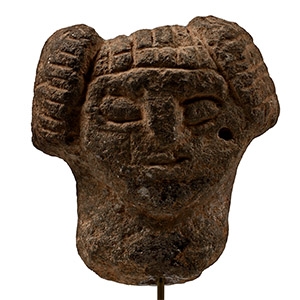
Phoenician-Iberian Stone Head of a Lady
Circa 600 B.C. or laterSold for (Inc. bp): £208
Carved in the round with hatched hair and low-relief facial features; mounted on a custom-made stand. 857 grams total, 17 cm high including stand
From a collection acquired on the UK art market from various auction houses and collections mostly before 2000. From an important Cambridgeshire estate; thence by descent. -
.jpg)
Egyptian Bronze Figure of Harpocrates
Late Period, 664-332 B.C.Sold for (Inc. bp): £3,250
Seated nude statuette of Harpocrates, with legs together and left arm by his side, right arm bent across the chest with forefinger raised to his lips, wearing a nemes headdress with uraeus on the front and a bold sidelock on the right side, surmounted by an elaborate hem-hem crown consisting of three conical atef crowns each topped with a sun disc, with an ostrich plume to the side of the outermost, and flanked by two uraei with sun discs, all supported on two horizontal ram's horns; semi-naturalistic anatomical detailing; feet resting on an integral square plinth, mounted on a wooden stand. 584 grams, 18.5 cm
Ex pre-war collection, Switzerland. Private collection, Europe. Accompanied by a copy of an Art Loss Register certificate no.S00075707. This lot has been checked against the Interpol Database of stolen works of art and is accompanied by a search certificate number no.12371-226682.
Harpocrates is the Greek rendering of the Egyptian Hor-pa-khered, which translates as 'Horus the Child'. This refers to Horus as the divine infant of Isis and Osiris. Statuettes of Harpocrates could provide the dedicator with the same protection that Isis gave her beloved son. -
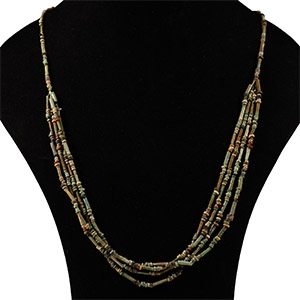
Egyptian Multi-Stranded Faience Mummy Bead Necklace
Late Period, 664-332 B.C.Sold for (Inc. bp): £234
Multi-stranded designer necklace composed of beads of mainly annular and tubular types. 23 grams, 78 cm
Acquired before 1979. From the private collection of Mr F.A., South Kensington, London, UK; thence by descent 2014.
For thousands of years, artisans in Egypt created vibrant ceramics to echo the beauty of rare jewels. These ornaments were created with almost every material, colour, and texture imaginable and they come from across Egypt and beyond: vibrant blue lapis lazuli from Afghanistan, glossy black obsidian from Turkey, and aqua-green turquoise from the Sinai. They were worn in life and, after death, they served as precious ornamentation for mummies.
