
Loading, please wait...


_900x900.jpg "Egyptian Faience Necklace with Pendant")
_200x200.jpg "Egyptian Faience Necklace with Pendant")
.jpg "Egyptian Faience Necklace with Pendant")
LOT 0417
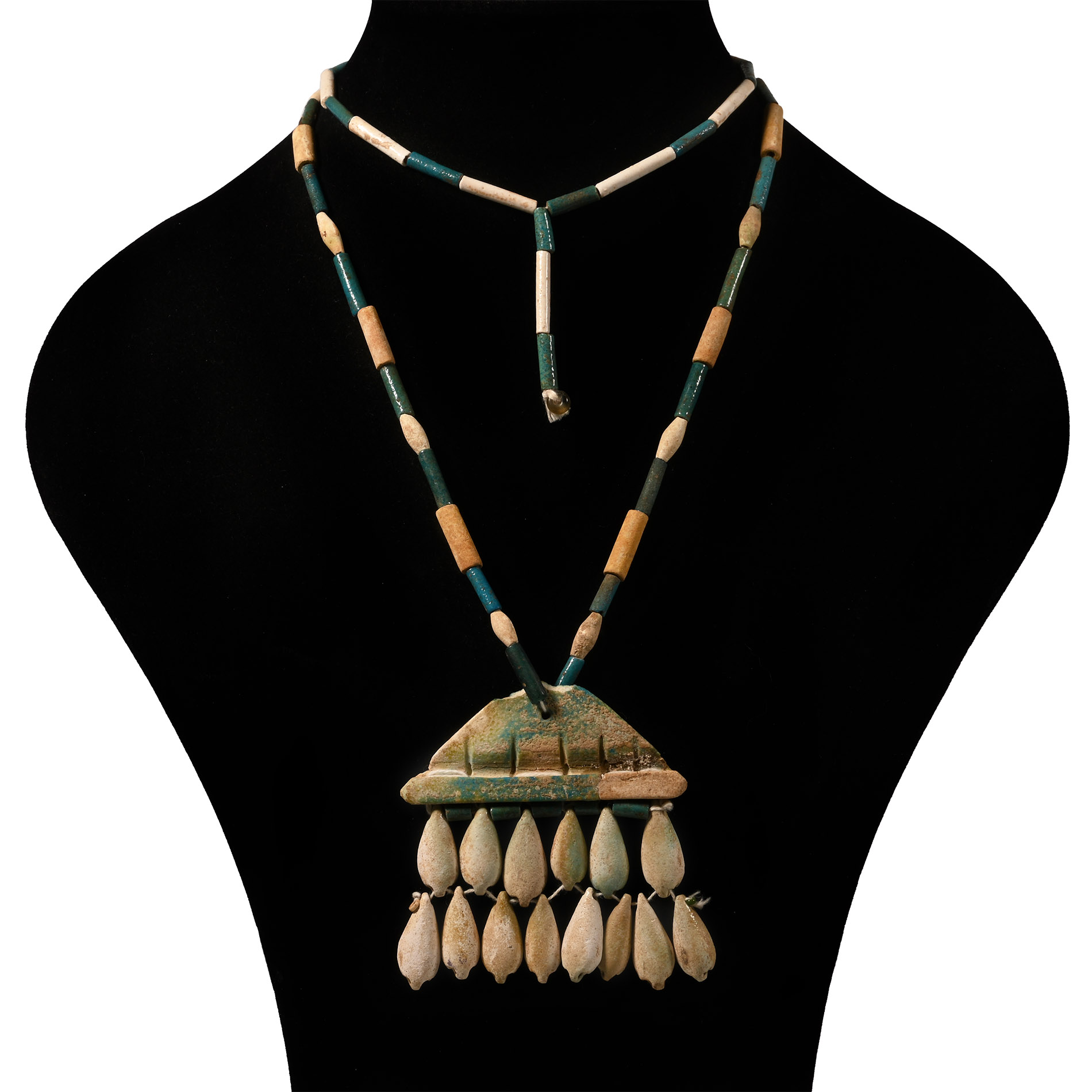
Egyptian Faience Necklace with Pendant
NEW KINGDOM, 1400-1100 B.C.
31 1/2 in. (48 grams, 80 cm long).
Restrung group of tubular and fusiform faience beads with D-shaped pendant and two tiers of dangles beneath.
ProvenanceAcquired in the mid 1980s-1990s.
Private collection, Switzerland, thence by descent.
Private collection, since the late 1990s.
This lot is accompanied by an illustrated lot declaration signed by the Head of the Antiquities Department, Dr Raffaele D’Amato.
TimeLine Auctions follows a vetting process to ensure the authenticity and legality of all items, reinforcing our commitment to integrity and responsible trading. Each antiquity, antique, and coin lot undergoes thorough examination by a vetting committee of at least ten external specialists, professional trade association members, scientists, and archaeologists: Our Vetting Process
AUCTIONS:
TimeLine is a leading auction house specialising in antiquities, ancient art, collectables, natural history, coins, medals, and books. Our auctions offer museums, collectors, historians, and enthusiasts the opportunity to acquire unique and historically significant pieces.
LOT 0417
Egyptian Faience Necklace with Pendant
Estimate £700 - 900€810 - 1,040 (for guidance only)$950 - 1,220 (for guidance only)
-
.jpg)
Egyptian Limestone Relief Fishing Scene
Saite Period, 664-525 B.C.Sold for (Inc. bp): £13,000
Irregular fragment of a low-relief frieze showing the hips and legs of two standing figures: left, torso with short kilt gathered at the waist and portions of legs below, body of a fish behind with long dorsal and ventral fins, small tail; right, torso of a figure similarly clad with right forearm and hand gripping a fishing line and upper portion of a fish attached; applied red-maroon pigment to skin areas; mounted in an old stand. 675 grams, 23 cm wide including stand
Private collection, Europe. with Sotheby's, London, July 1991, no.162. Acquired by the current owner from the above. Accompanied by a copy of the relevant Sotheby's catalogue pages. This lot has been checked against the Interpol Database of stolen works of art and is accompanied by a search certificate number no.12585-232180. This lot has been cleared against the Art Loss Register database, and is accompanied by an illustrated lot declaration signed by the Head of the Antiquities Department, Dr Raffaele D’Amato.
The crisp and detailed carving and colour palette are reminiscent of reliefs from the grand Theban tomb of Montuemhat, Mayor and Fourth Priest of Amun (circa 700-650 B.C.). -
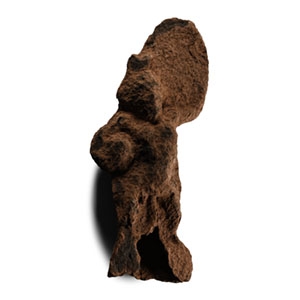
Romano-Egyptian Terracotta Figurine
1st century B.C.-2nd century A.D.Sold for (Inc. bp): £65
Hollow-formed figure modelled in the half-round with left arm raised and right arm bent carrying a vessel; piled hairstyle with lunar motif above; hole to the reverse. 220 grams, 19.5 cm
The Erotica Collection Christian von Faber-Castell, Küsnacgt ZH, Switzerland, since the late 1970s. This lot is accompanied by an illustrated lot declaration signed by the Head of the Antiquities Department, Dr Raffaele D’Amato.
Christian von Faber-Castell (born 1950) is a renowned German entrepreneur and art collector, best known as a member of the prominent Faber-Castell family, famed for their iconic writing instruments. A passionate advocate for art and culture, Christian von Faber-Castell curated an extensive and diverse private collection of erotica, spanning centuries and cultures. His collection reflects a deep appreciation for the interplay of beauty, sensuality, and artistic expression, bringing together rare and unique works that explore themes of intimacy and human connection. Pieces from this collection have been featured in notable exhibitions and are celebrated for their artistic and historical significance. This offering represents a rare opportunity to acquire works from one of the most fascinating and eclectic private collections of its kind. -
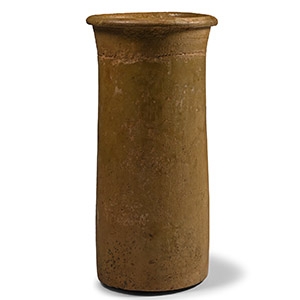
Egyptian Terracotta Cylindrical Jar
Early Dynastic Period, Naqada IIIC, circa 3100 B.C.Estimate: £300 - 400 (‡+bp*)
Opening Bid: £135
Band of imitation rope-twist decoration encircling the top of the jar, the mouth slightly flaring with a slightly damaged rolled lip. 950 grams, 22 cm
with Bonhams, London, 1 May 2008, no.432 [Part]. Accompanied by a copy of an Art Loss Register certificate no.S00035996. Accompanied by a copy of relevant Bonhams catalogue pages. This lot is accompanied by an illustrated lot declaration signed by the Head of the Antiquities Department, Dr Raffaele D’Amato.
These vessels often exhibit different surface treatments; the rim and area above the rope twist show marks where the vessel was rotated to produce the rim, and below, the rest of the jar has a scrape-smoothed surface.
