
Loading, please wait...

_900x900.jpg "Egyptian Faience Necklace with Pendant")
_200x200.jpg "Egyptian Faience Necklace with Pendant")
.jpg "Egyptian Faience Necklace with Pendant")
LOT 0467
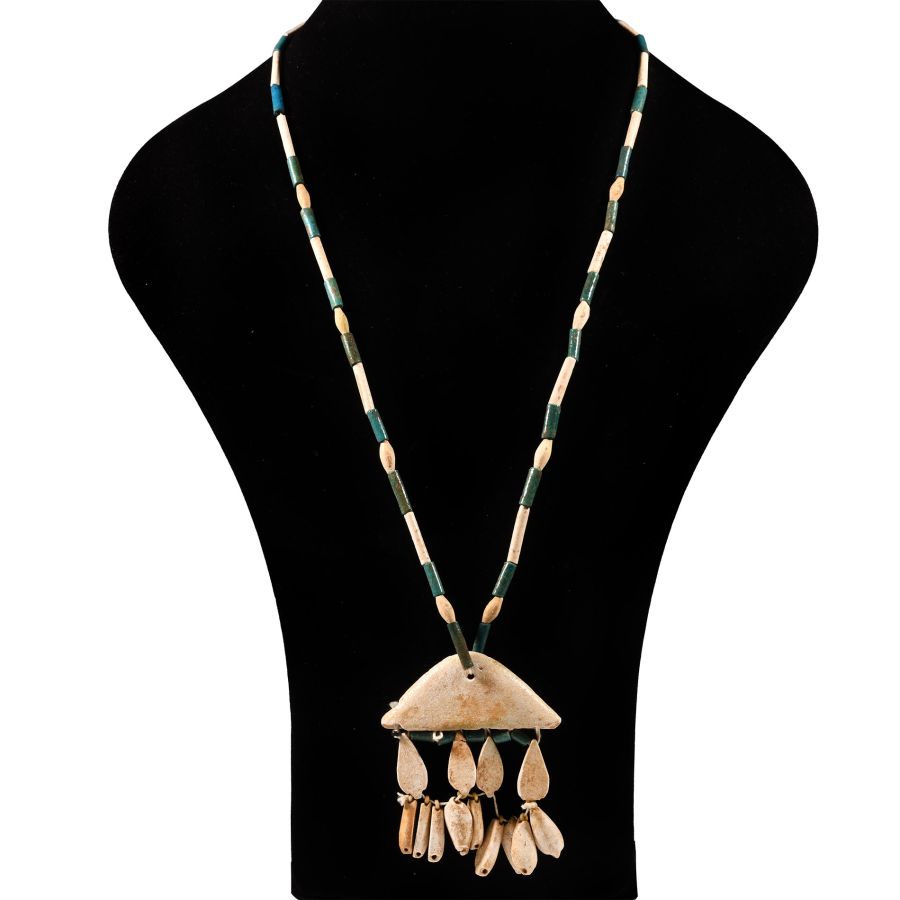
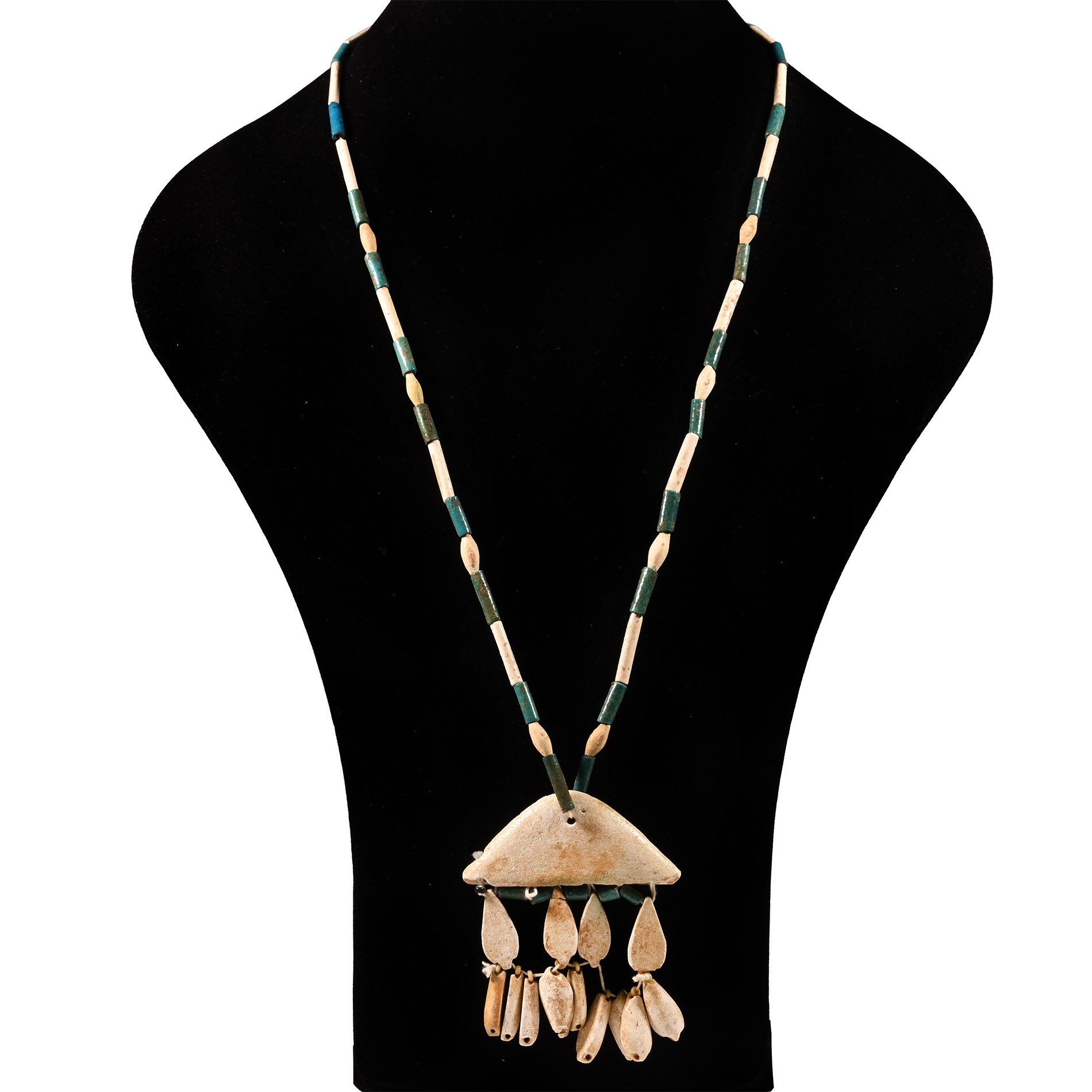
Egyptian Faience Necklace with Pendant
NEW KINGDOM, 1400-1100 B.C.
30 in. (41 grams, 76 cm long).
Designer necklace composed of alternating white and turquoise tubular beads with oval spacer bead; a collar terminal as a central pendant with two rows of petal-shaped beads incorporating tubular and ring spacers suspended below.
ProvenanceAcquired in the mid 1980s-1990s.
Private collection, Switzerland, thence by descent.
Private collection, since the late 1990s.
This lot is accompanied by an illustrated lot declaration signed by the Head of the Antiquities Department, Dr Raffaele D’Amato.
Cf. Andrews, C., Ancient Egyptian Jewellery, London, 1990, p.58, fig. 41, for examples of similarly shaped collar terminals.
CONDITIONTimeLine Auctions follows a vetting process to ensure the authenticity and legality of all items, reinforcing our commitment to integrity and responsible trading. Each antiquity, antique, and coin lot undergoes thorough examination by a vetting committee of at least ten external specialists, professional trade association members, scientists, and archaeologists: Our Vetting Process
AUCTIONS:
TimeLine is a leading auction house specialising in antiquities, ancient art, collectables, natural history, coins, medals, and books. Our auctions offer museums, collectors, historians, and enthusiasts the opportunity to acquire unique and historically significant pieces.
LOT 0467
Egyptian Faience Necklace with Pendant
Estimate £700 - 900€810 - 1,040 (for guidance only)$950 - 1,220 (for guidance only)
-
.jpg)
Egyptian Decorated Wooden Mask From a Mummy
Late Period, 4th-3rd century B.C.Sold for (Inc. bp): £3,380
Displaying semi-naturalistic detailing in relief, beneath a band of headdress ornament composed of rows of architectural dot-and-dash and zig-zag patterns over a segmental panel, possible hieroglyphs to the top tier; attachment pegs to the sides of the face and through the head; extensive remains of painted black pigmentation and composition fill to the eyes. 677 grams, 36 cm
From a French estate, acquired between 1960 and 1980. with SAS Cornette de Saint Cyr Auction, Paris, Vente 882, Mobilier et Objets d'art, 2 December 2014, lot 69. Accompanied by a copy of a French cultural passport no.167062. Accompanied by an academic report by Dr Alberto Maria Pollastrini. This lot has been checked against the Interpol Database of stolen works of art and is accompanied by search certificate no.11807-206837. This lot has been cleared against the Art Loss Register database, and is accompanied by an illustrated lot declaration signed by the Head of the Antiquities Department, Dr Raffaele D’Amato. -
Egyptian Faience Necklace with Pendant
New Kingdom, 1400-1100 B.C.Estimate: £700 - 900 (‡+bp*)
Opening Bid: £350
Designer necklace composed of alternating white and turquoise tubular beads with oval spacer bead; a collar terminal as a central pendant with two rows of petal-shaped beads incorporating tubular and ring spacers suspended below. 41 grams, 76 cm long
Acquired in the mid 1980s-1990s. Private collection, Switzerland, thence by descent. Private collection, since the late 1990s. This lot is accompanied by an illustrated lot declaration signed by the Head of the Antiquities Department, Dr Raffaele D’Amato. -
Egyptian Terracotta of a Concubine
Middle Kingdom, 12th Dynasty, circa 1976-1793 B.C.Sold for (Inc. bp): £1,235
D-shaped in section with tongue-shaped base, slender, long-limbed female figure modelled in the half-round with tightly curled, shoulder length hair, the chest and abdomen with linear and dotted decoration. 69 grams, 14.6 cm
From an old English deceased estate. Property of a London, UK, collector. This lot is accompanied by an illustrated lot declaration signed by the Head of the Antiquities Department, Dr Raffaele D’Amato.
