
Loading, please wait...


LOT 0448
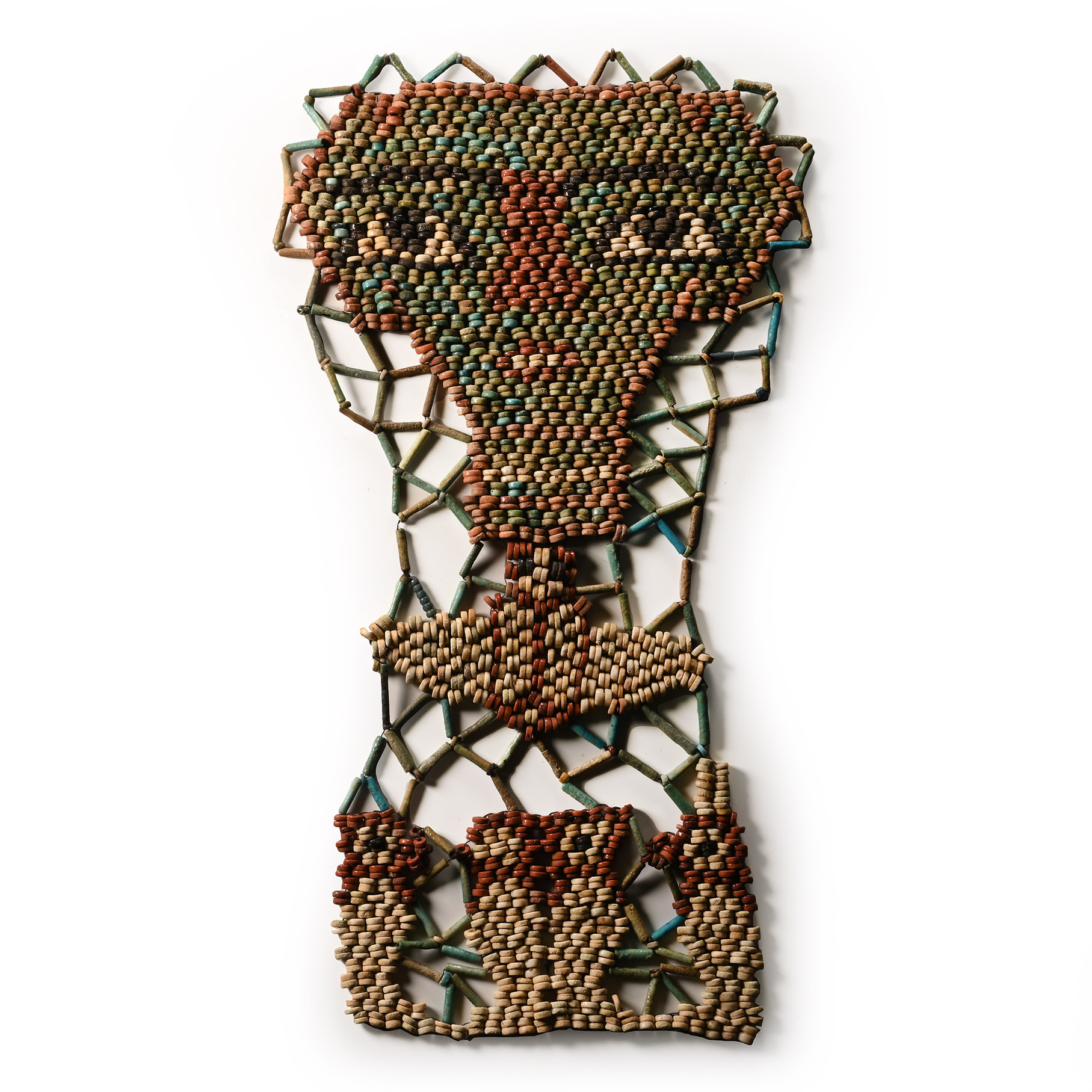
Egyptian Faience Mummy Beadwork Mask with Sons of Horus
PTOLEMAIC PERIOD, 332-30 B.C.
11 1/4 in. (115 grams, 28.5 cm).
A netted beadwork panel of annular and tubular glazed composition beads in blues, greens, black, cream and red-brown colours, depicting a mummy face mask with a false beard, a scarab with extended wings below, and beneath the 'Four Sons of Horus’, Duamutef, Qebehsenuef, Imsety, and Hapy joined together with areas of open netting of tubular examples; restrung with some later beads.
ProvenanceMariaud de Serres, Paris, 1990s.
FootnotesWinged scarabs were often used as funerary amulets, and were believed to symbolise the rebirth and regeneration of the deceased. The Four Sons of Horus were deities responsible for protecting the deceased's internal organs. The jackal-headed Duamutef protected the stomach, the falcon-headed Qebehsenuef protected the intestines, the human-headed Imsety protected the liver, and the baboon-headed Hapy protected the lungs. These internal organs were often placed in canopic jars, each with the head of the respective Son of Horus. Amulets depicting these deities were placed within the mummy wrappings.
CONDITIONTimeLine Auctions follows a vetting process to ensure the authenticity and legality of all items, reinforcing our commitment to integrity and responsible trading. Each antiquity, antique, and coin lot undergoes thorough examination by a vetting committee of at least ten external specialists, professional trade association members, scientists, and archaeologists: Our Vetting Process
AUCTIONS:
TimeLine is a leading auction house specialising in antiquities, ancient art, collectables, natural history, coins, medals, and books. Our auctions offer museums, collectors, historians, and enthusiasts the opportunity to acquire unique and historically significant pieces.
LOT 0448
Egyptian Faience Mummy Beadwork Mask with Sons of Horus
Sold for (Inc. bp): £416
-
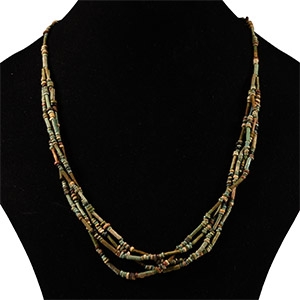
Egyptian Multi-Stranded Faience Mummy Bead Necklace
Late Period, 664-332 B.C.Sold for (Inc. bp): £234
Multi-stranded designer necklace composed of beads of mainly annular and tubular types. 21 grams, 72 cm long
Acquired before 1979. From the private collection of Mr F.A., South Kensington, London, UK; thence by descent 2014.
For thousands of years, artisans in Egypt created vibrant ceramics to echo the beauty of rare jewels. These ornaments were created with almost every material, colour, and texture imaginable and they come from across Egypt and beyond: vibrant blue lapis lazuli from Afghanistan, glossy black obsidian from Turkey, and aqua-green turquoise from the Sinai. They were worn in life and, after death, they served as precious ornamentation for mummies. -
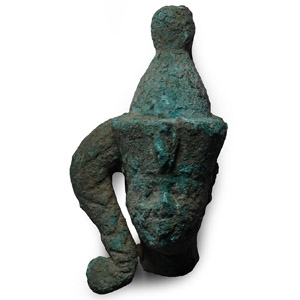
Egyptian Bronze Head of Harpocrates
Late Period, circa 664-332 B.C.Sold for (Inc. bp): £117
Head from a statuette of Harpocrates, wearing the Pschent crown fronted by uraeus, sporting the large plaited sidelock above the right ear. 86.5 grams, 60 mm
Acquired in the mid 1980s-1990s. Private collection, Switzerland, thence by descent. Private collection, since the late 1990s.
Harpocrates is the Greek rendering of the Egyptian Hor-pa-khered, meaning 'Horus the Child'. This title refers to Horus as the divine infant of Isis and Osiris. Wearing the amulet of Harpocrates was believed to offer the same protection that Isis gave her beloved son. -
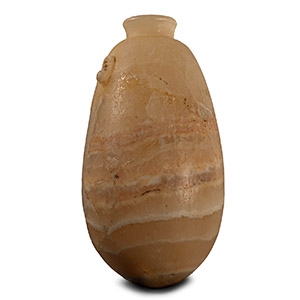
Egyptian Alabaster Alabastron
Third Intermediate Period, circa 8th-7th century B.C.Estimate: £1,000 - 1,400 (‡+bp*)
Opening Bid: £500
Ovoid jar with a rounded base, concave shoulders and flared neck/rim; remains of lug handles. 332 grams, 14 cm
Acquired in the mid 1980s-1990s. Private collection, Switzerland, thence by descent. Private collection, since the late 1990s.
