
Loading, please wait...
LOT 0444
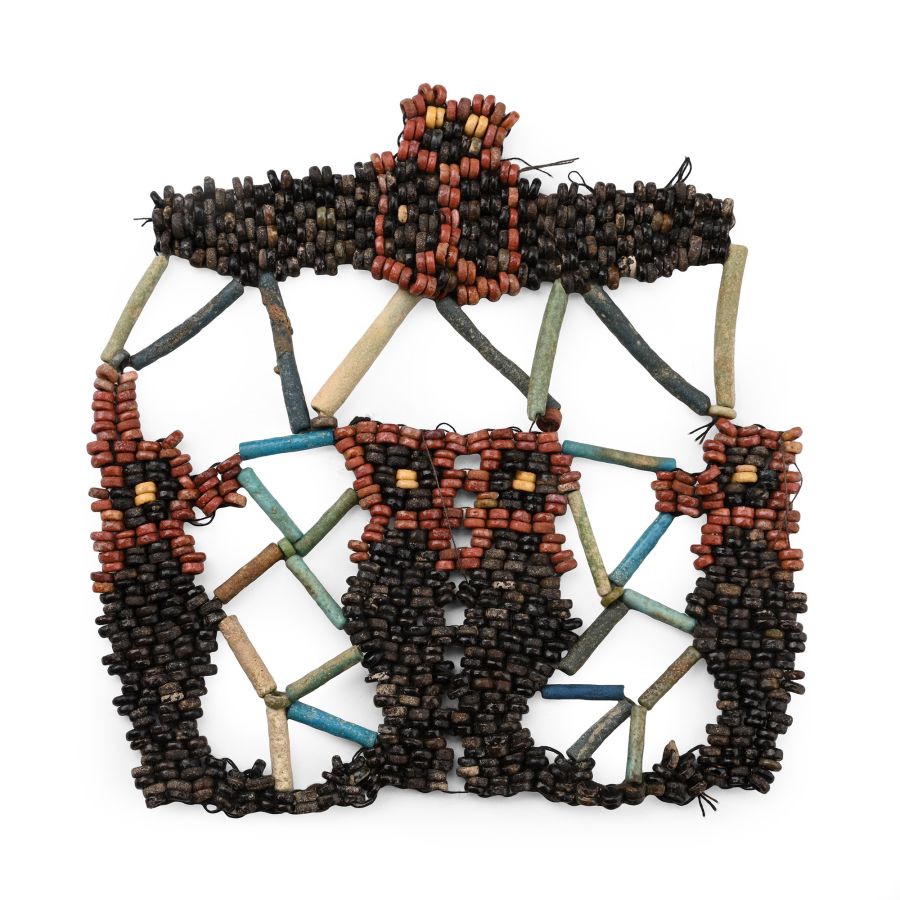
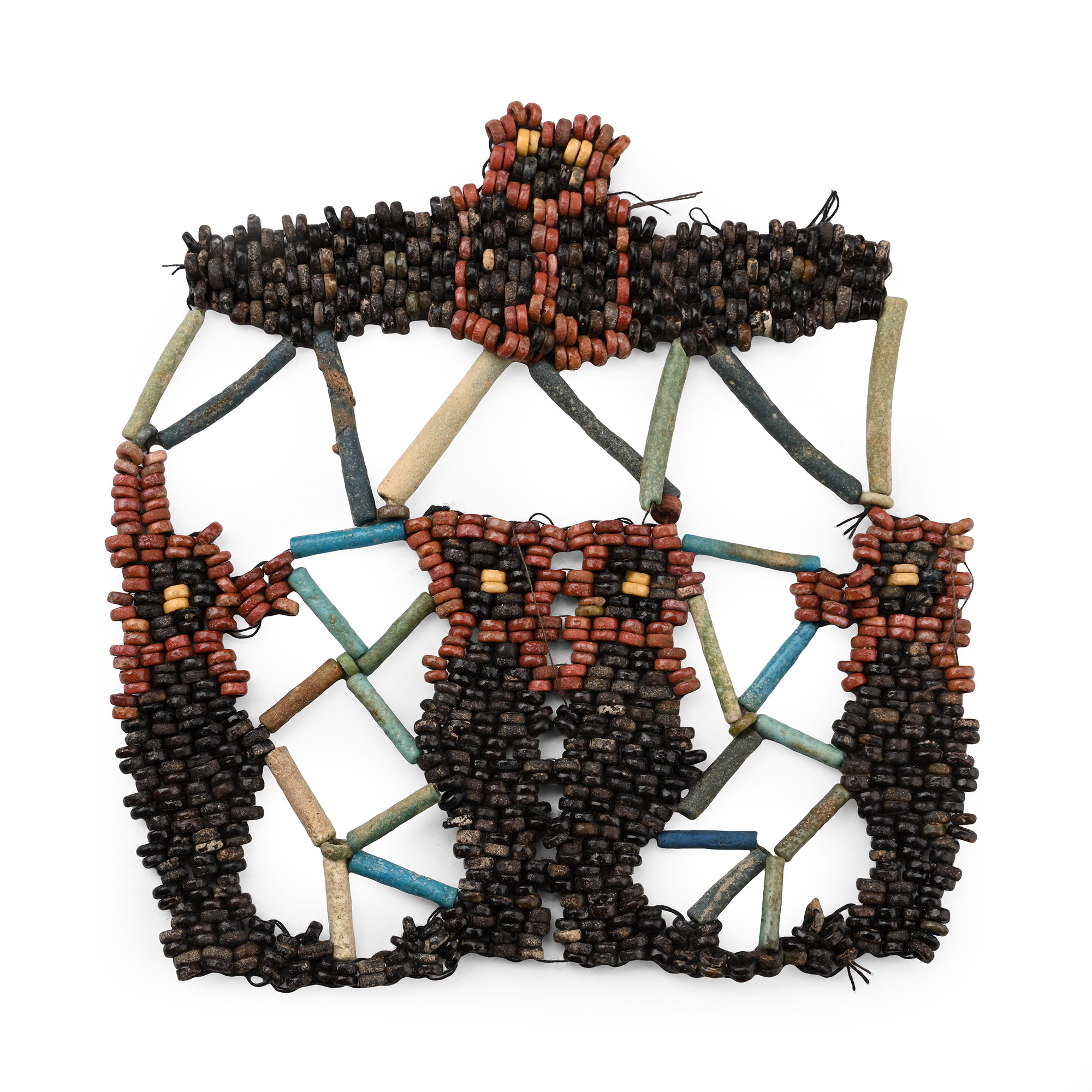
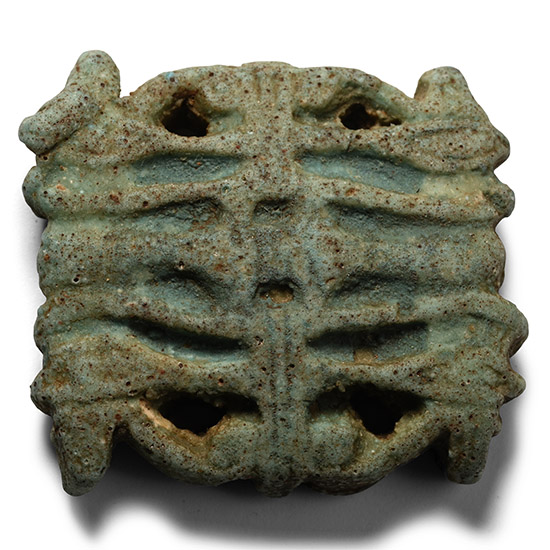
Egyptian Faience Mummy Bead Panel with Four Sons of Horus
PTOLEMAIC PERIOD, CIRCA 332-30 B.C.
4 1/2 in. (22.9 grams, 11.3 cm wide).
Openwork beaded panel depicting a winged scarab with the Four Sons of Horus, Hapy, Imsety, Qebehsenuef, and Duamutef below; restrung.
ProvenanceEx Mariaud de Serres collection, Paris, France, 1980s-1990s.
Accompanied by a previously illustrated catalogue card with provenance.
Cf. Manley, B., and Dodson, A., Life Everlasting. National Museum of Scotland Collection of Ancient Egyptian Coffins, Edinburgh, 2010, p.114, no.43, for a bead-work shroud incorporating the mask, winged scarab, and Four Sons of Horus.
FootnotesWinged scarabs were often used as funerary amulets and believed to symbolise the deceased's rebirth and regeneration.
The Four Sons of Horus were deities responsible for protecting the deceased's internal organs. Here, on the left, is the baboon-headed Hapy, protector of the lungs, then the human-headed Imsety, protector of the liver, followed by the falcon-headed Qebehsenuef, who protected the intestines and, finally, the erect-eared jackal-headed Duamutef on the right, who protected the stomach.
TimeLine Auctions follows a vetting process to ensure the authenticity and legality of all items, reinforcing our commitment to integrity and responsible trading. Each antiquity, antique, and coin lot undergoes thorough examination by a vetting committee of at least ten external specialists, professional trade association members, scientists, and archaeologists: Our Vetting Process
AUCTIONS:
TimeLine is a leading auction house specialising in antiquities, ancient art, collectables, natural history, coins, medals, and books. Our auctions offer museums, collectors, historians, and enthusiasts the opportunity to acquire unique and historically significant pieces.
LOT 0444
Egyptian Faience Mummy Bead Panel with Four Sons of Horus
Sold for (Inc. bp): £182
-
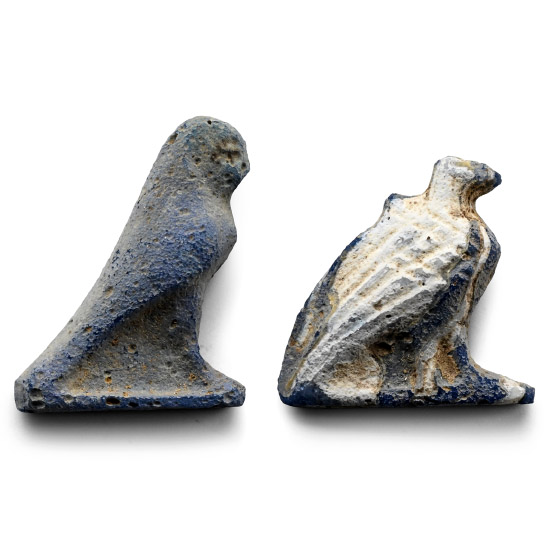
Egyptian Glass Pair of Bird Inlays
Late Period, 664-332 B.C.Sold for (Inc. bp): £234
Comprising: a standing hawk in cobalt blue glass, a standing vulture in white and blue glass with feather detailing on the wings. 4.76 grams total, 20-22 mm
From a 20th century UK collection. -
Egyptian Faience Multiple Eye of Horus Amulet
New Kingdom-Late Period, 1550-332 B.C.Estimate: £200 - 300 (+bp*)
Current Winning Bid: £5
Green glazed amulet with two wedjats at the top and the mirror image below, pierced through the centre for suspension. 11.83 grams, 33 mm
From an early 20th century UK collection. Accompanied by a previously illustrated catalogue card with provenance. -
.jpg)
Egyptian Mixed Scarab Collection
2nd-1st millennium B.C. and laterSold for (Inc. bp): £650
Stone plaque with raised relief depictions of the Apis bull and a falcon deity beneath; a mixed group of scarabs and scaraboids, most bearing text or motifs on the underside, including: a rope border enclosing the head of a lion wearing a sun disc and uraeus; a plain copper-alloy scaraboid; a line border enclosing the throne name of Amenhotep III (neb-maat-Re); an indeterminate standing figure; a central hes- vase flanked by rearing cobras; a group of hieroglyphs, perhaps a slightly incorrect spelling of the throne name of Amenhotep II (akheperu-Re); and a group of four hieroglyphs. 36.9 grams total, 14-35 mm
From the collection of a gentleman, acquired on the London art market in the 1990s.
