
Loading, please wait...
_900x900.jpg "Egyptian Faience Lotus Flower Amulet")
_200x200.jpg "Egyptian Faience Lotus Flower Amulet")
.jpg "Egyptian Faience Lotus Flower Amulet")
LOT 0476
Egyptian Faience Lotus Flower Amulet
18TH DYNASTY, AMARNA PERIOD, 1353-1336 B.C.
1/2 in. (0.26 grams, 14 mm).
A blue glazed composition pendant in the form of a lotus, with some repair to the suspension loop. [No Reserve]
ProvenanceEx early 20th century London collection.
CONDITIONTimeLine Auctions follows a vetting process to ensure the authenticity and legality of all items, reinforcing our commitment to integrity and responsible trading. Each antiquity, antique, and coin lot undergoes thorough examination by a vetting committee of at least ten external specialists, professional trade association members, scientists, and archaeologists: Our Vetting Process
AUCTIONS:
TimeLine is a leading auction house specialising in antiquities, ancient art, collectables, natural history, coins, medals, and books. Our auctions offer museums, collectors, historians, and enthusiasts the opportunity to acquire unique and historically significant pieces.
-
.jpg)
Very Large Egyptian Expedition Lithograph of Elephantine Island
Early 19th century A.D.Sold for (Inc. bp): £98
Proof etching on laid paper of plate 31 from Vol.I of Description de l'Égypte : ou, Recueil des observations et des recherches qui ont été faites en Égypte pendant l'expédition de l'armée française. entitled Ile d'Eléphantine et Syène. Plan général de l'Île d'Eléphantine, de Syène, et des carrières de granit exploitées par les Anciens Egyptiens. 223 grams, 105.5 x 69 cm
From the collection of a North American priest. Acquired between 1981-1996. Property of a North American collector.
Produced between February 1802 and 1830 on the orders of Napoleon Bonaparte; published between 1809 and 1828. Just 1,000 copies were distributed to various institutions, printed on laid paper with an 'Égypte ancienne et moderne' watermark. The book is subtitled Recueil des observations et des recherches qui ont été faites en Égypte pendant l’expédition de l’Armée française, publié par les ordres de Sa Majesté l’Empereur Napoléon le Grand (Gathering of observations and discoveries which were made in Egypt during the expedition of the French army, published on the orders of His Majesty the Emperor Napoleon the Great). It was the world's first encyclopedia devoted exclusively to the remains of ancient Egypt. The plates of this book are the first to present the archaeological sites of Thebes (Luxor). Elephantine Island holds archaeological remains that span the entire history of ancient Egypt. Syene is the Greek name for the ancient Egyptian city of Swennet, now known as Aswan. -
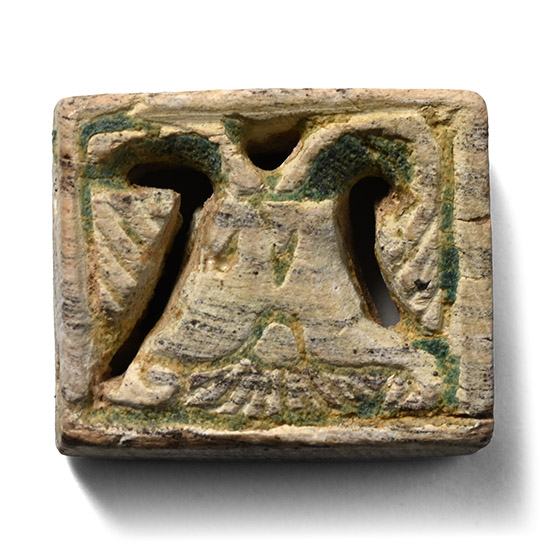
Egyptian Steatite Plaque Amulet with Lotus
Late Period, 664-332 B.C.Estimate: £100 - 140 (+bp*)
Opening Bid: £50
Rectangular openwork plaque with two blooming lotus flowers, one on each side, pierced twice for suspension. 1.77 grams, 14 mm
From an early 20th century UK collection. Accompanied by a previously illustrated catalogue card with provenance. -
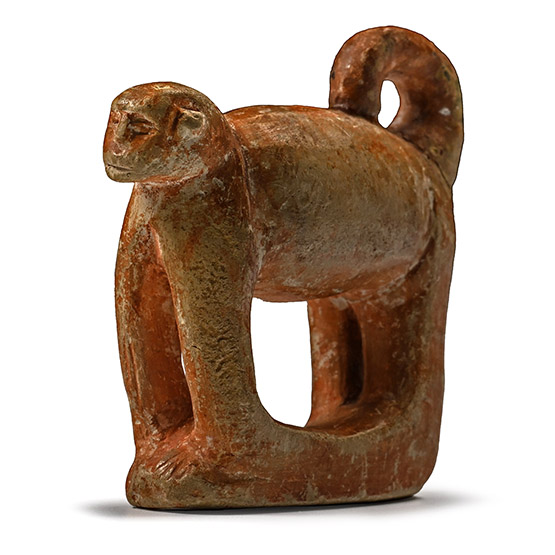
Egyptian Statuette of a Monkey
Ptolemaic Period, 4th-1st century B.C.Estimate: £600 - 800 (‡+bp*)
Current Winning Bid: £400
Standing on a rectangular plinth with head raised and tail curled above the hindquarters, barrel-shaped body with incised detailing at the shoulders and hips, traces of a white and reddish brown coating; partially restored; old collector's labels to underside '51' and 'N13234'. 42.8 grams, 60 mm
Ex Baden-Württemberg, Germany, formed since ca.1930. Private collection, Saarland, Germany. Thereafter, Michael Schrôder, Germany. Consigned to DAWO Auktion, 18 February 2017, no.824. Accompanied by a copy of an Art Loss Register certificate no.S00123279.
The ancient Egyptians kept pet monkeys (baboons as well as the more slender guenons) for amusement and as status symbols. These animals played around the house and accompanied the master on outings.
