
Loading, please wait...
_900x900.jpg "Egyptian Faience Ibis Amulet")
_200x200.jpg "Egyptian Faience Ibis Amulet")
.jpg "Egyptian Faience Ibis Amulet")
LOT 0499
Egyptian Faience Ibis Amulet
LATE PERIOD, 664-332 B.C.
1 in. (1.56 grams, 26 mm).
Flat rectangular base with crouching ibis in profile with curved beak resting on an object (possibly a diminutive seated figure of Maat), details to the feathered body, pale green glaze.
ProvenanceFrom an early 20th century collection.
This lot is accompanied by an illustrated lot declaration signed by the Head of the Antiquities Department, Dr Raffaele D'Amato.
Cf. Petrie, W.M.F., Amulets. Illustrated by the Egyptian Collection in University College, London, 1914, pl. XLII, nos. 247h, j, and k, for similar examples.
CONDITIONTimeLine Auctions follows a vetting process to ensure the authenticity and legality of all items, reinforcing our commitment to integrity and responsible trading. Each antiquity, antique, and coin lot undergoes thorough examination by a vetting committee of at least ten external specialists, professional trade association members, scientists, and archaeologists: Our Vetting Process
AUCTIONS:
TimeLine is a leading auction house specialising in antiquities, ancient art, collectables, natural history, coins, medals, and books. Our auctions offer museums, collectors, historians, and enthusiasts the opportunity to acquire unique and historically significant pieces.
LOT 0499
Egyptian Faience Ibis Amulet
Estimate £150 - 200€170 - 230 (for guidance only)$200 - 270 (for guidance only)
-
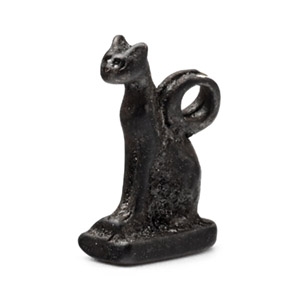
Egyptian Silver Bastet as Seated Cat Amulet
Late-Ptolemaic Period, 664-30 B.C.Sold for (Inc. bp): £208
Seated figure of a cat with pointed ears mounted on a rectangular base with a rounded end; suspension loop on the back. 0.34 grams, 8 mm
Ex London, UK, gentleman 1980-1990s. This lot is accompanied by an illustrated lot declaration signed by the Head of the Antiquities Department, Dr Raffaele D'Amato.
The cat was sacred to Bastet, a protective mother goddess and the daughter of the sun god Re. Amulets offered the wearer the goddess's protection. Her name means ‘she of the bast [ointment jar],’ which may have contained a substance favoured by or exclusive to royalty. Originally, Bastet was depicted as a woman with the head of a lioness, but by the late New Kingdom, she was usually shown with a cat's head. She is sometimes portrayed with kittens, emphasising her maternal role as a fierce protector of offspring. -
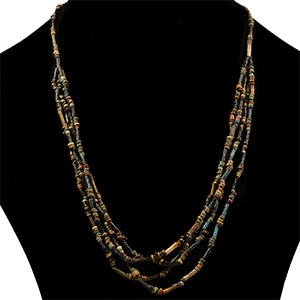
Egyptian Multi-Stranded Mummy Bead Necklace
Late Period, 664-332 B.C.Sold for (Inc. bp): £338
Three-stranded designer necklace composed of polychrome beads of mainly annular and tubular types. 18.2 grams, 63 cm
Acquired before 1979. From the private collection of Mr F.A., South Kensington, London, UK; thence by descent 2014. This lot is accompanied by an illustrated lot declaration signed by the Head of the Antiquities Department, Dr Raffaele D'Amato.
For thousands of years, artisans in Egypt created vibrant ceramics to echo the beauty of rare jewels. These ornaments were created with almost every material, colour, and texture imaginable and they come from across Egypt and beyond: vibrant blue lapis lazuli from Afghanistan, glossy black obsidian from Turkey, and aqua-green turquoise from the Sinai. They were worn in life and, after death, they served as precious ornamentation for mummies. -
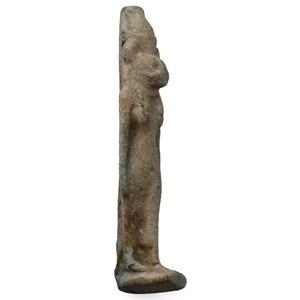
Egyptian Faience Standing Lioness Amulet
Ptolemaic Period, 332-30 B.C.Sold for (Inc. bp): £85
Standing figure of lioness-headed goddess in a striding pose with arms at the sides, sporting a black coloured tripartite wig surmounted by the double-crown; dorsal pillar. 3.96 grams, 56 mm
Acquired on the UK art market during the late 20th century. From the private collection of David King (1940-2024), Hoddesdon, Hertfordshire, UK. This lot is accompanied by an illustrated lot declaration signed by the Head of the Antiquities Department, Dr Raffaele D'Amato.
Throughout ancient Egyptian mythology, lion-headed goddesses played a significant role in the religious beliefs of the people. These goddesses, including Sekhmet, Wadjet, and Bastet, were revered as powerful and fierce protectors. Their presence was believed to ward off evil and safeguard the people from harm.
