
Loading, please wait...
_900x900.jpg "Egyptian Faience Horus Falcon Amulet")
_200x200.jpg "Egyptian Faience Horus Falcon Amulet")
.jpg "Egyptian Faience Horus Falcon Amulet")
LOT 0487
Egyptian Faience Horus Falcon Amulet
LATE PERIOD, 664-332 B.C.
3/8 in. (1.08 grams, 17 mm).
Seated falcon with impressed detailing to wings and head; rectangular base and suspension loop on the back.
ProvenanceEx early 20th century collection, London, UK.
LiteratureCf. Andrews, C., Amulets of Ancient Egypt, London, 1994, p. 28, fig. 25a, for an amulet with a decorated head and wings.
FootnotesHorus is one of the most significant and widely worshipped gods in ancient Egyptian mythology. His importance spans multiple facets of Egyptian religion, including kingship, protection, the sky, and the sun. Depicted in various human and animal forms, Horus played a vital role in Egyptian cosmology, particularly as the Pharaoh's protector and as a symbol of divine authority.
CONDITIONTimeLine Auctions follows a vetting process to ensure the authenticity and legality of all items, reinforcing our commitment to integrity and responsible trading. Each antiquity, antique, and coin lot undergoes thorough examination by a vetting committee of at least ten external specialists, professional trade association members, scientists, and archaeologists: Our Vetting Process
AUCTIONS:
TimeLine is a leading auction house specialising in antiquities, ancient art, collectables, natural history, coins, medals, and books. Our auctions offer museums, collectors, historians, and enthusiasts the opportunity to acquire unique and historically significant pieces.
-
.jpg)
Egyptian Pale Blue Steatite Scarab with Hieroglyphs
Late Period, 664-332 B.C. or laterSold for (Inc. bp): £104
Plano-convex in section with scarab detailing to the upper face; underside with hieroglyphic inscription; pierced longitudinally. 2.22 grams, 17 mm
Ex Constable collection, 1990s. Ex P. Morris collection. -
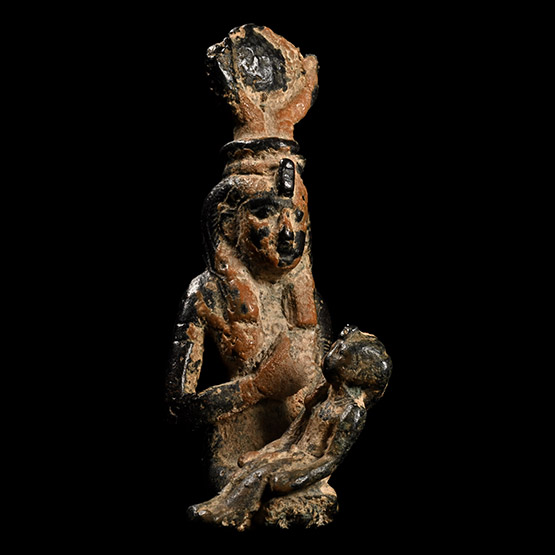
Egyptian Bronze Figure of Isis and Horus
Late Period, 664-332 B.C.Estimate: £800 - 1,000 (‡+bp*)
Opening Bid: £400
Isis enthroned wearing a cow's horn headdress with a solar disc fronted by uraeus, suckling the infant Horus on her lap; Horus with a side-lock of youth. 73.4 grams, 68 mm
Acquired in the mid 1980s-1990s. Private collection, Switzerland, thence by descent. Private collection, since the late 1990s.
In ancient Egyptian mythology, Isis was the sister-wife of Osiris and the mother of the sky god Horus. She is associated with aspects of fertility and motherhood and is often depicted in various artworks seated in a nursing pose with her son Horus on her lap, as here. -
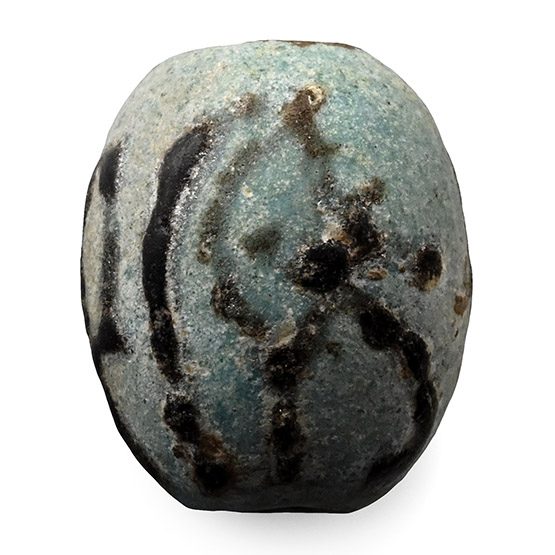
Egyptian Faience Bead with Eye of Horus and Ankh Symbols
Late Period, 664-332 B.C.Estimate: £100 - 140 (+bp*)
Opening Bid: £50
Barrel-shaped bead with blue glaze, wedjat and ankh in black glaze. 2.09 grams, 14 mm
From an early 20th century collection.
The wedjat-eye amulet is a representation of the healed eye of the god Horus, featuring both human and falcon elements. The name wedjat in ancient Egyptian means ‘the one that is sound.’ According to Egyptian mythology, Horus' eye was wounded or taken by the god Seth and restored by Thoth. The wedjat-eye amulet was thought to protect its wearer and bestow the power of recovery and regeneration onto them. It was very popular and used by both the living and the dead.
