
Loading, please wait...
Details
LOT 255705
Egyptian Faience Heiroglyphic Shabti
LATE PERIOD, 26TH DYNASTY, 664-525 B.C.
3 1/2 in. (23.6 grams, 89 mm).
Slender in profile with tripartite wig and incised tools in the crossed hands, net to the left shoulder; dorsal pillar with impressed hieroglyphic legend. [No Reserve]
Provenance
Ex Alexander Crawford Collection.
From the collection of David Donlan (1947-2025), a dedicated and lifelong collector with a passion for the ancient world and the natural sciences, forming his collection from 1960s onwards, using many reputable dealers across the United Kingdom, including the well-regarded Coincraft and The Parthenon Gallery.
Literature
Cf. Schlögl, H., and Brodbeck, A., Ägyptische Totenfiguren aus öffentlichen und privaten sammlungen der Schweiz, Göttingen, 1990, p.117, no.55, for a similar example.
Footnotes
Alexander Crawford Lamb (1843-1897) was a Scottish hotelier, art collector, antiquarian and collector of paintings, literary works, china, furniture, antiquities and other ephemera and memorabilia. His most notable literary achievement was the publication of a massive volume entitled Dundee: Its Quaint and Historic Buildings, 1895.
CONDITIONVETTING:
TimeLine Auctions follows a vetting process to ensure the authenticity and legality of all items, reinforcing our commitment to integrity and responsible trading. Each antiquity, antique, and coin lot undergoes thorough examination by a vetting committee of at least ten external specialists, professional trade association members, scientists, and archaeologists: Our Vetting Process
AUCTIONS:
TimeLine is a leading auction house specialising in antiquities, ancient art, collectables, natural history, coins, medals, and books. Our auctions offer museums, collectors, historians, and enthusiasts the opportunity to acquire unique and historically significant pieces.
LOT 255705
Egyptian Faience Heiroglyphic Shabti
Estimate £80 - 100€93 - 116 (for guidance only)$108 - 135 (for guidance only)
Opening Bid
£5 (EUR 6; USD 7) +BP*
RELATED LOTS
-
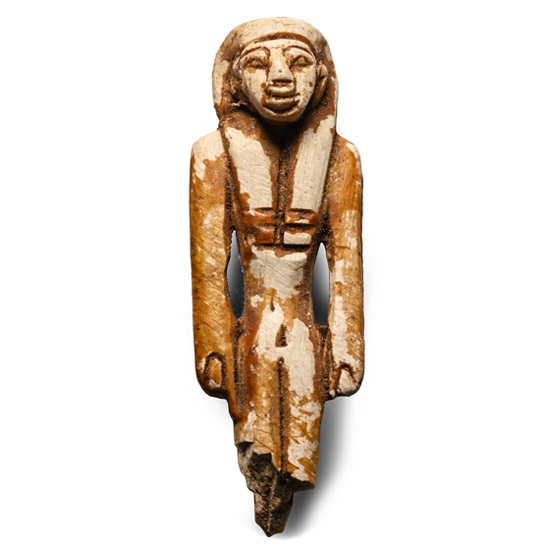
Egyptian Bone Figural Amulet of Goddess Nebhat
Late Period, 664-332 B.C.Estimate: £60 - 80 (+bp*)
Opening Bid: £5
Modelled as a standing figure wearing a lappet wig, hands resting along the body, dorsal pillar on the reverse. 4.23 grams, 42 mm
From the private collection of a European gentleman (1942-2024), formed since the 1970s. -
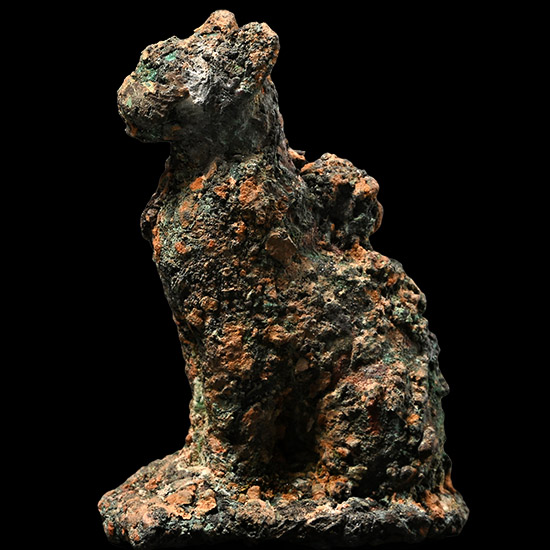
Egyptian Bronze Seated Cat Statuette
Late Period, 664-332 B.C.Estimate: £300 - 400 (+bp*)
Opening Bid: £150
Bastet in crouching pose with her tail wrapped close to right side of her body, seated on a tongue-shaped base. 90 grams, 55 mm
Acquired on the UK art market, 1990s. Private collection, New York, USA. -
.jpg)
Egyptian 'Becker' Serpentine Vessel
New Kingdom, 18th Dynasty, circa 1450 B.C.Estimate: £2,500 - 3,500 (‡+bp*)
Opening Bid: £1,250
Piriform jar with wide, flat rim and short neck, narrow neck and flat base. 1.2 kg, 15.5 cm
Ex Becker collection, 1920s. Private collection, Los Angeles, USA, 1990s. Private European collection. Accompanied by an academic report by Dr Raffaele D’Amato. This lot has been checked against the Interpol Database of stolen works of art and is accompanied by a search certificate number no.12576-232111.
Three forms of serpentine were mainly used by the ancient Egyptians for stone vessels: a) green or grey serpentine with black veins; b) translucent green serpentine with black patches; c) granular black serpentine with intermixed grey or brown granules. Type a) Serpentine, i.e. the green or grey one with black veins, has the longer time range, and was used for vessels from the Predynastic Period (Naqada II) through the New Kingdom. It was used for stone vessels, but also became common for statuettes and small toilet vessels. The class of green glazed kohl pots, many with carved or openwork decoration which are usually called ‘glazed steatite’ were more likely to be made of serpentine. The type here represented is a form known in the New Kingdom: a bag-shaped jar with neck, flat base, and wide thin rim. Similar vessels have been found in Thebes, Amarna, Kahun, among the other localities.
