
Loading, please wait...
LOT 0043
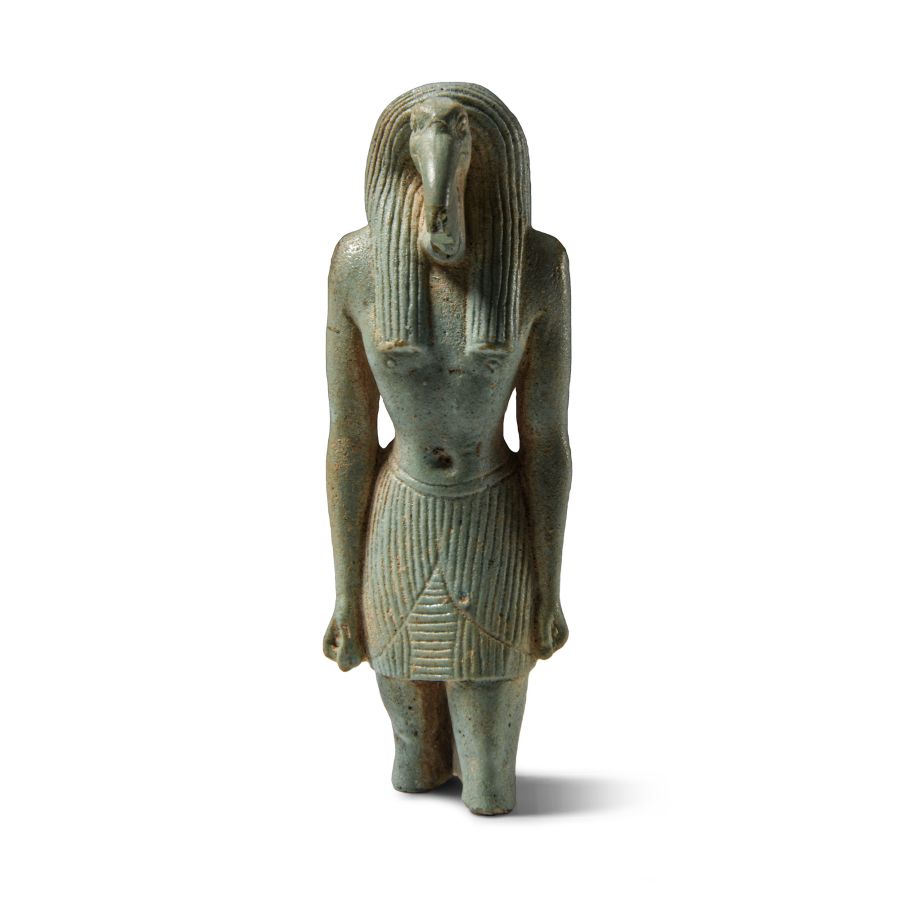
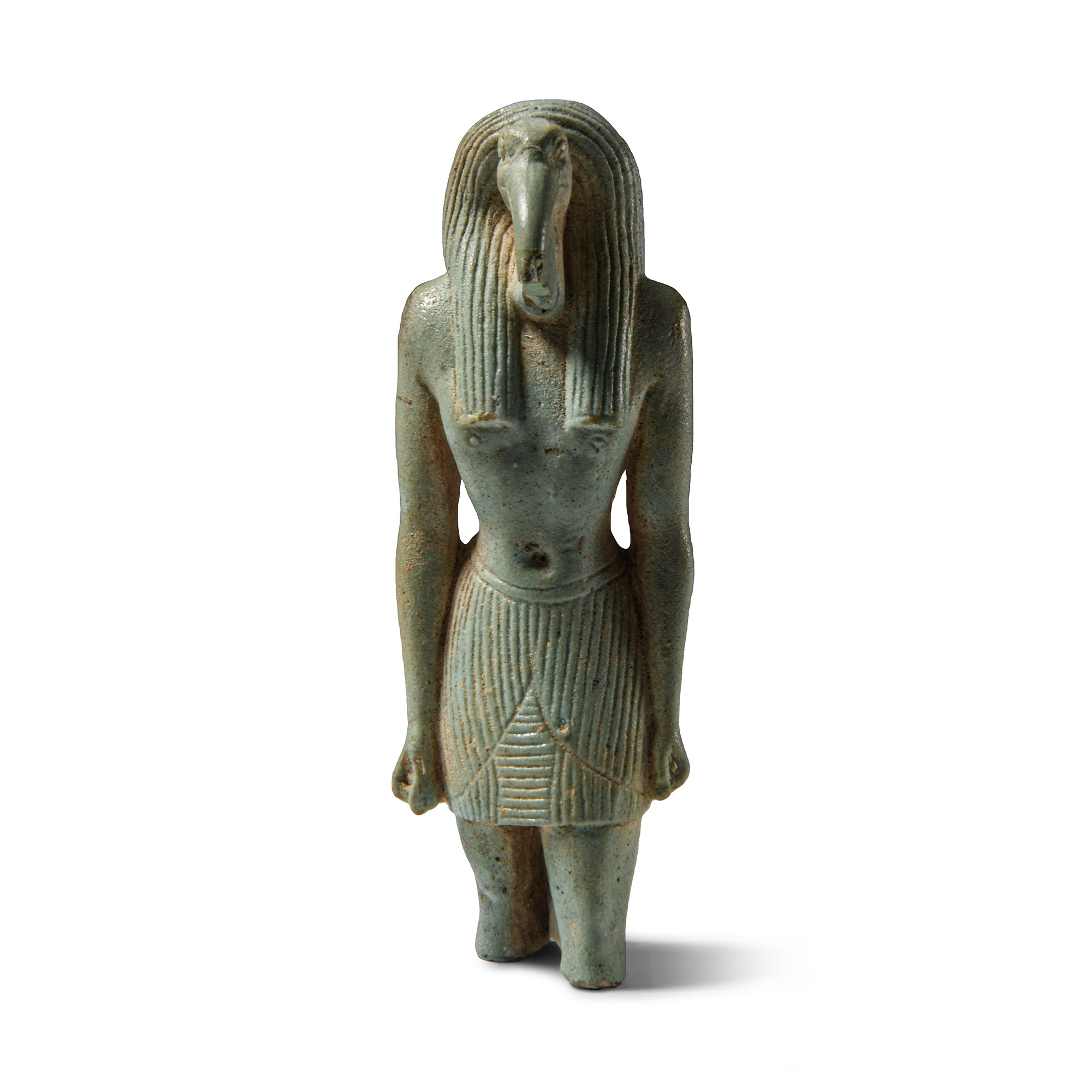
Egyptian Faience Figure of Thoth
26TH DYNASTY, 664-525 B.C.
3 1/2 in. (44.7 grams, 88 mm high).
In ibis-headed form, plain dorsal pillar, pleated kilt, tripartite wig; old collector's inked accession number 'E.1000' to the reverse; repaired.
ProvenanceEx Roger Liechti collection, Geneva, Switzerland.
This lot has been checked against the Interpol Database of stolen works of art and is accompanied by search certificate no.11595-199013.
Cf. Andrews, C., Amulets of Ancient Egypt, London, 1994, frontispiece for similar.
FootnotesOne of the most prominent of the ancient Egyptian gods, Thoth was associated with writing, magic and wisdom, and was credited with founding a number of branches of knowledge including law, religion and science. He is believed to have been self-created or grown from the seed of Horus from the forehead of Set. As the son of the gods of order and chaos, he was also the god of equilibrium. As such, he was considered a just and infallible judge.
Worshipped from the Pre-Dynastic to the Ptolemaic periods, Thoth was one of the longest, continuously worshipped gods from any civilisation. Thoth's Egyptian name was Djehuty (also dhwty) meaning ‘He Who is Like the Ibis’, a sacred bird in ancient Egypt as well as a popular pet associated with wisdom.
TimeLine Auctions follows a vetting process to ensure the authenticity and legality of all items, reinforcing our commitment to integrity and responsible trading. Each antiquity, antique, and coin lot undergoes thorough examination by a vetting committee of at least ten external specialists, professional trade association members, scientists, and archaeologists: Our Vetting Process
AUCTIONS:
TimeLine is a leading auction house specialising in antiquities, ancient art, collectables, natural history, coins, medals, and books. Our auctions offer museums, collectors, historians, and enthusiasts the opportunity to acquire unique and historically significant pieces.
LOT 0043
Egyptian Faience Figure of Thoth
Estimate £3,000 - 4,000€3,480 - 4,640 (for guidance only)$4,050 - 5,400 (for guidance only)
-
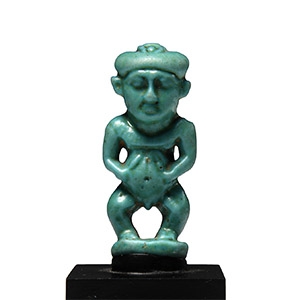
Egyptian Faience Pataikos Amulet
Ptolemaic Period, 4th-3rd century B.C.Estimate: £1,000 - 1,400 (‡+bp*)
Opening Bid: £500
Depicting the creator god in the form of the dwarf god Pataikos, modelled nude with stylised anatomical detailing, holding two knives to his stomach, squatting on an oval base; a scarab on the top of his cap; ribbed suspension loop to reverse; mounted on a custom-made display base. 29.6 grams total, 66 mm high including stand
Ex private French collection. with Thierry Maigret, Hotel Drouot, Paris, 12 July 2005, 76.
The Egyptian deity Pataikos is a special manifestation of the creator god Ptah, and the dwarf-like appearance symbolises his magical power. As a protective deity, amulets of Pataikos were worn for their apotropaic qualities; Pataikos was often depicted subjugating poisonous animals such as snakes and scorpions, and Pataikos amulets were probably worn to protect the wearer from such animals. -
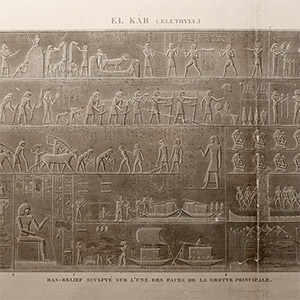
Large Egyptian Expedition Lithograph Print of Elethyia
1809 A.D.Sold for (Inc. bp): £117
Charlin - El Kab (Elethyia) - Bas-relief sculpté sur l'une des faces de la grotte principale - Proof etching on laid paper of plate 68 from La Description de l’Égypte (first volume) with later backing sheet. 360 grams, 130.5 x 87 cm
From the collection of a North American priest. Acquired between 1981-1996. Property of a North American collector.
Produced between February 1802 and 1830 on the orders of Napoleon Bonaparte; published between 1809 and 1828. Just 1,000 copies were distributed to various institutions, printed on on laid paper with an 'Égypte ancienne et moderne' watermark. The book is subtitled Recueil des observations et des recherches qui ont été faites en Égypte pendant l’expédition de l’Armée française, publié par les ordres de Sa Majesté l’Empereur Napoléon le Grand (Gathering of observations and discoveries which were made in Egypt during the expedition of the French army, published on the orders of His Majesty the Emperor Napoleon the Great). It was the world's first encyclopaedia devoted exclusively to the remains of ancient Egypt. The image depicts wall-carvings from the main chamber. -
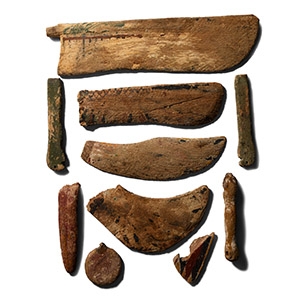
Egyptian Wooden Artefact Collection
Late Period, 664-332 B.C.Sold for (Inc. bp): £98
Comprising various items with remains of polychrome pigment, including a sun disk; an arm from a diorama; a wing of Isis; two scarab wings and others. 47 grams total, 3.6-18.5 cm
UK private collection. Acquired from Den of Antiquity, Cambridgeshire, UK, 2010. Property of a Nottinghamshire gentleman.
