
Loading, please wait...
_900x900.jpg "Egyptian Faience Figure of Nefertum")
_200x200.jpg "Egyptian Faience Figure of Nefertum")
_900x900.jpg "Egyptian Faience Figure of Nefertum")
_200x200.jpg "Egyptian Faience Figure of Nefertum")
.jpg "Egyptian Faience Figure of Nefertum")
.jpg "Egyptian Faience Figure of Nefertum")
LOT 0007
Egyptian Faience Figure of Nefertum
PTOLEMAIC PERIOD, 332-30 B.C.
5 1/8 in. (71 grams total, 13 cm including stand).
In a striding pose with arms at the sides, sporting a black coloured tripartite wig surmounted by the god's distinctive headdress consisting of a lotus flower with two plumes on top; a suspension loop at the back; repaired.
ProvenanceProperty from an American deceased estate, acquired between 1970 and 1989.
with Bonham's, London, 28 October 2009, no.81 [Part].
This lot is accompanied by an illustrated lot declaration signed by the Head of the Antiquities Department, Dr Raffaele D'Amato.
Cf. Andrews, C., and van Dijk, J., Objects for Eternity: Egyptian Antiquities from the W. Arnold Meijer Collection, Mainz am Rhein, 2006, p.229, no.3.41, for a similar faience figurine.
FootnotesNefertum was closely associated with the creator god Ptah and the goddesses Sekhmet and Bastet. He represented the first sunlight and the sweet scent of the Egyptian blue lotus flower (nymphaea caerulea). According to beliefs, the sun rose from the bloom of a blue lotus, embodying notions of rebirth and rejuvenation. Additionally, as the lotus was seen as a symbol of fertility, it is possible that this amulet was also worn for that purpose.
CONDITIONTimeLine Auctions follows a vetting process to ensure the authenticity and legality of all items, reinforcing our commitment to integrity and responsible trading. Each antiquity, antique, and coin lot undergoes thorough examination by a vetting committee of at least ten external specialists, professional trade association members, scientists, and archaeologists: Our Vetting Process
AUCTIONS:
TimeLine is a leading auction house specialising in antiquities, ancient art, collectables, natural history, coins, medals, and books. Our auctions offer museums, collectors, historians, and enthusiasts the opportunity to acquire unique and historically significant pieces.
LOT 0007
Egyptian Faience Figure of Nefertum
Estimate £500 - 700€580 - 810 (for guidance only)$680 - 950 (for guidance only)
-
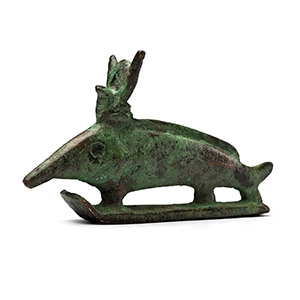
Egyptian Bronze Oxyrhynchus Fish
Late Period, 664-332 B.C. or laterEstimate: £700 - 900 (+bp*)
Opening Bid: £350
Modelled in the round on a sledge attached by ventral and pectoral fins; with forked tail, a dorsal ridge, and a tapering nose, featuring recessed circular eyes to accept an insert, a horned sun disc headdress fronted by a uraeus, and a suspension loop behind. 203 grams, 11.5 cm
From the collection of a gentleman, acquired on the London art market in the 1990s. This lot is accompanied by an illustrated lot declaration signed by the Head of the Antiquities Department, Dr Raffaele D'Amato. -
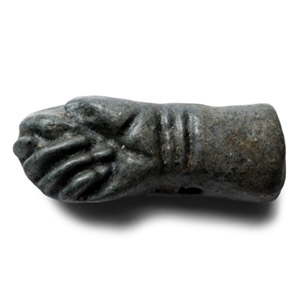
Egyptian Faience Fist Amulet
Ptolemaic-Roman Period, 323 B.C.-323 A.D.Sold for (Inc. bp): £124
Modelled as a right hand in fica protective gesture; pierced at wrist. 1.48 grams, 20 mm
From an early 20th century collection. This lot is accompanied by an illustrated lot declaration signed by the Head of the Antiquities Department, Dr Raffaele D'Amato. -
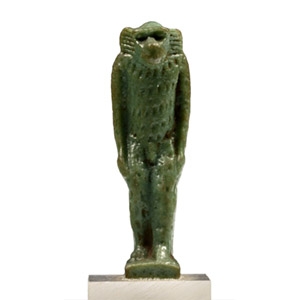
Egyptian Green Glazed Faience Amulet of a Monkey
Third Intermediate Period, circa 1069-735 B.C.Sold for (Inc. bp): £520
Modelled in the round with dorsal pillar and loop, small base. 6.1 grams total, 43 mm including stand
Collection of Monsieur M.; Etude Tajan, Paris, 26 February 1996, no.101. Private collection, London, UK, acquired from the above sale. Accompanied by a copy of a French cultural passport, dated 21 March 1996. This lot is accompanied by an illustrated lot declaration signed by the Head of the Antiquities Department, Dr Raffaele D'Amato.
The vervet monkey was a symbol of love and sexual fulfilment.
