Loading, please wait...

Egyptian Faience Figure of Bes Egyptian Faience Figure of Bes Egyptian Faience Figure of Bes
Use mousewheel to zoom in and out, click to enlarge
Details

LOT 0461

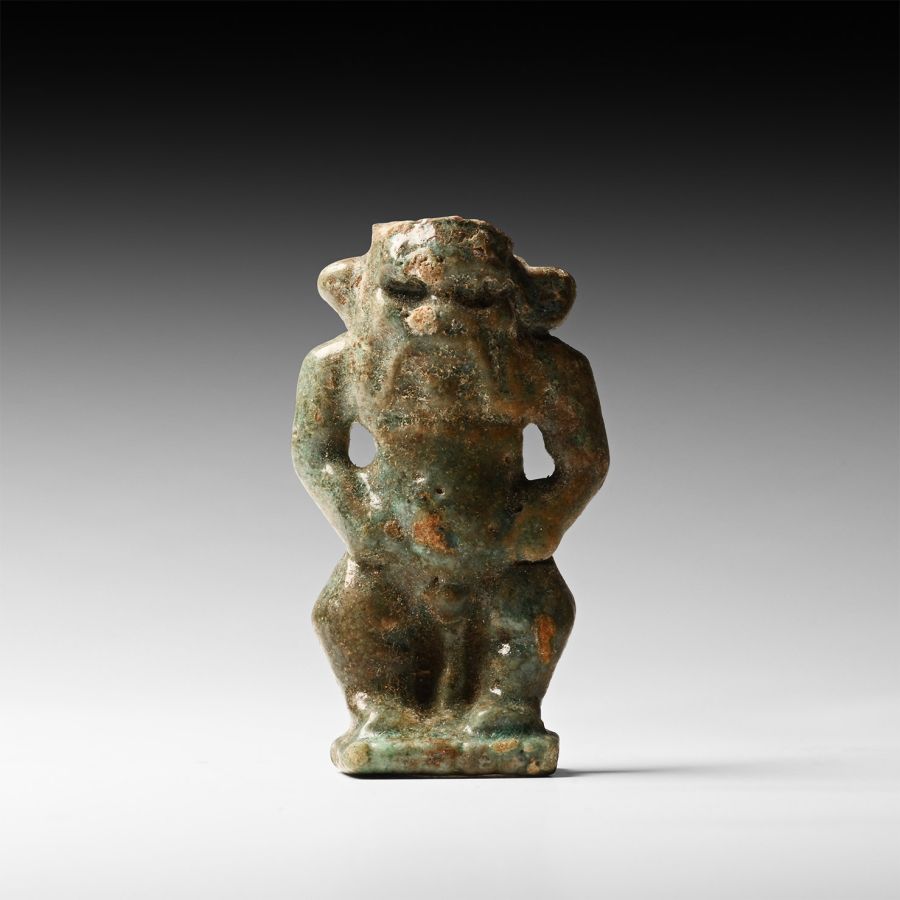
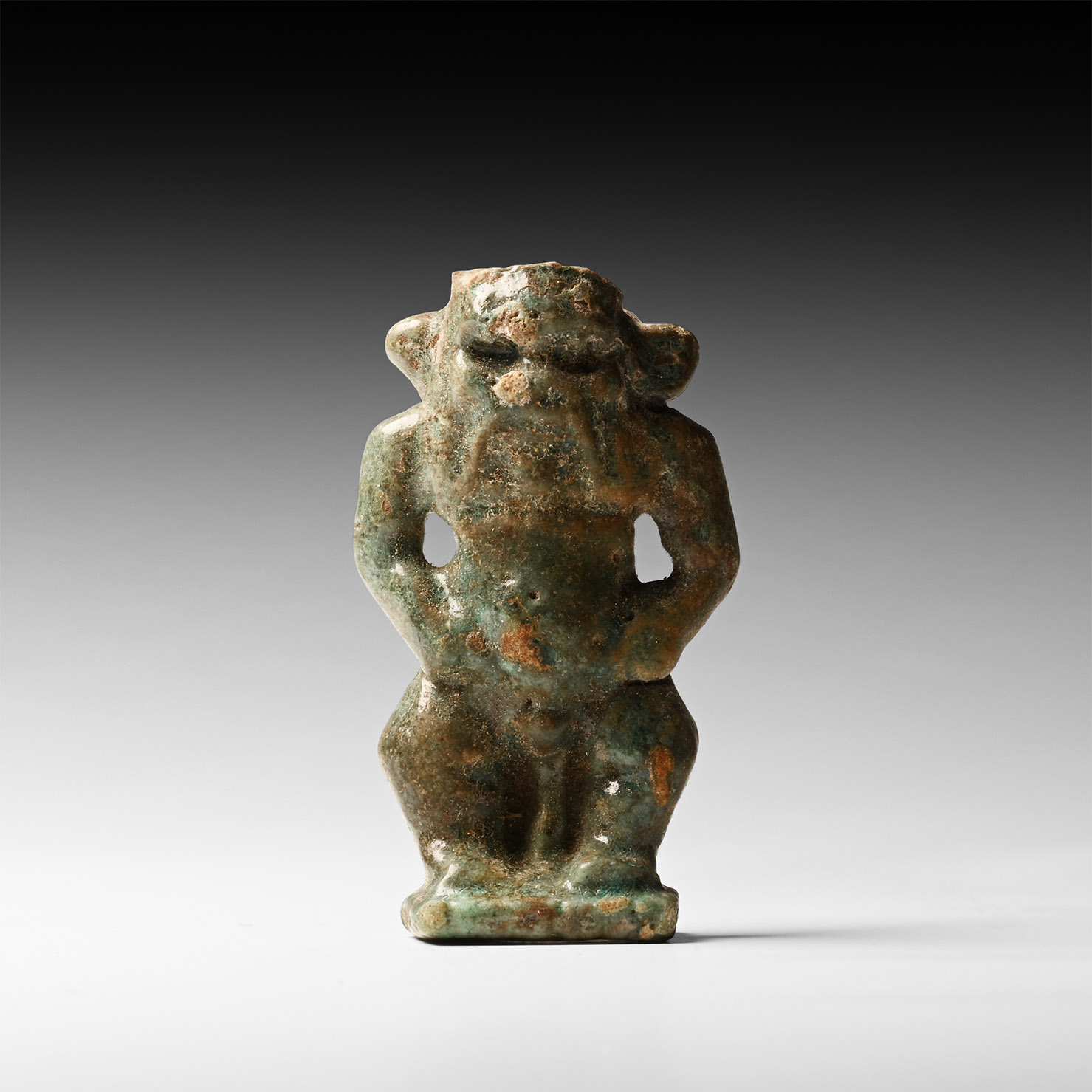
Egyptian Faience Figure of Bes

PTOLEMAIC PERIOD, 332-30 B.C.

1 3/8 in. (4.79 grams, 34 mm).

A green glazed composition figure of Bes standing on a base; plumed headdress and loop absent.

Provenance

Acquired early 1990s.
Ex private American collection; thence by descent.
Private Swiss collection since 1998.

CONDITION
VETTING:

TimeLine Auctions follows a vetting process to ensure the authenticity and legality of all items, reinforcing our commitment to integrity and responsible trading. Each antiquity, antique, and coin lot undergoes thorough examination by a vetting committee of at least ten external specialists, professional trade association members, scientists, and archaeologists: Our Vetting Process


AUCTIONS:

TimeLine is a leading auction house specialising in antiquities, ancient art, collectables, natural history, coins, medals, and books. Our auctions offer museums, collectors, historians, and enthusiasts the opportunity to acquire unique and historically significant pieces.

LOT 0461

Egyptian Faience Figure of Bes

Sold for (Inc. bp): £234

Print page

RELATED LOTS
  • Egyptian Blue Faience Shabti of Nesitanebisheru
    Egyptian Blue Faience Shabti of Nesitanebisheru
    Third Intermediate Period, 21st Dynasty, circa 980-935 B.C.

    Estimate: £30,000 - 40,000 (‡+bp*)

    Opening Bid: £15,000

    A vibrant blue-glazed mummiform shabti of princess Nesitanebisheru, daughter of Pinudjem II, on a custom-made display stand; modelled with arms crossed over the chest, holding a hoe in each hand, wearing a tripartite wig; netted seed bag painted on the back; the bottom half of the figure bearing eight columns of hieroglyphic text in black giving a version of the shabti spell reading: (1) The illuminated one, the Osiris Nesitanebisheru, she says: (2) ‘O this shabti, if one counts, if one reckons to do (3) for the Osiris Nesitanebisheru, to cultivate the fields, (4) to irrigate the riparian lands, to transport by boat the sand of (5) the east (to) the west and vice-versa – now indeed obstacles are implanted (6) therewith – as a man at his duties (to do for ?) (7) the Osiris Nesitanebisheru, to do all the works that are to be done (8) in God’s land at any time to serve, ‘here I am,’ (you shall say). 314 grams total, 16.5 cm high including stand


    The object comes from the well known Deir el-Bahari cache (near Thebes) first discovered in 1870. Ex Zurich Antiquities Fair. Ex R. Liechti, Geneva, acquired from the above. Accompanied by an academic report by Egyptologist Paul Whelan. This lot has been checked against the Interpol Database of stolen works of art and is accompanied by search certificate no.11598-198961.

    Nesitanebisheru’s burial was discovered in the famous ‘Royal Cache I’ at Deir el-Bahari (DB 320), with many dozens of coffins and vast quantities of funerary equipment belonging to pharaohs, including Thutmose III and Ramesses II, queens, and other royals, as well as elite members of society that had been reburied by Amun priests to hide them from tomb robbers. Nesitanebisheru’s coffin and burial equipment, including her shabtis, were found at the very end of the c. 70m long tomb in a chamber which served as a family vault for her father, the High Priest of Amun, Pinudjem II, and his principal wife Neskhons. While her worker shabtis are all mostly similar in style with 6-8 text columns, the composition of their inscriptions are not consistent with different openings and variations to the content (often including several peculiarities). Curiously, her titles do not appear in her shabti inscription, unlike those for her mother.

    Lot Details

  • Egyptian Limestone Figure of Isis-Aphrodite
    Egyptian Limestone Figure of Isis-Aphrodite
    Ptolemaic-Roman Period, 332 B.C.-200 A.D.

    Sold for (Inc. bp): £483

    A limestone figure modelled in the half-round, lying naked on a rectangular bed, executed with semi-naturalistic anatomical detailing, voluminous coiffed hair and painted necklace, armbands and distinctive ornamental girdle at the waist; accompanied by a custom-made display stand. 109 grams total, 11.5 cm including stand

    Fine condition.

    with Secret Eye Gallery, New York City, 1977. with Arte Primitivo, New York, USA, 8 October, 2003, lot 66. Private collection of Professor Kenneth Graham, London, UK. Accompanied by an original Arte Primitivo catalogue page. Accompanied by a scholarly note by Egyptologist Paul Whelan.

    This syncretic figure combines the Egyptian goddess Isis and the Greek goddess Aphrodite, a deity popular from the 3rd century B.C. into the Roman Period, who embodied aspects of fertility, marriage, and childbirth.

    Lot Details

  • Egyptian Glass Anubis Head Inlay
    Egyptian Glass Anubis Head Inlay
    Late Period, 664-332 B.C.

    Sold for (Inc. bp): £572

    An opaque black glass inlay in the form of the head of Anubis in jackal form; repaired. 19.2 grams, 58 mm high


    French collection, 1960s-early 2000s. From an important Paris gallery, France.

    Lot Details

Stay up-to-date with the latest from TimeLine Auctions by joining our mailing list