
Loading, please wait...

LOT 0036
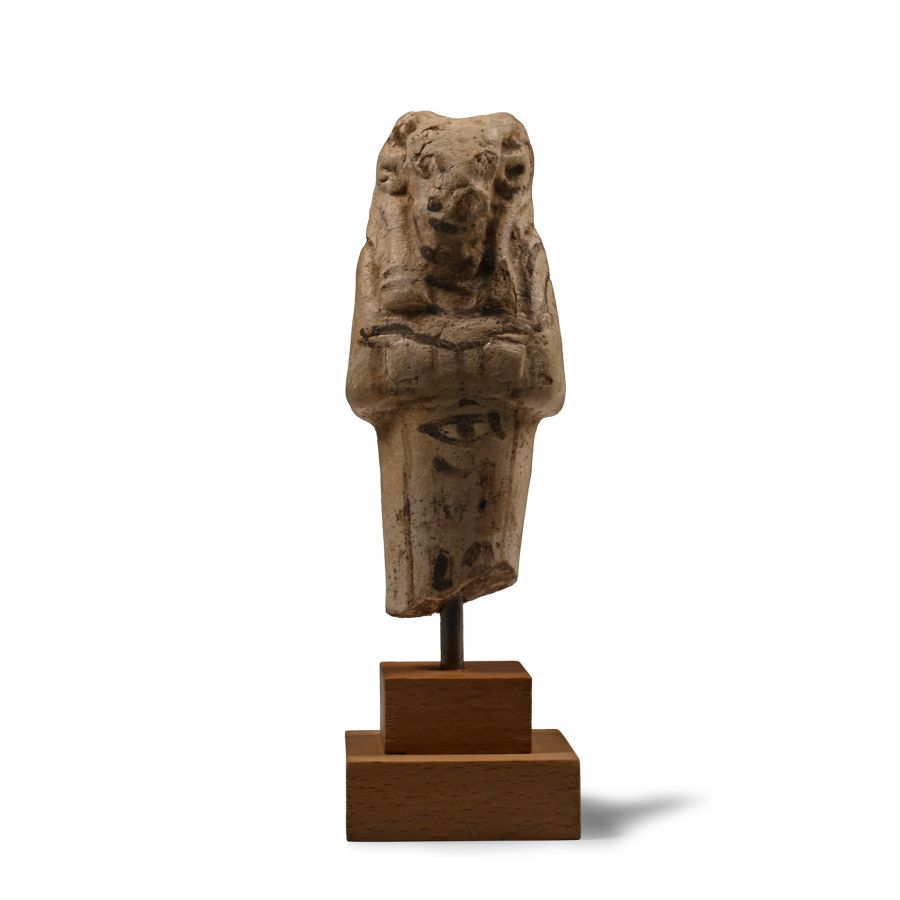
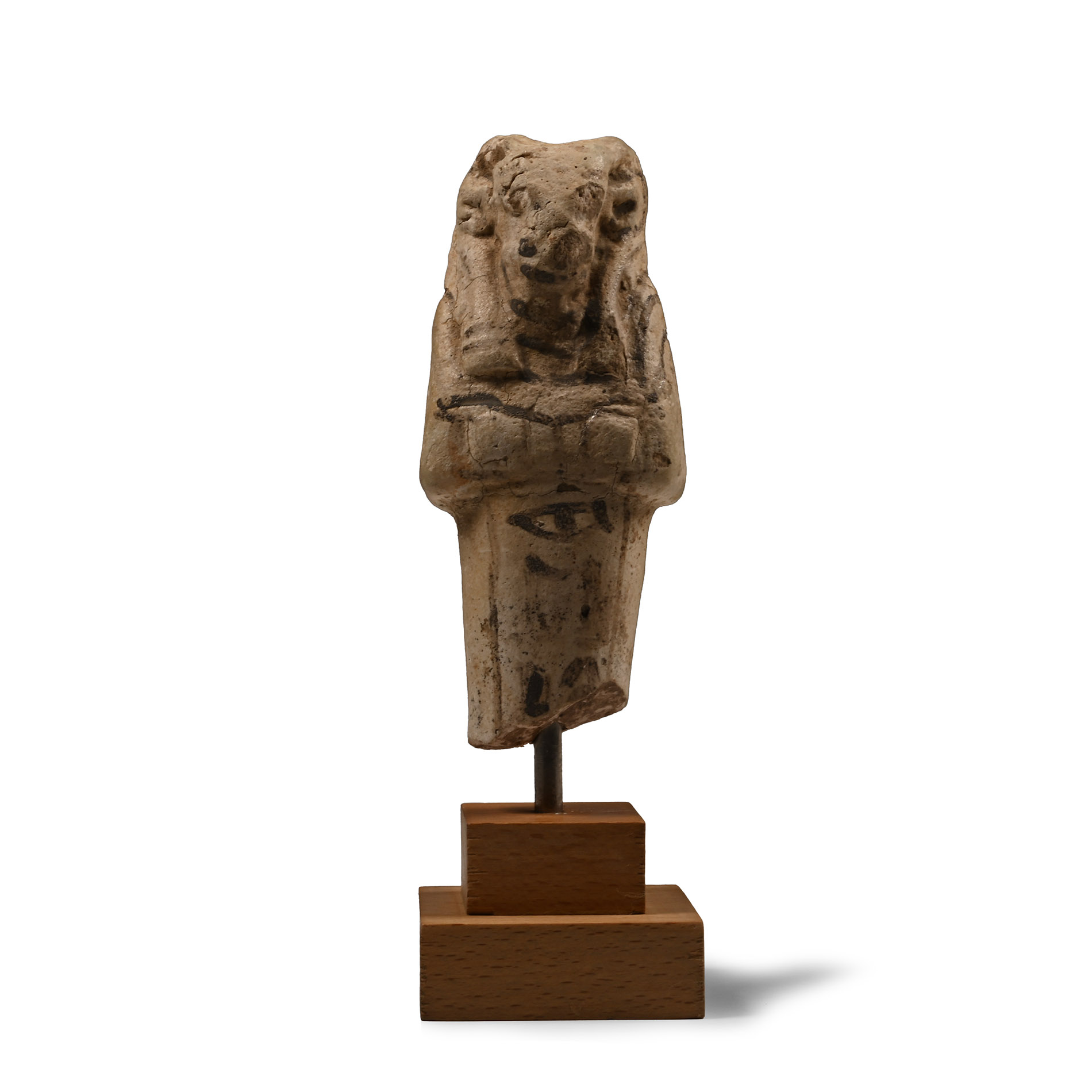
Egyptian Faience Bull-Headed Shabti from the Serapeum at Saqqara
NEW KINGDOM, RAMESSIDE PERIOD, 1295-1069 B.C.
5 7/8 in. (152 grams total, 15 cm including stand).
Pale faience figurine representing a bull-headed mummy adorned with a tripartite wig and human arms crossed over the chest with hands holding a pick and a hoe; only the lower legs and feet missing; the opening part of a central panel of hieroglyphic inscription reads: Wsir ͗ ḥp, 'the Osiris Apis'; mounted on a custom-made display stand.
ProvenanceProbably found at the Serapeum at Saqqara in the 19th century.
From the private collection of the late Mr M.S.C., Norfolk, UK, formed 1950s-1960s.
Accompanied by an academic report by Egyptologist Paul Whelan.
Cf. Mariette, A., Le Serapeum de Memphis, Paris, 1882, pl. 19, for others of the type.
FootnotesWhile most shabtis served as substitutes or servants of the deceased and were placed in the tomb, some, like this example, were votive objects deposited in places of great sanctity. Virtually all known Apis shabtis come from excavations in the Serapeum catacombs led by Auguste Mariette from 1850 to 1853. They all belong to activity dating to the 19th and 20th Dynasties (circa 1295-1069 BC) and were unearthed in various chambers where they had been placed as votive offerings to honour the deified Apis bulls.
CONDITIONTimeLine Auctions follows a vetting process to ensure the authenticity and legality of all items, reinforcing our commitment to integrity and responsible trading. Each antiquity, antique, and coin lot undergoes thorough examination by a vetting committee of at least ten external specialists, professional trade association members, scientists, and archaeologists: Our Vetting Process
AUCTIONS:
TimeLine is a leading auction house specialising in antiquities, ancient art, collectables, natural history, coins, medals, and books. Our auctions offer museums, collectors, historians, and enthusiasts the opportunity to acquire unique and historically significant pieces.
LOT 0036
Egyptian Faience Bull-Headed Shabti from the Serapeum at Saqqara
Sold for (Inc. bp): £3,250
-
Egyptian Faience Shabti for Hor-sa-Iset
Late Period, circa 4th century B.C.Estimate: £1,000 - 1,400 (‡+bp*)
Opening Bid: £500
Of mummiform type, wearing a tripartite wig and long plaited divine beard; holding a pick in the left hand, a hoe in the right, and the cord of a seed bag hanging over his left shoulder; standing on an integral plinth, a plain back pillar terminating at the base of the wig; two vertical panels of hieroglyphic inscription to the front, including dedication: sḥḏ wsỉr ḥr sꜢ Ꜣst, ‘The illuminated, the Osiris, Hor-sa-Iset’; mounted on a custom-made display stand. 124 grams, 15.2 cm
Jacques René Fiechter, Switzerland (1920-1950). with Auction Martin, Egyptian collection of André Bircher, 1949. with Cahn Auktionen AG, Basel, 5 November 2011, no.20. Private collection, Europe. Accompanied by copies of the relevant Cahn catalogue pages. -
Egyptian Hardstone Architectural Amulet
Late Period, 664-332 B.C.Sold for (Inc. bp): £260
Amuletic model of a stonemason's plummet. 2.38 grams, 25 mm
with Hotel des Ventes, Drouot, Paris, France. From the collection of Mr H. Naudy, Paris, France. Acquired at between 2004-2010. Property of a French collector.
The stonemason’s plumb bob amulet was most frequently made of a dark hardstone like this example and paired with a set-square amulet. Plummet amulets were thought to grant their owner everlasting balance and harmony. -
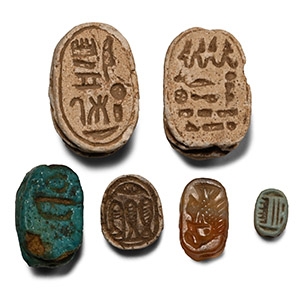
Egyptian Steatite and Faience Scarab Group
Late Period, 664-332 B.C.Sold for (Inc. bp): £208
Their bases decorated with hieroglyphs and figures, including one with the motto 'Amun lord of the Two Lands', another with the motto 'lord Ramesses beloved of Amun', and one with a detailed representation of a Nile tilapia fish. 8.68 grams total, 7-21 mm
From an early 20th century collection.
