
Loading, please wait...
LOT 0539
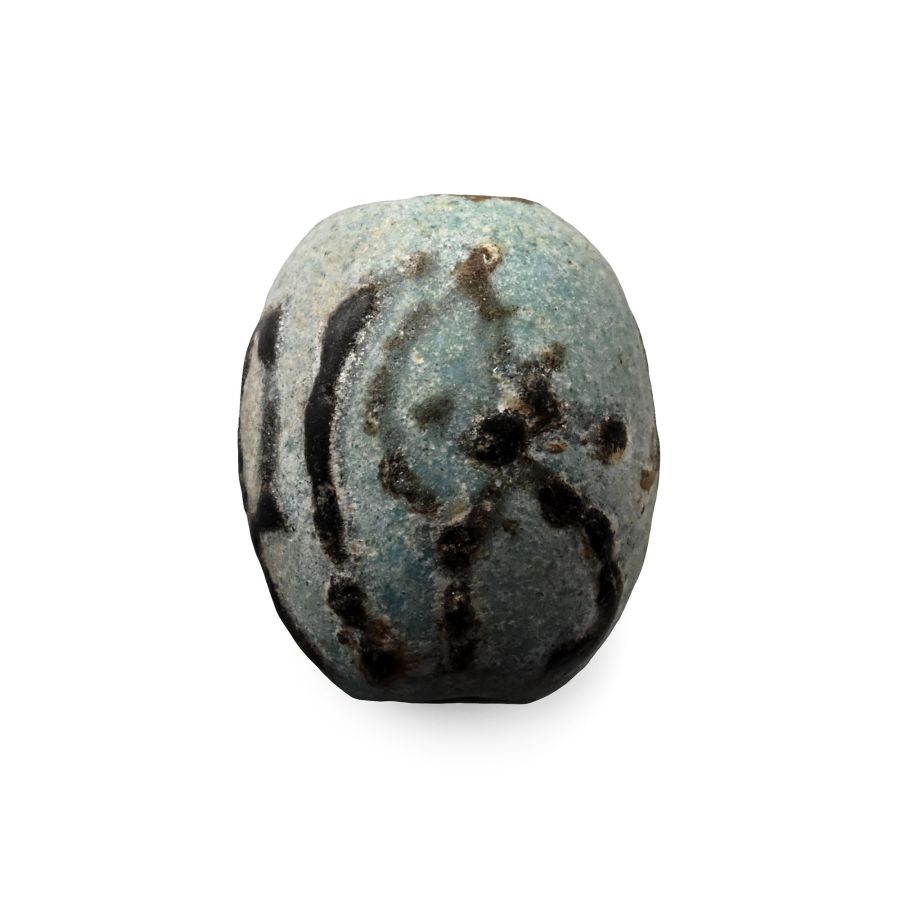
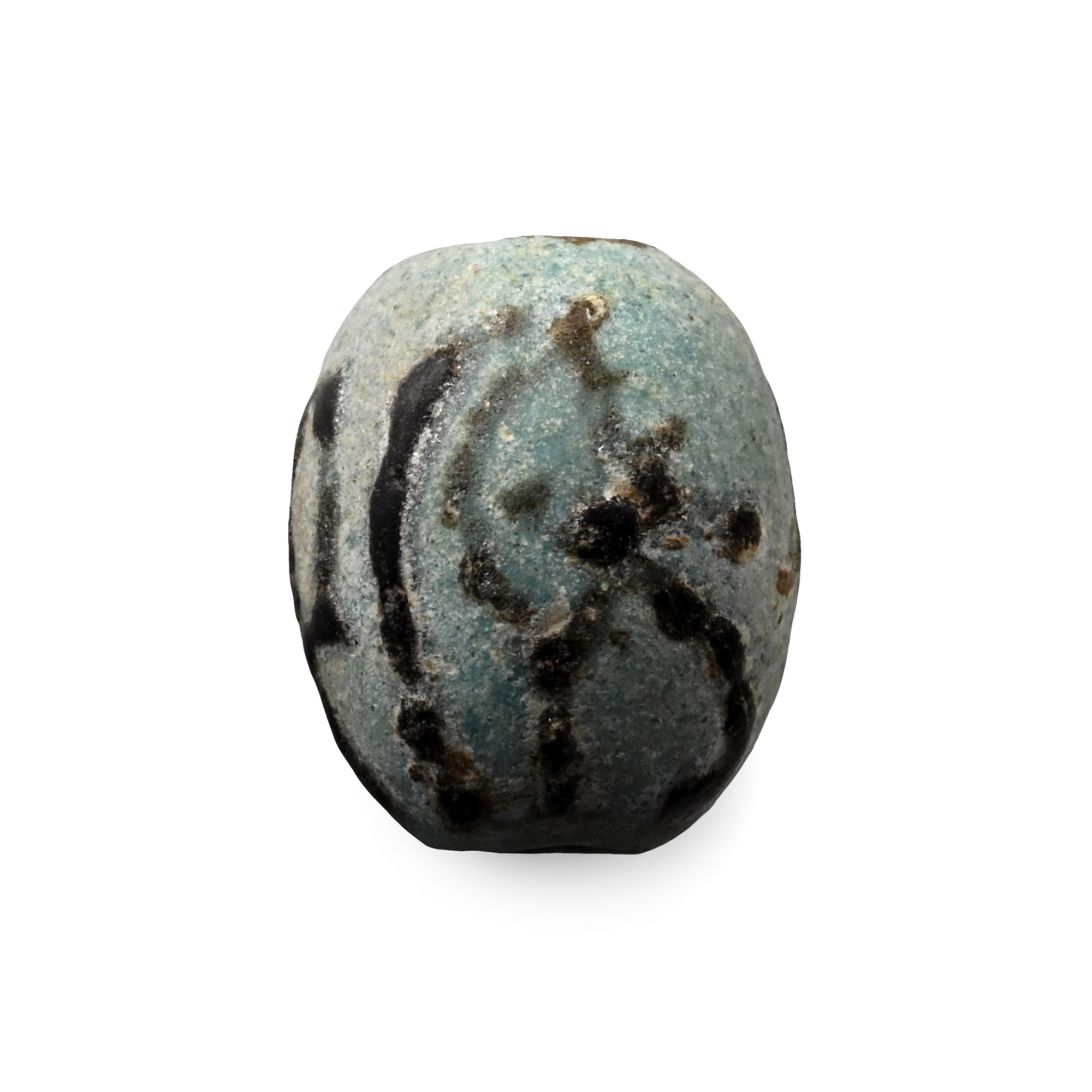
Egyptian Faience Bead with Eye of Horus and Ankh Symbols
LATE PERIOD, 664-332 B.C.
1/2 in. (2.09 grams, 14 mm).
Barrel-shaped bead with blue glaze, wedjat and ankh in black glaze.
ProvenanceFrom an early 20th century collection.
FootnotesThe wedjat-eye amulet is a representation of the healed eye of the god Horus, featuring both human and falcon elements. The name wedjat in ancient Egyptian means ‘the one that is sound.’ According to Egyptian mythology, Horus' eye was wounded or taken by the god Seth and restored by Thoth. The wedjat-eye amulet was thought to protect its wearer and bestow the power of recovery and regeneration onto them. It was very popular and used by both the living and the dead.
CONDITIONTimeLine Auctions follows a vetting process to ensure the authenticity and legality of all items, reinforcing our commitment to integrity and responsible trading. Each antiquity, antique, and coin lot undergoes thorough examination by a vetting committee of at least ten external specialists, professional trade association members, scientists, and archaeologists: Our Vetting Process
AUCTIONS:
TimeLine is a leading auction house specialising in antiquities, ancient art, collectables, natural history, coins, medals, and books. Our auctions offer museums, collectors, historians, and enthusiasts the opportunity to acquire unique and historically significant pieces.
LOT 0539
Egyptian Faience Bead with Eye of Horus and Ankh Symbols
Estimate £100 - 140€120 - 160 (for guidance only)$140 - 190 (for guidance only)
-
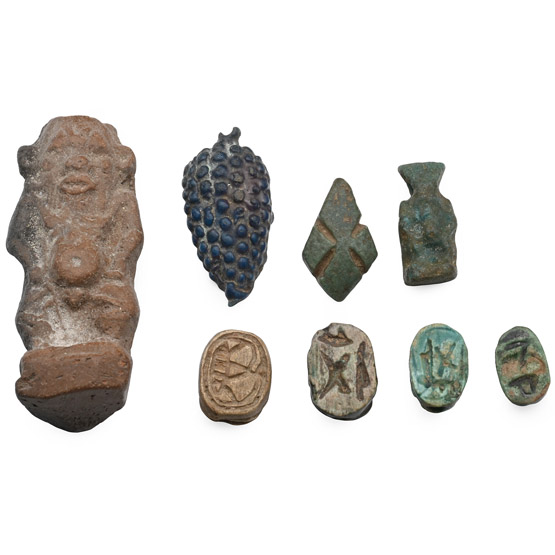
Egyptian Faience Amulet Group
New Kingdom-Ptolemaic Period, 1550-30 B.C.Sold for (Inc. bp): £156
Comprising a large standing Bes statuette on a rectangular base and a smaller Bes pierced for suspension; four scarabs with detailing to the upper face and incised signs and motifs on the underside; a tear-shaped bunch of grapes with a broken suspension loop; a lozenge-shaped pierced for suspension. 11 grams total, 9-38 mm
From the Walter Thomas Gaze Cooper (1895-1980) collection; thence by descent. -
Egyptian Faience Group of Amulets
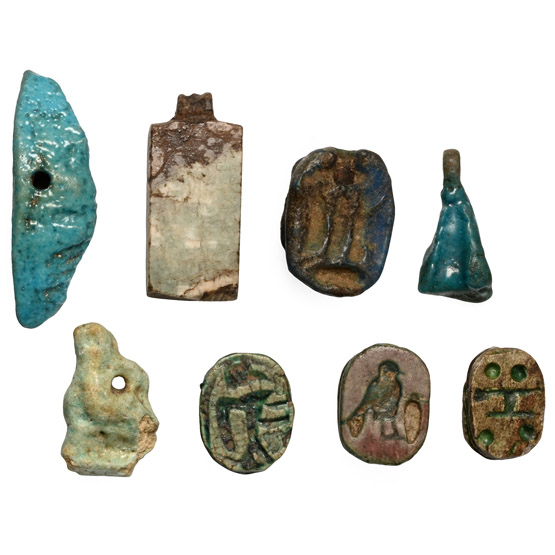
New Kingdom-Ptolemaic Period, 1550-30 B.C.Sold for (Inc. bp): £182
Comprising of blue-glazed composite amulets including lotus flower; crescentic bead; bird amulet with minor chips to the body; four scarabs with longitudinal piercing and carvings to the underside; a plain green stone rectangular plaque with ribbed suspension bar to the top. 6.17 grams total, 10-24 mm
From the Walter Thomas Gaze Cooper (1895-1980) collection; thence by descent. -
.jpg)
Historic Collection of 859 Slides of Archaeological Sites and Artefacts From Egypt
1960s-1980s A.D.Sold for (Inc. bp): £1,430
Housed in five linen-covered boxes, covering tombs, wall paintings, Tutankhamun, Giza, El Kab, Menkaure, Roash, Merysankh, Medinet Habu, Abusir, Ramesses III Temple, Seti I Chapel etc. 4.34 kg total, 26.5 x 16.5 x 6.5 cm each box
Property of archaeologist Stephanie Gee, N.W. London, UK, 1960s-1980s.
Stephanie Gee was a prominent archaeologist who took part in several expeditions in Egypt. She was a trusted assistant to the British-Australian archaeologist Veronica Seton-Williams, who excavated in Egypt, Britain, and the Near East. Stephanie also took part in the Tell El-Farâ'în expeditions of 1965-1968, and assisted Seton-Williams with preparing the 1966 expedition report. Their collaboration continued and Stephanie helped with the manuscript of Seton-Williams’ book ‘The Road to El-Aguzein’, a narrative account of her life that was first published in 1988.
