
Loading, please wait...
_900x900.jpg "Egyptian Faience Bead with Cartouches of Pharaoh Amasis")
_200x200.jpg "Egyptian Faience Bead with Cartouches of Pharaoh Amasis")
.jpg "Egyptian Faience Bead with Cartouches of Pharaoh Amasis")
LOT 0062
Egyptian Faience Bead with Cartouches of Pharaoh Amasis
LATE PERIOD, 26TH DYNASTY, CIRCA 664-525 B.C.
1 in. (4.96 grams, 26 mm).
Square in plan with transverse piercing, obverse with three panels: the left bearing a cartouche surmounted by two plumes containing the pharaoh’s birth name, i͗Ꜥms sꜢ nt (Ahmose, son (of) Neith); the right, a similar cartouche containing his throne name, ẖnm-i͗b-RꜤ (He who embraces the heart of Re); the centre inscription reads, ḥpw Ꜥnḫ sꜢ ḥpt(?) (the living Apis, son [of] Hepet?) two with a cartouche for Amasis, text to the centre.
ProvenanceEx private collection, Germany.
with Galerie Günter Puhze, Freiburg, Germany, prior to 2003.
Private collection, acquired on the German art market, 2004.
This lot has been checked against the Interpol Database of stolen works of art and is accompanied by search certificate number no.13186-249203.
Cf. Zecchi, M., The Naos of Amasis, Leiden, 2019, fig.III.8, for a cartouche of Amasis.
FootnotesThe three-column text arrangement closely resembles that of another rectangular spacer bead, engraved with Ahmose II’s cartouches flanking a central inscription, now held at The Walters Art Museum, Baltimore (accession number 42.377). Although the central inscription differs in content, the bead’s connection to the Apis bull is shown on the opposite side, where the sacred animal is depicted.
Amasis II (Egyptian: Ahmose II), fifth king of the 26th Dynasty (Saite Period), reigned c. 570–526 BC. Rising to power after overthrowing Apries, Amasis presided over a period of renewed stability and prosperity in Late Period Egypt. His reign is characterised by administrative reform, economic growth, and an active foreign policy, including close diplomatic and commercial relations with the Greek world, evidenced by Greek mercenaries in Egyptian service and the granting of Naukratis as a trading enclave. Amasis undertook extensive temple building and restoration programmes throughout Egypt, particularly at Sais, Memphis, and in Upper Egypt, consciously aligning himself with earlier pharaonic traditions. His royal titulary appears widely on monuments, scarabs, amulets, and architectural elements, often reflecting an emphasis on divine legitimacy and Maʿat. Amasis died shortly before the Persian conquest of Egypt under Cambyses II; his reign represents the final florescence of independent Egyptian kingship before Achaemenid rule.
TimeLine Auctions follows a vetting process to ensure the authenticity and legality of all items, reinforcing our commitment to integrity and responsible trading. Each antiquity, antique, and coin lot undergoes thorough examination by a vetting committee of at least ten external specialists, professional trade association members, scientists, and archaeologists: Our Vetting Process
AUCTIONS:
TimeLine is a leading auction house specialising in antiquities, ancient art, collectables, natural history, coins, medals, and books. Our auctions offer museums, collectors, historians, and enthusiasts the opportunity to acquire unique and historically significant pieces.
LOT 0062
Egyptian Faience Bead with Cartouches of Pharaoh Amasis
Sold for (Inc. bp): £2,340
-
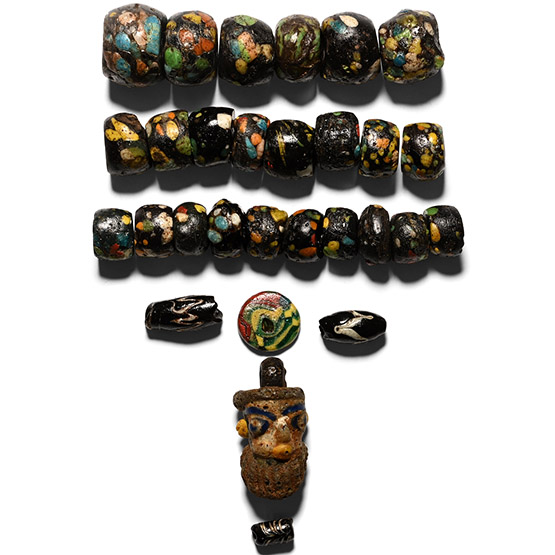
Phoenician Glass Bead Collection
6th-3rd century B.C. or laterSold for (Inc. bp): £910
Comprising a group of crumb-decorated polychrome oblate beads and a centrepiece pendant formed as a stylised bearded head. 179 grams total, 12-42 mm
From the collection of a gentleman, acquired on the London art market in the 1990s.
The Phoenicians, renowned seafarers and traders, were also skilled glassworkers. They produced a wide variety of glass beads using core-forming and winding techniques, with vivid colours and elaborate designs that reflect both technical mastery and cross-cultural influence. Among the most iconic Phoenician beads are glass 'head' beads, crafted in the form of stylised human or mythological faces. Typically, they feature exaggerated facial details like bulging eyes, large noses, beards, and headdresses, often with expressive or comic features. They were possibly worn as amulets to ward off evil or attract protection, though they may also represent deities, ancestors, or foreigners. These beads often incorporate Egyptian, Greek, and Near Eastern stylistic elements, reflecting the Phoenicians’ extensive trade networks. -
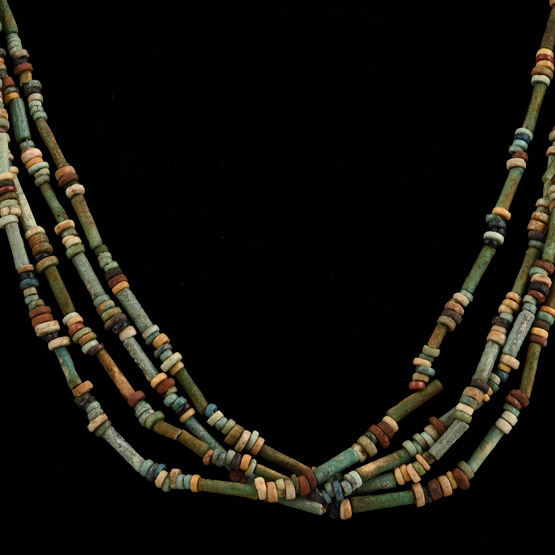
Egyptian Multi-Stranded Mummy Bead Necklace
Late Period, 664-332 B.C.Sold for (Inc. bp): £234
Four-strand designer necklace composed of polychrome beads of mainly disc and cylindrical types. 27.4 grams, 69.5 cm
Acquired before 1979. From the private collection of Mr F.A., South Kensington, London, UK; thence by descent 2014.
For thousands of years, artisans in Egypt created vibrant ceramics to echo the beauty of rare jewels. These ornaments were created with almost every material, colour, and texture imaginable, and they come from across Egypt and beyond: vibrant blue lapis lazuli from Afghanistan, glossy black obsidian from Turkey, and aqua-green turquoise from the Sinai. They were worn in life and, after death, they served as precious ornamentation for mummies. -
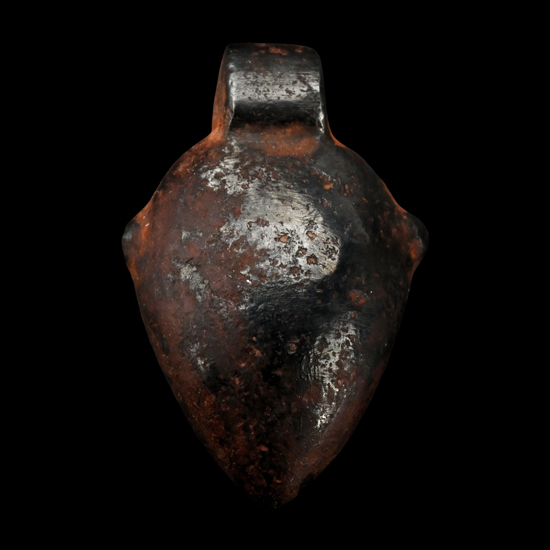
Egyptian Haematite Heart Amulet
Late Period, 664-332 B.C.Sold for (Inc. bp): £130
Carved with lateral triangular lugs and an integral bale. 2 grams, 15 mm
Ex early 20th century collection.
