
Loading, please wait...
LOT 0477
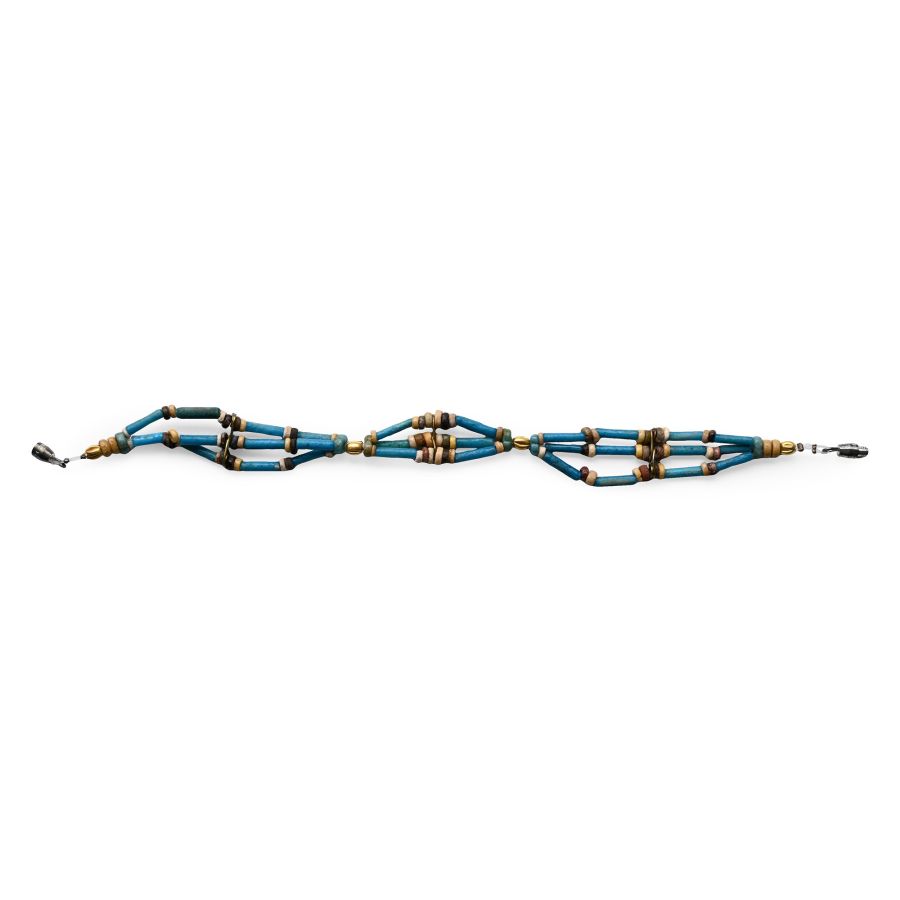
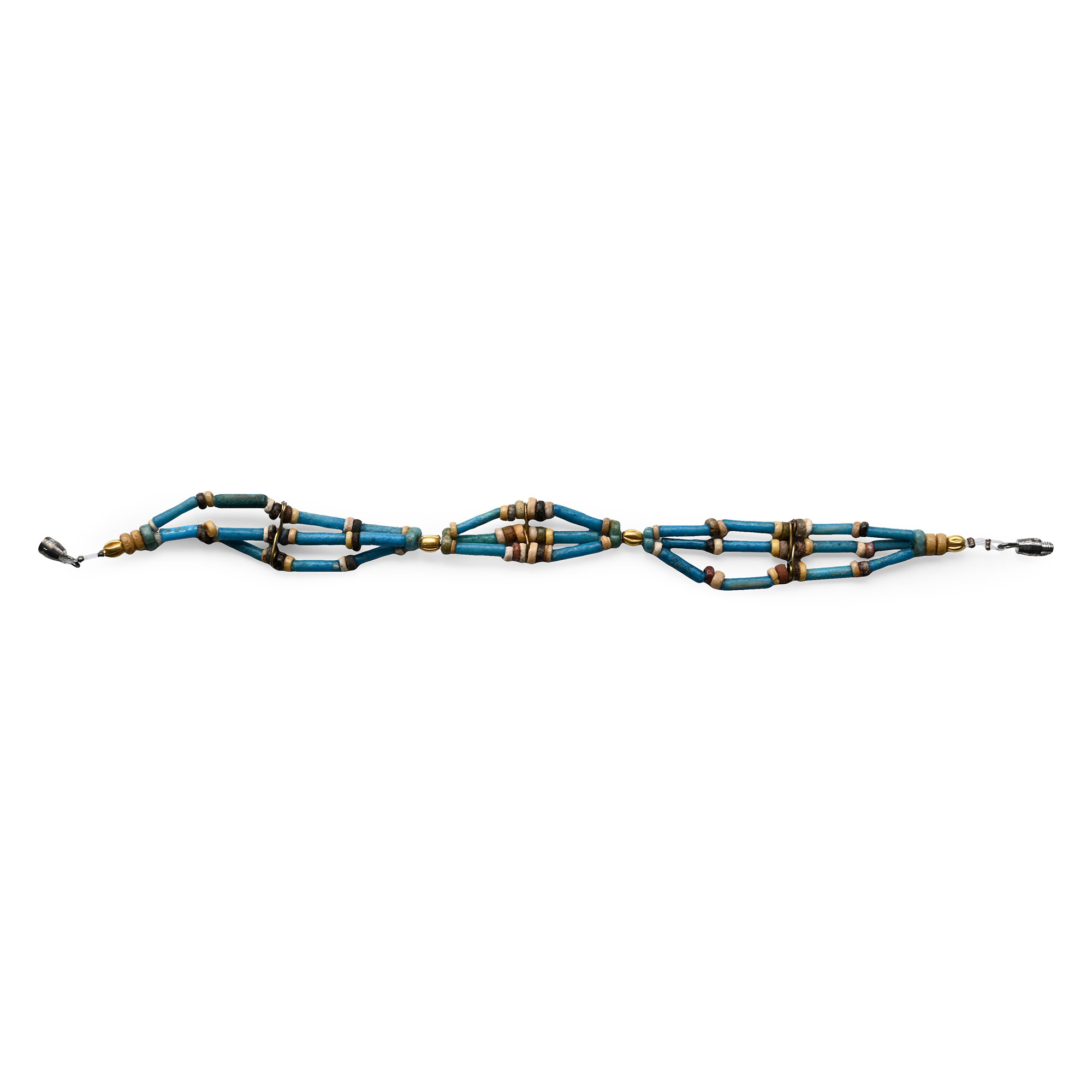
Egyptian Faience and Gold Bead Bracelet
LATE PERIOD, 664-332 B.C.
7 1/2 in. (3.89 grams, 19 cm).
A designer restrung three-strand bracelet composed of gold and composition beads coloured shades of blue, cream and brown; modern silver-coloured clasp; accompanied with a note reading 'Egyptian, Faience New Kingdom Beaded Bracelet, C. 1570-30 BC- New Kingdom to Ptolemaic Period. beautiful, restrung, elegant Egyptian beaded bracelet consisting of a selection of turquoise coloured, faience tubular beads & polychromatic disc-shaped beads, in a style inspired by the earliest bracelets known (from about 3000 BC) which were found in the tomb of King Djer.' [No Reserve]
ProvenanceProperty of a Cambridgeshire, UK, gentleman.
Restrung from various accumulations of Egyptian beads from the last 30 years.
TimeLine Auctions follows a vetting process to ensure the authenticity and legality of all items, reinforcing our commitment to integrity and responsible trading. Each antiquity, antique, and coin lot undergoes thorough examination by a vetting committee of at least ten external specialists, professional trade association members, scientists, and archaeologists: Our Vetting Process
AUCTIONS:
TimeLine is a leading auction house specialising in antiquities, ancient art, collectables, natural history, coins, medals, and books. Our auctions offer museums, collectors, historians, and enthusiasts the opportunity to acquire unique and historically significant pieces.
-
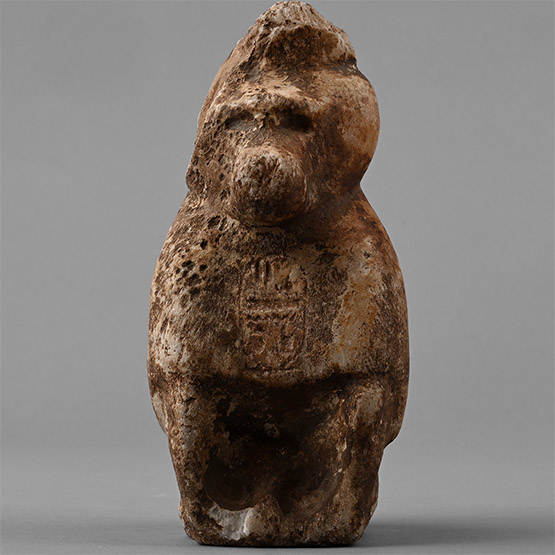
Egyptian Alabaster Baboon with Dedication to Queen Tiye
New Kingdom, 1184-1152 B.C.Sold for (Inc. bp): £3,120
Carved alabaster figure of a baboon, crouching with his forepaws resting on his knees, tail curled around from the rear; cartouche dedicated to Queen Tiye at the chest as a later addition. 1.06 kg, 15.4 cm
From the private collection of Dr Athanasios Ghertsos, Zurich, by at least 1970. Private collection of Hermann A. Schlögl (1932-2023), Basel. Accompanied by a copy of an Art Loss Register certificate, no.S00261724. This lot has been checked against the Interpol Database of stolen works of art and is accompanied by search certificate no.13073-248325.
In ancient Egypt, baboons were sacred, representing wisdom, the moon, and the underworld, linked to gods like Thoth and Babi, often depicted greeting the sun or guarding tombs, and were imported, mummified as offerings, and used as powerful religious symbols despite their often harsh captive conditions. The aforementioned Tiye is the wife of Sethnakht, the founder of the 20th Dynasty, and not to be confused with the wife of Amenhotep III. All monuments bearing her name originate from Abydos, where her son Ramesses III built a temple for his parents. -
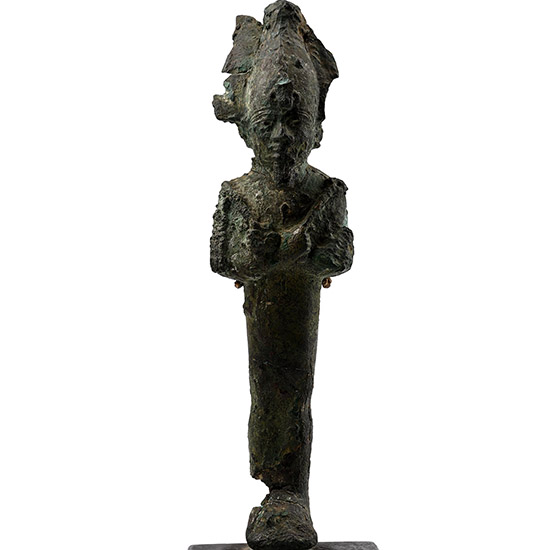
Egyptian Bronze Osiris Statue
Late Period, 664-332 B.C.Sold for (Inc. bp): £910
A sizeable, slender standing mummiform figure of Osiris, wearing his iconic tall conical Atef crown with flanking ostrich plumes and a central uraeus, holding the crook (heka) and flail (nekhakha) regalia; mounted on a display stand. 821 grams total, 26 cm high including stand
From the estate of Alexander Dobkin (1908-1975), New York, USA, acquired prior to 1975. Thence by descent to his daughter, Katherine Dobkin, New York, USA..
Osiris was associated with death and fertility and was widely recognised as the supreme god of renewal and rebirth. Although he was once a mortal ruler, as a deity, his domain was the Underworld. Abydos served as the main site of Osiris’ worship, where a renowned annual celebration in his honour took place. -
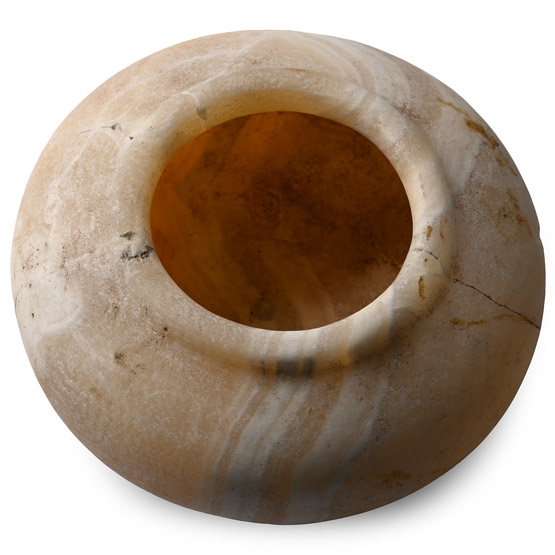
Egyptian Alabaster Jar
2nd-1st millennium B.C.Sold for (Inc. bp): £286
Of squat profile with flattened base, flat shoulder and rounded rim. 574 grams, 11.5 cm wide
From a West Country, UK, collection, 1980-2020s.
