
Loading, please wait...
LOT 0576
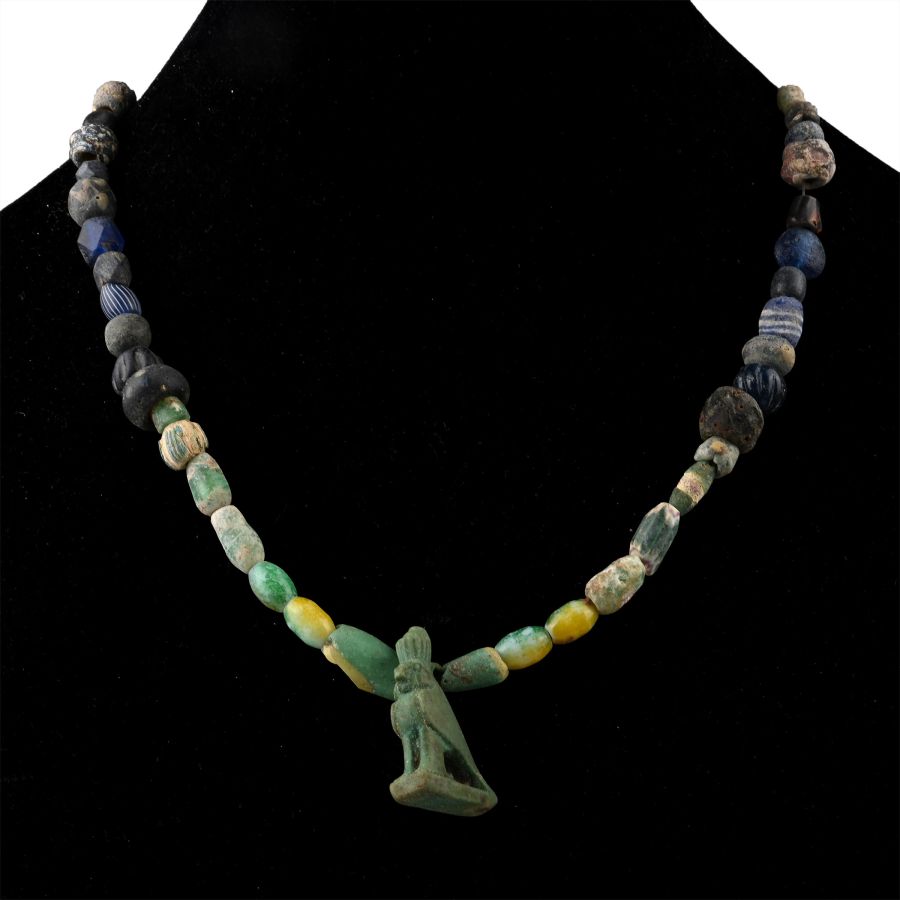
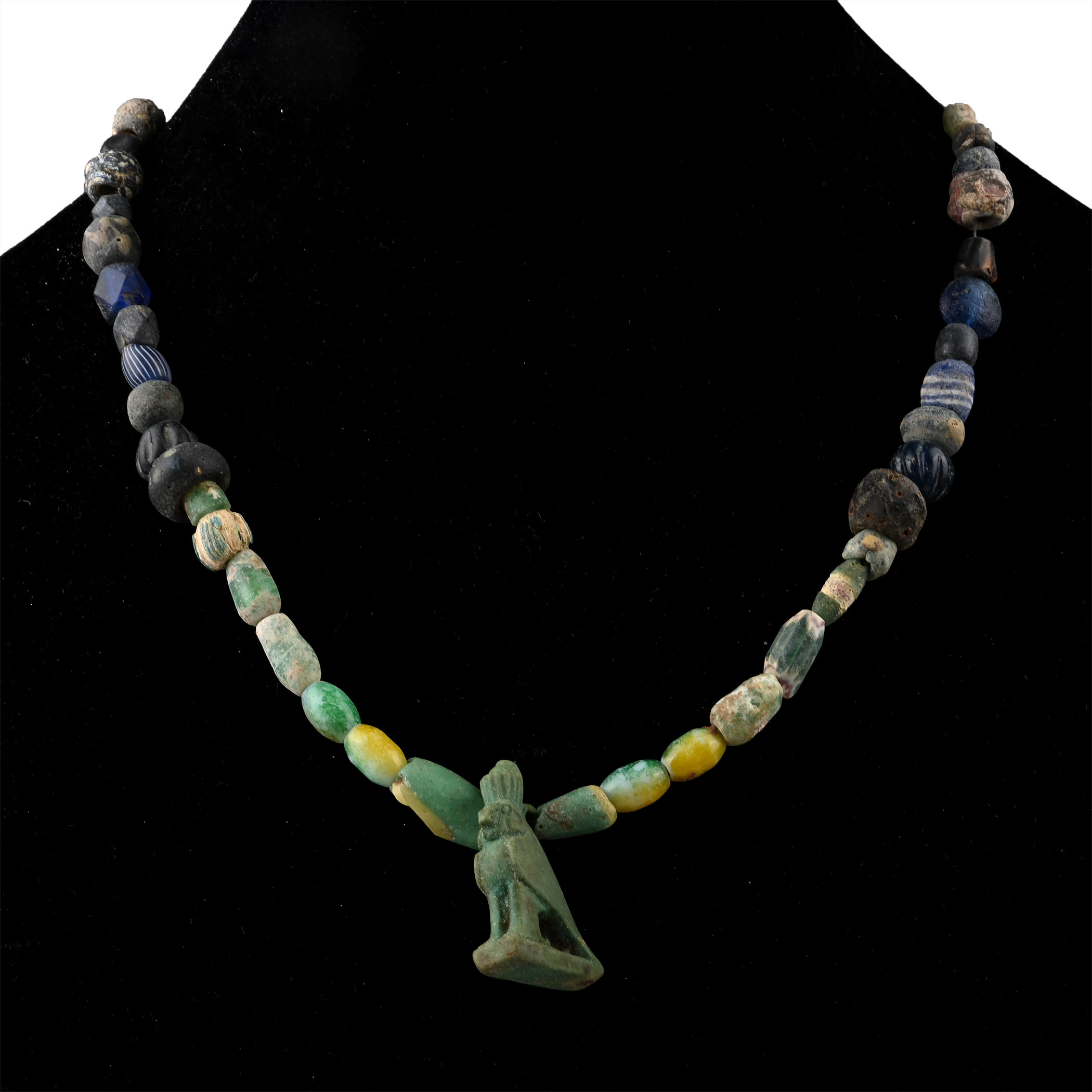
Egyptian Faience and Glass Bead Necklace String with Later Horus Amulet
LATE PERIOD-ROMAN PERIOD, CIRCA 664-323 A.D. AND LATER
15 in. (43 grams, 38 cm).
Including melon, polyhedral, annular, and other bead types, with a crowned Horus falcon pendant; restrung.
ProvenanceLondon gentleman's collection, 1970-1990s, by descent.
CONDITIONTimeLine Auctions follows a vetting process to ensure the authenticity and legality of all items, reinforcing our commitment to integrity and responsible trading. Each antiquity, antique, and coin lot undergoes thorough examination by a vetting committee of at least ten external specialists, professional trade association members, scientists, and archaeologists: Our Vetting Process
AUCTIONS:
TimeLine is a leading auction house specialising in antiquities, ancient art, collectables, natural history, coins, medals, and books. Our auctions offer museums, collectors, historians, and enthusiasts the opportunity to acquire unique and historically significant pieces.
LOT 0576
Egyptian Faience and Glass Bead Necklace String with Later Horus Amulet
Estimate £150 - 200€170 - 230 (for guidance only)$200 - 270 (for guidance only)
Opening Bid
£75 (EUR 87; USD 101) +BP*
-
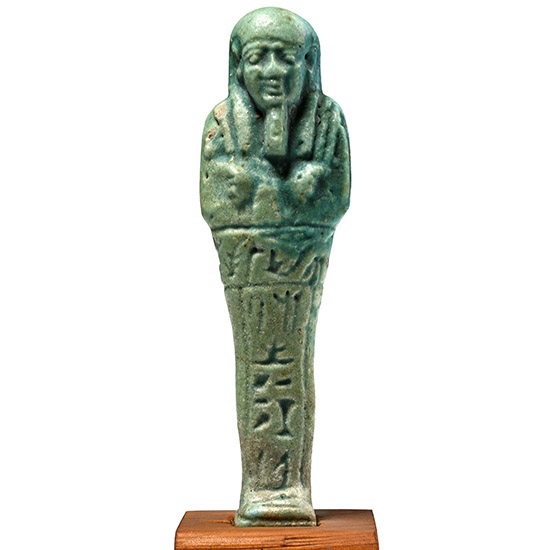
Egyptian Blue Glazed Faience Shabti of the Royal Scribe Aahmes
Persian Period, circa 6th century B.C.Estimate: £500 - 700 (+bp*)
Bids: 3 | Current Bid: £110
Mummiform figure wearing a lappet wig and long false beard, arms crossed over the chest; the left hand holds a pick, the right a hoe, and a cord from a small seed bag hangs over the shoulder; plain dorsal pillar; a T-form hieroglyphic text arrangement on the lower body, with the horizontal line reading: 'The illuminated one, the Osiris, the royal scribe Aahmes,' and the central column 'born to Hotep-Bastet, true of voice'; with a wooden display stand bearing the legend 'Ushabti of Aahmes, Royal Scribe, Persian period'. 44.7 grams, 10.7 cm (62.2 grams total, 12.2 cm including stand)
Acquired Herne Bay High Street, circa February 1957, for 2 shillings and sixpence. From the private collection of Peter Clayton, FCILIP, Dip, Arch, FSA, FRNS, Hemel Hempstead, Hertfordshire, UK; formed since the late 1950s. Accompanied by an old handwritten information card by Peter Clayton, collection no.4. -
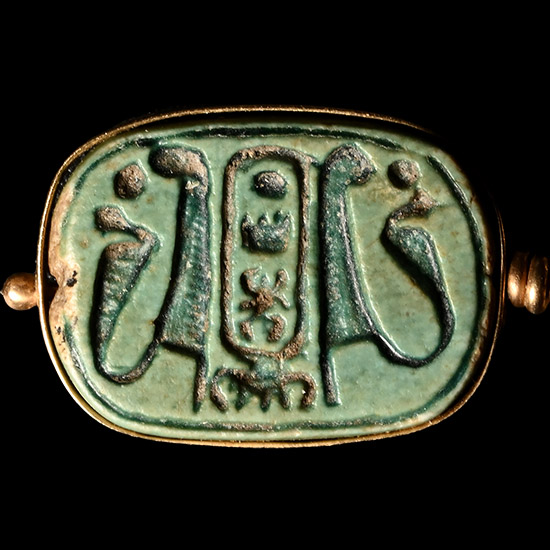
Egyptian Blue Faience Scarab with Cartouche of Thutmosis III in Gold Loop
Late Period, 664-332 B.C.Estimate: £600 - 800 (‡+bp*)
Bids: 1 | Current Bid: £300
Ellipsoid in plan, with a gold frame to the edge, a mounting loop, and a granule finial; obverse with a cartouche of Thutmosis III flanked by addorsed uraei attached to Maat feathers; reverse with an advancing lion, with the hieroglyphs for 'lord of the two lands' behind it and those for 'good god' over its body, facing another cartouche of Thutmosis III. 2.43 grams, 29 mm
Private collection of Kal Noselson, New York, acquired between 1976 and the late 1990s; thence by descent. Accompanied by the collector's original inked images. -
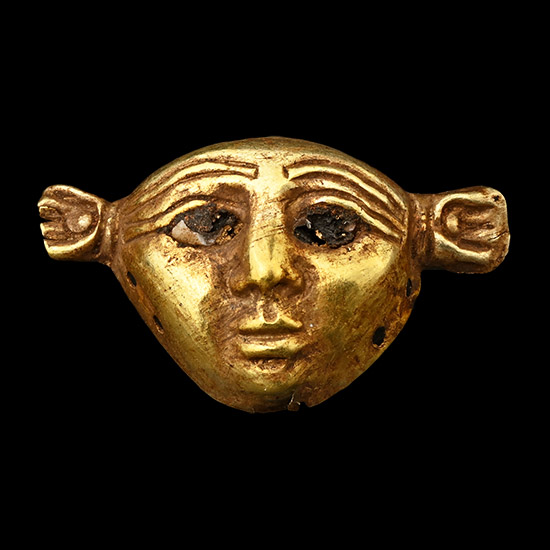
Egyptian Gold Hathor Face Mask
Late Period-Ptolemaic Period, circa 664-30 B.C.Estimate: £1,800 - 2,400 (+bp*)
Opening Bid: £900
Depicted as a woman's head with cow ears, her eyebrows and cosmetic lines carefully defined, with her eyes retaining traces of inlay. 0.96 grams, 28 mm
From the collection of a UK gentleman, London, UK, by descent from his family collection 1970s.
This particular appearance of Hathor, with a human head and cow ears, often appears on columns, particularly in temples associated with goddesses or mammisi-temples ("birth houses"), which were devoted to the birth of a goddess's divine son. The form also appears in the decoration of sistra used in Hathoric and birth-related rituals. Therefore, this diminutive gold image embodies Hathor's symbolic protective potency in all matters maternal.
