
Loading, please wait...
_900x900.jpg "Egyptian Faience Amulet of Tawaret")
_200x200.jpg "Egyptian Faience Amulet of Tawaret")
.jpg "Egyptian Faience Amulet of Tawaret")
LOT 0501
Egyptian Faience Amulet of Tawaret
664-332 B.C.
2 in. (7.9 grams, 50 mm).
Modelled in the round, with a dorsal pillar and a loop at the shoulder, the goddess is in hippopotamus form, with a human torso and arms and a crocodile tail.
ProvenancePrivate collection, Carouge, Switzerland, assembled in the 1980s-1990s.
Thence by descent to the collection of Mr S.P., since 2020.
Cf. Andrews, C., Amulets of Ancient Egypt, London, 1994, item 31b.
CONDITIONTimeLine Auctions follows a vetting process to ensure the authenticity and legality of all items, reinforcing our commitment to integrity and responsible trading. Each antiquity, antique, and coin lot undergoes thorough examination by a vetting committee of at least ten external specialists, professional trade association members, scientists, and archaeologists: Our Vetting Process
AUCTIONS:
TimeLine is a leading auction house specialising in antiquities, ancient art, collectables, natural history, coins, medals, and books. Our auctions offer museums, collectors, historians, and enthusiasts the opportunity to acquire unique and historically significant pieces.
LOT 0501
Egyptian Faience Amulet of Tawaret
Estimate £350 - 450€410 - 520 (for guidance only)$470 - 610 (for guidance only)
-
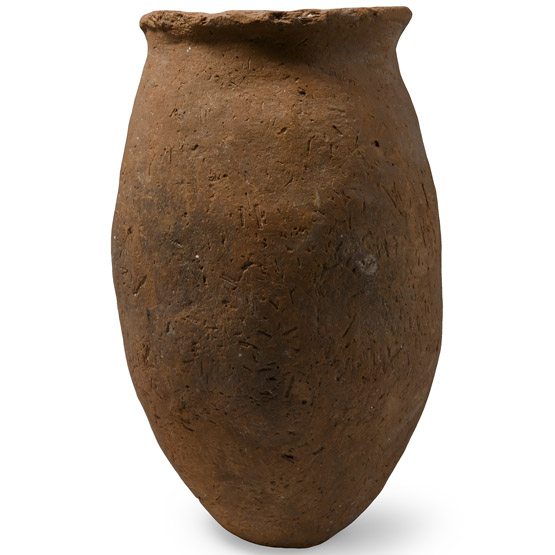
Egyptian Predynastic Terracotta Jar
3500-3100 B.C.Sold for (Inc. bp): £234
Piriform in profile with flared rim; marked with collector's reference to base '2348'. 1.14 kg, 21 cm
Private collection, London, UK. Acquired on the UK art market, 2003. -
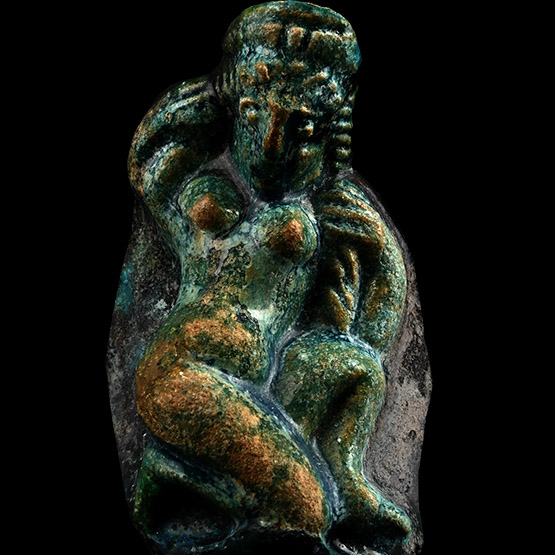
Egyptian Applique with Aphrodite
Ptolemaic Period, 332-30 B.C.Estimate: £400 - 600 (‡+bp*)
Opening Bid: £222
Fragment from a representation of the nude Aphrodite in high-relief, crouching with her left knee raised and her right knee touching the ground, holding her long hair with her hands and wearing a diadem on her head; an appliqué from a vessel with minor filling at the right thigh. 85 grams, 86 mm
Private collection, Somerset, England. with M.B., Los Angeles County, acquired 2014-2015 at a sale in the UK. with Ancient Resource, USA, Auction 70, 06 October 2018, no.7. This lot has been checked against the Interpol Database of stolen works of art and is accompanied by a search certificate number no.12827-240895. -
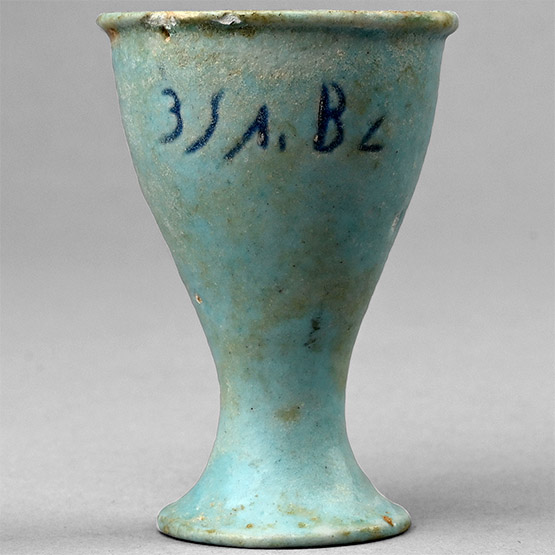
Egyptian Blue Faience Offering Cup with Inscription
Late Period-Ptolemaic Period, 664-30 B.C.Sold for (Inc. bp): £1,170
Conical in profile with a wide base and a shallow interior hollow; inscription in a darker blue glaze, consisting of a single line of demotic-script text. 57 grams, 62 mm
Mariaud de Serres, Drouot, Paris, 1999. with Christie’s, New York, 5-6 December 2001, no.354. Accompanied by copies of the relevant Christie's catalogue pages.
Demotic script was an ancient Egyptian writing system that was used from approximately the 7th century B.C. to the 4th century A.D. It represented a more simplified and cursive form of writing compared to hieroglyphs and hieratic script. Demotic text was employed for a wide range of purposes in ancient Egypt, including administrative, legal, religious, and literary documents. Deciphering Demotic has played a pivotal role in enhancing our understanding of ancient Egyptian culture, history, and everyday life.
