
Loading, please wait...


LOT 0050
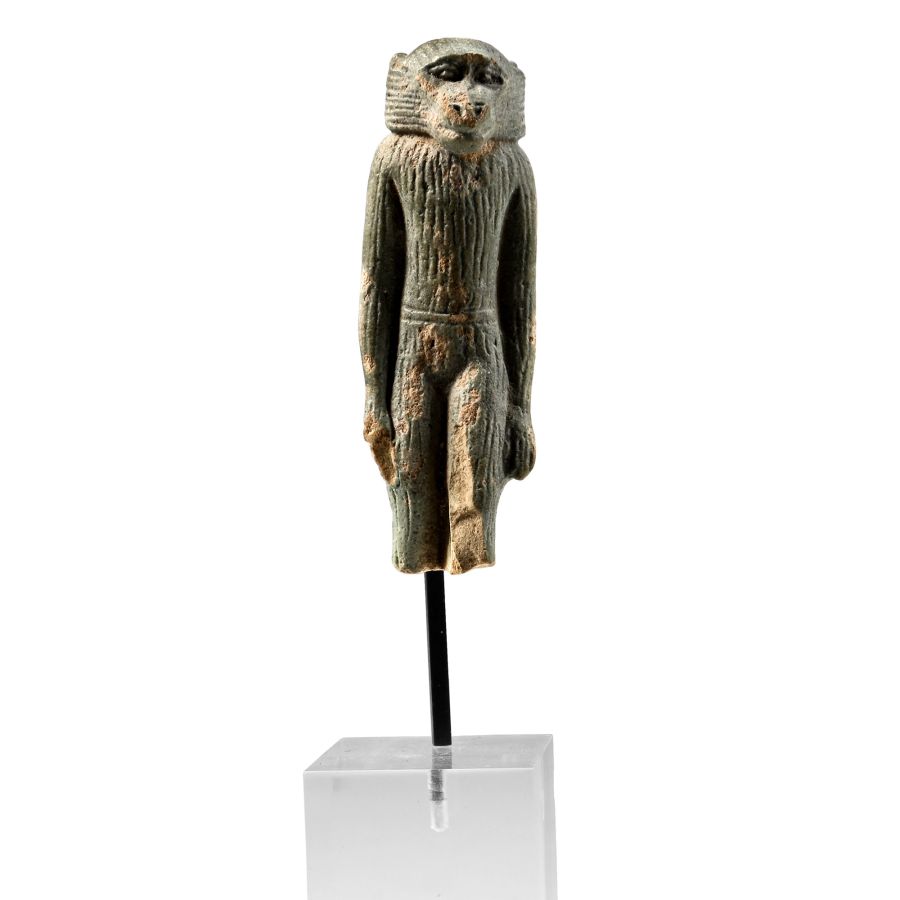
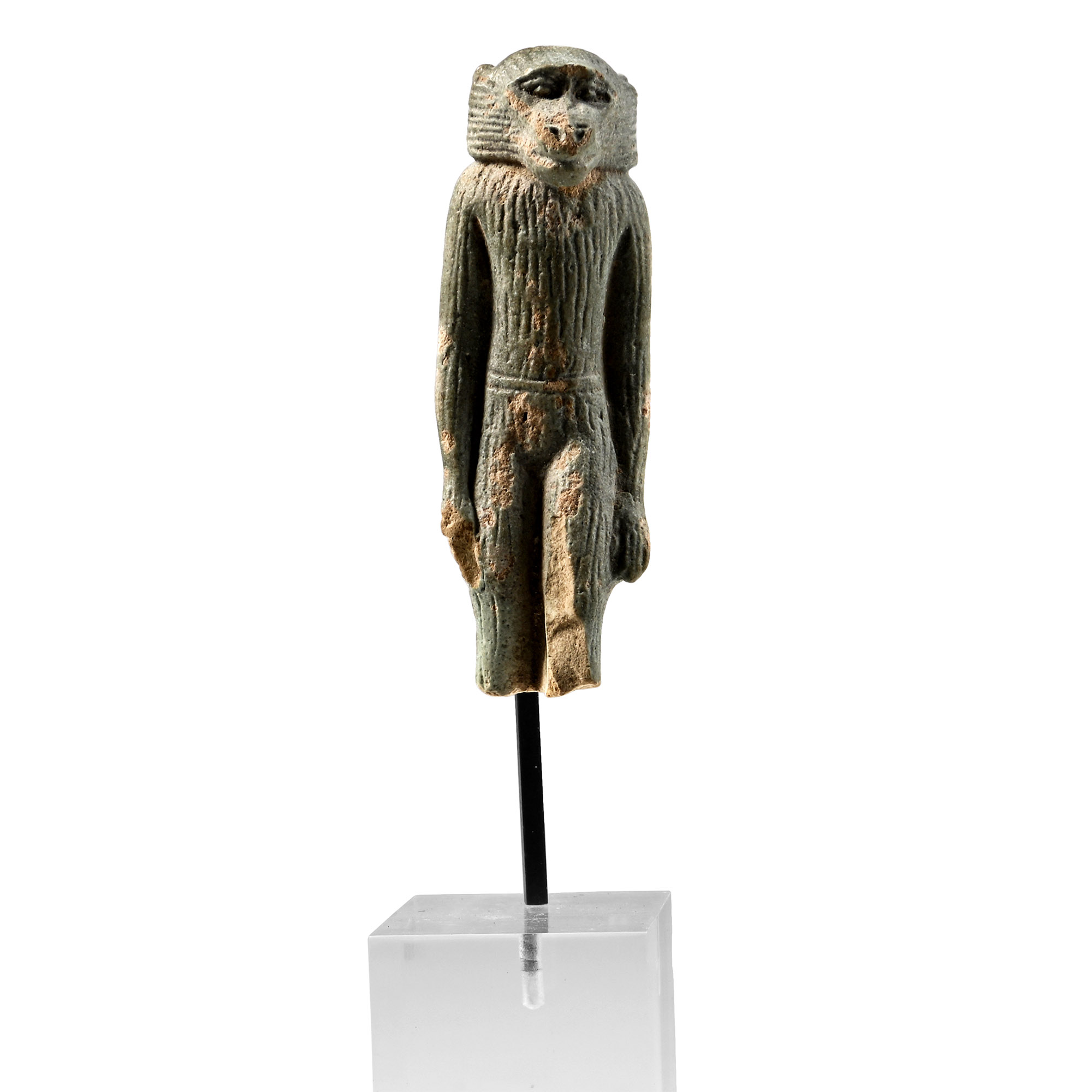
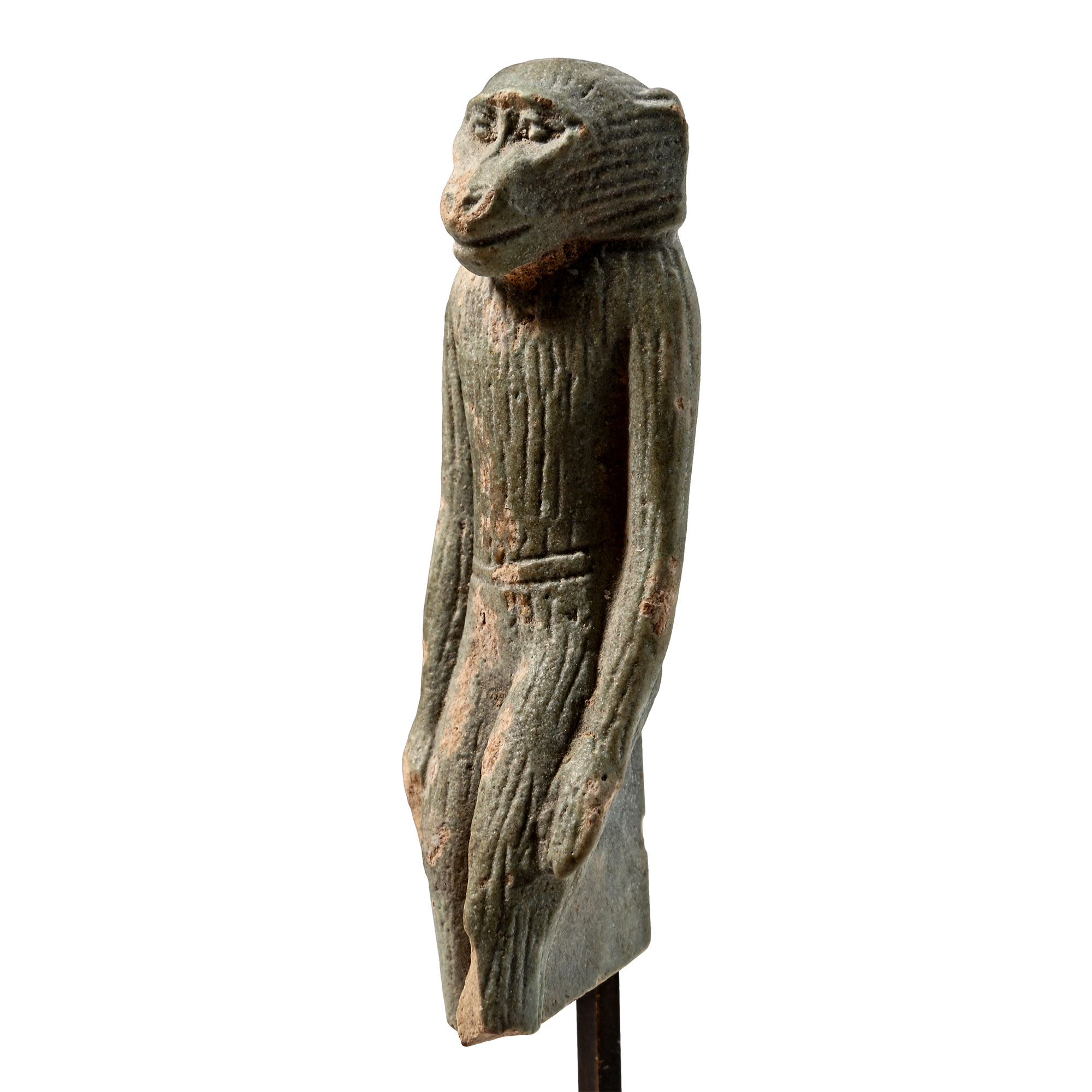
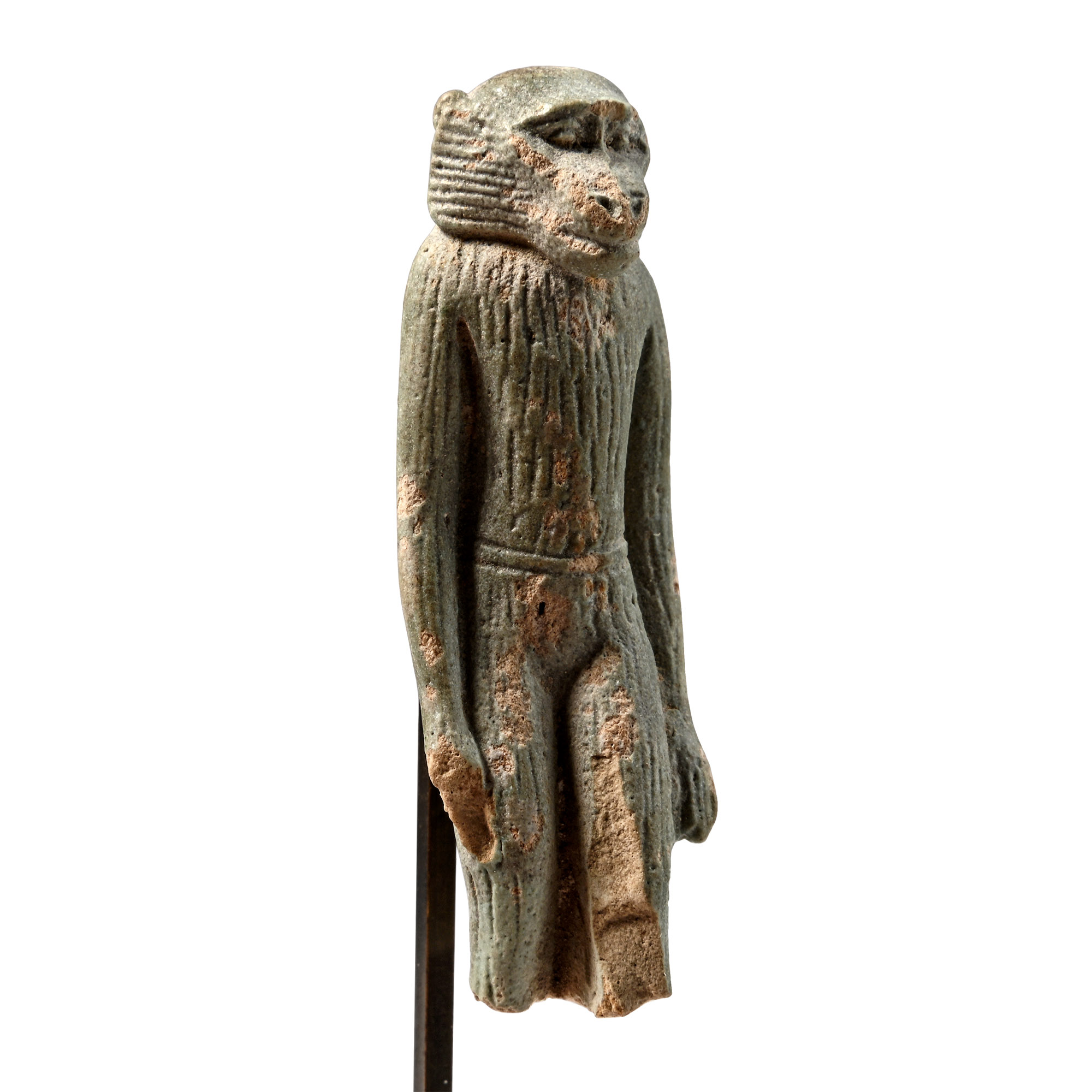
Egyptian Faience Amulet in the Shape of a Striding Monkey
LATE PERIOD, 664-332 B.C.
2 1/4 in. (5 3/8 in.) (68.9 grams total, amulet: 57 mm, 13.5 cm high including stand).
Formed as a striding African savannah monkey (Chlorocebus aethiops), or grivet, with human proportions but monkey hair texture; long arms hanging close to the body, hands extended downward; an incised belt at the waist; a suspension loop at the reverse (repaired); with a custom-made stand.
ProvenancePrivate collection of an English amateur archaeologist (1849-1927), thence by descent.
with Bonhams Auction, 5 October 2011, no.360.
Thereafter, private collection of Erika (1934-2025) and Jakob (1927-2025) Binkert, Binningen, Switzerland; acquired in 2012 from Jean-David Cahn AG, exhibition Aegyptiaca, Basel.
Thence by descent.
Cf. Reisner, G.A., Catalogue général des antiquités égyptiennes du Musée du Caire, Nos.12528-13595, Vol. II, Amulets, Cairo, 1958, pls. II and XXI, no. 12575, for the type.
FootnotesIn the minds of the ancient Egyptians, male monkeys' behaviour may have linked them to masculinity, suggesting that, when worn as an amulet, they could have served a magical role in the reproductive cycle, facilitating birth in this life and rebirth in the afterlife. Alternatively, the prolonged care that females provide for their offspring may have linked the monkey with maternal protection and fertility. These associations may have been reinforced here by the monkey’s greenish faience, which symbolised renewal.
CONDITIONTimeLine Auctions follows a vetting process to ensure the authenticity and legality of all items, reinforcing our commitment to integrity and responsible trading. Each antiquity, antique, and coin lot undergoes thorough examination by a vetting committee of at least ten external specialists, professional trade association members, scientists, and archaeologists: Our Vetting Process
AUCTIONS:
TimeLine is a leading auction house specialising in antiquities, ancient art, collectables, natural history, coins, medals, and books. Our auctions offer museums, collectors, historians, and enthusiasts the opportunity to acquire unique and historically significant pieces.
LOT 0050
Egyptian Faience Amulet in the Shape of a Striding Monkey
Estimate £1,200 - 1,700€1,390 - 1,970 (for guidance only)$1,620 - 2,300 (for guidance only)
Opening Bid
£675 (EUR 783; USD 911) ‡+BP*
-
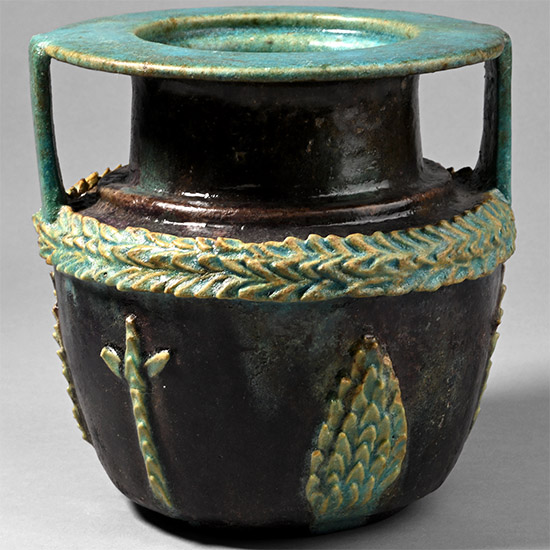
Egyptian Turquoise and Cobalt Blue Faience Amphora
Roman Period, circa 2nd century A.D.Estimate: £8,000 - 10,000 (+bp*)
Opening Bid: £4,000
Barrel-shaped in profile, with a stepped shoulder, wide neck, and broad, flared flange rim at the mouth, supported by two lateral strap handles; applied wreath decoration to the outer edge of the shoulder and vertical fronds to the lower body; restored. 1.48 kg, 17.8 cm high
Stift Neuberg (Neuberg Abbey) collection, Heidelberg, Germany, by 1893 and into the 20th century. Anonymous sale; Münzen und Medaillen, Auktion 41, 1972, no.151. Fiorella Cottier-Angeli collection, Geneva, 1981-2007. Herbert A. Cahn, acquired from the above. With Galerie Günter Puhze, Freiburg, 2007. Private collection, Midwest USA, acquired in 2007. This lot has been checked against the Interpol Database of stolen works of art and is accompanied by search certificate no.13477-262436.
Stift Neuberg was privately owned from 1798 until 1926. By 1893, a collection of antiquities had been assembled there, and its Greek and Roman holdings were published. It is believed that the amphora was acquired as part of this collection by Friedrich Alexander von Bernus (1838–1908), who inherited Stift Neuberg from his relative Johann Friedrich Schlosser (1780-1851), a nephew of Goethe. In 1926, the abbey was sold to the Benedictines and has remained a religious establishment ever since. -
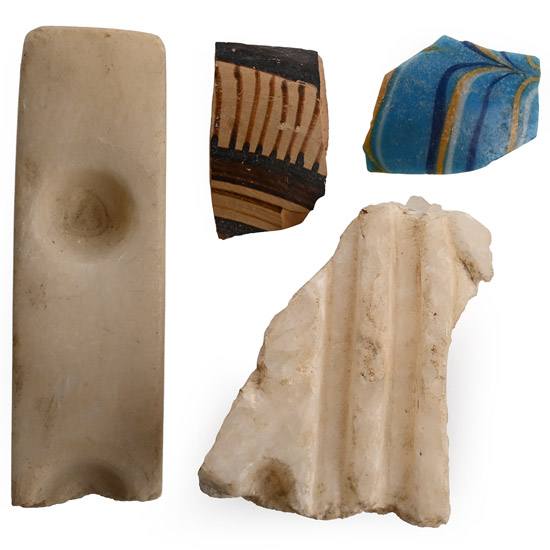
Egyptian Alabaster and Ceramic Group
New Kingdom, 18th Dynasty, Amarna Period, 1353-1336 B.C.Estimate: £60 - 80 (+bp*)
Opening Bid: £5
Comprising: an alabaster fragment with two deeply incised lines and part of a hieroglyph; a portion of a narrow rectangular inkwell with two feet on the underside; a fragment of an opaque blue glass vessel with dark blue, yellow and white decoration; and a fragment of a decorated Mycenaean vessel. 94 grams total, 29-78 mm
From the private collection of Peter Clayton, FCILIP, Dip, Arch, FSA, FRNS, Hemel Hempstead, Hertfordshire, UK; formed since the late 1950s. -
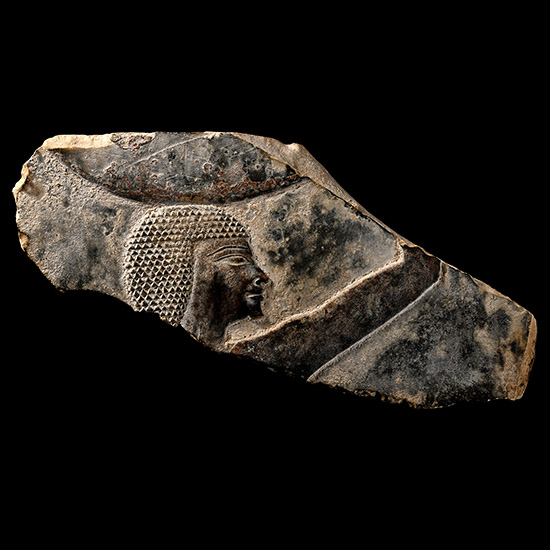
Egyptian Limestone Relief Fragment of a Man
26th Dynasty, 664-525 B.C.Estimate: £1,000 - 1,400 (+bp*)
Bids: 1 | Current Bid: £5
An irregular, elongated limestone fragment intricately carved in low, raised relief, depicting the head and neck of a male figure facing right, wearing a tightly curled wig and a short beard, his arm extended upwards, likely to support the large basket resting on his head. 180 grams total including stand, fragment: 14.5 cm wide
From the private collection of Peter Clayton, FCILIP, Dip, Arch, FSA, FRNS, Hemel Hempstead, Hertfordshire, UK; formed since the late 1950s.
The downturned eyebrow above an almond-shaped eye with a sharply defined eyelid and a long, thin cosmetic line, the small, fairly rounded nose with a lightly drilled nostril above rather thick lips, and the chin below obscured by the short beard are characteristic of the archaising style of the early 26th Dynasty. Artisans of that period adapted and refined earlier Old Kingdom artistic traditions, most apparent in the tomb scenes of high officials at Thebes, particularly those of Montuemhat (see the discussion: der Manuelian, P., 'Two Fragments of Relief and a New Model for the Tomb of Montuemhet at Thebes', Journal of Egyptian Archaeology 71 (1985), pp. 98–121).
