
Loading, please wait...
LOT 0508
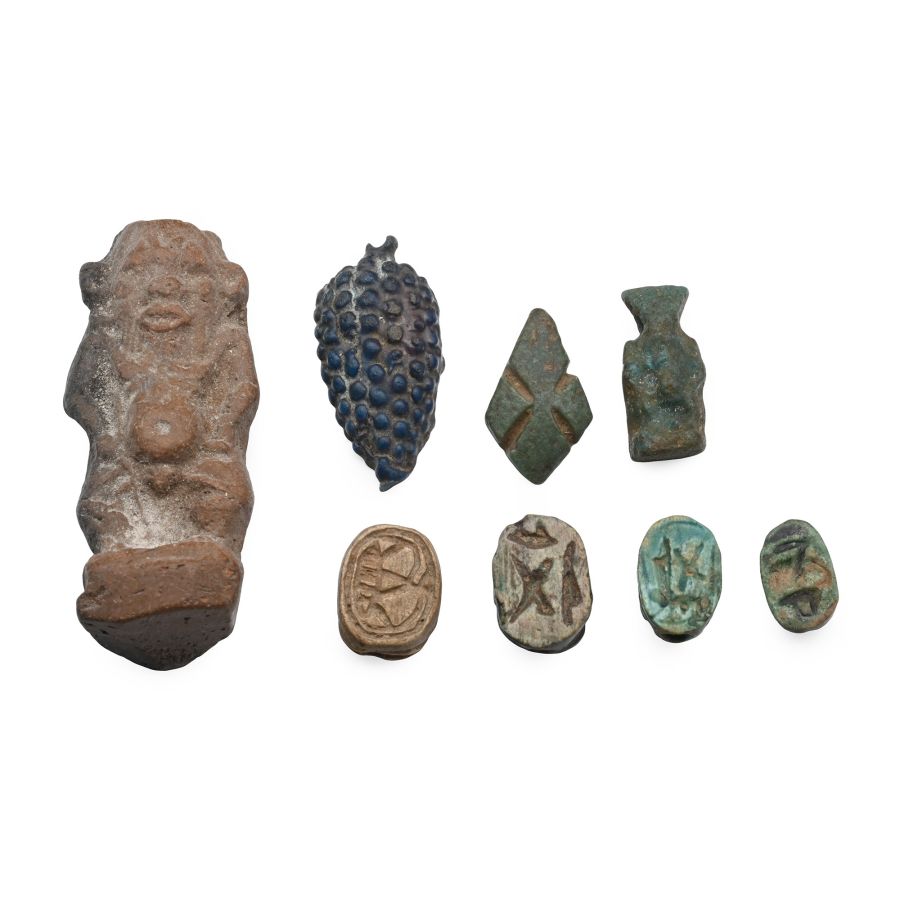
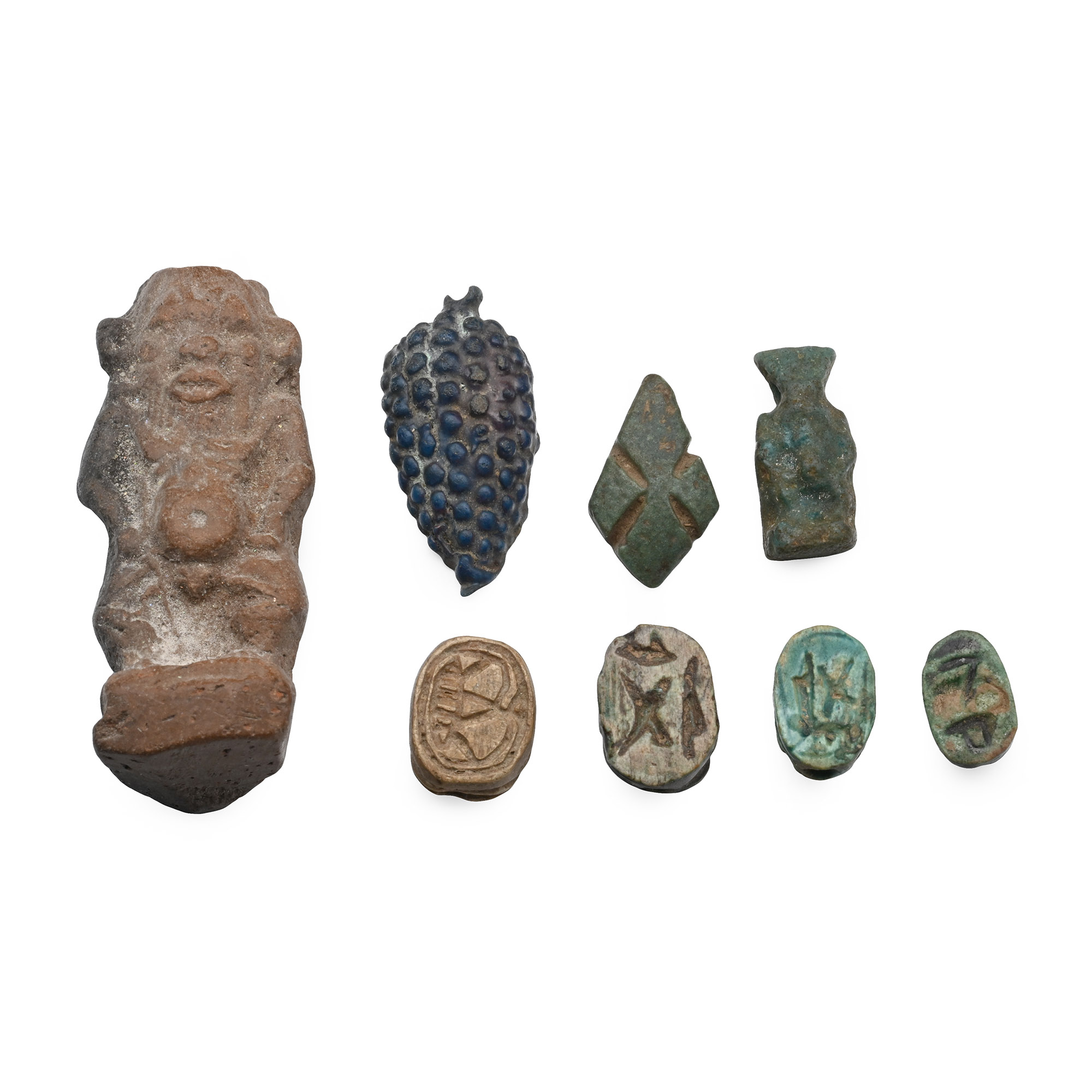
Egyptian Faience Amulet Group
NEW KINGDOM-PTOLEMAIC PERIOD, 1550-30 B.C.
3/8 - 1 1/2 in. (11 grams total, 9-38 mm).
Comprising a large standing Bes statuette on a rectangular base and a smaller Bes pierced for suspension; four scarabs with detailing to the upper face and incised signs and motifs on the underside; a tear-shaped bunch of grapes with a broken suspension loop; a lozenge-shaped pierced for suspension. [8, No Reserve]
ProvenanceFrom the Walter Thomas Gaze Cooper (1895-1980) collection; thence by descent.
LiteratureCf. Lacovara, P., and Markowitz, Y.J., Jewels of the Nile: Ancient Egyptian Treasures from the Worcester Art Museum, Worcester MA, 2020, p. 155, for a similar grape bunch pendant.
CONDITIONTimeLine Auctions follows a vetting process to ensure the authenticity and legality of all items, reinforcing our commitment to integrity and responsible trading. Each antiquity, antique, and coin lot undergoes thorough examination by a vetting committee of at least ten external specialists, professional trade association members, scientists, and archaeologists: Our Vetting Process
AUCTIONS:
TimeLine is a leading auction house specialising in antiquities, ancient art, collectables, natural history, coins, medals, and books. Our auctions offer museums, collectors, historians, and enthusiasts the opportunity to acquire unique and historically significant pieces.
-
.jpg)
Egyptian Faience Amulet of Nefertum
Late Period, 664-332 B.C.Sold for (Inc. bp): £78
In a striding pose with arms at the sides, sporting a black coloured tripartite wig surmounted by the god's distinctive headdress consisting of a lotus flower with two plumes on top; mounted on a display stand. 10.66 grams total, 50 mm including stand
Ex H Norri collection, Milton Keynes, Bedfordshire, UK, 1980s-1990s. -
.jpg)
Egyptian Steatite Heart Scarab
Late Period, 664-332 B.C.Sold for (Inc. bp): £143
With ribbed carapace and suspension loop to underside. 2.89 grams, 22 mm
Acquired on the European art market in the early 2000s. with Galerie Rhéa, Zurich, Switzerland. -
.jpg)
Large Egyptian Blue Faience Roundel for Ramesses II
New Kingdom, 19th Dynasty, 1295-1186 B.C.Estimate: £10,000 - 14,000 (+bp*)
Opening Bid: £5,000
A fitting or pommel made for King Ramesses II, his throne name (User-Maat-Re Setep-en-Re) inscribed within a cartouche topped by two ostrich feathers framing a solar disc; the cartouche positioned above the hieroglyphic sign nbw, which signifying 'gold' and alluded to the luminous radiance of the royal name; two uraei flanking the cartouche, wearing the White Crown of Upper Egypt and the Red Crown of Lower Egypt, respectively; the throne name roughly translating as 'The justice of Re is powerful, chosen of Re'; a square-shaped socket located at the back for attachment; mounted on a custom-made display stand. 475 grams total, 14 cm including stand
Formerly with G. Janes, Manchester, UK and collection Galerie Nefer. Previously with Cybele Galerie Librairie Egyptologie, Paris, France. From an important English collection. Accompanied by an academic report by Dr Alberto Maria Pollastrini. Accompanied by a copy of the Cybele invoice. This lot has been checked against the Interpol Database of stolen works of art and is accompanied by search certificate number no.10740-177442.
The epithet part of the throne name Setep en Re appears in Ramesses II's royal titulary from Year 2 of his reign. The two rearing cobras, which symbolise the goddesses Nekhbet and Wadjet, also represent the unity of the Two Lands under Ramesses II's rule. A similar green faience fitting bearing Ramesses II's throne name is kept in the Archaeological Collection of Zürich (inv. no. 3702). Similar objects linked to the 18th Dynasty kings Akhenaten and Ay show that such fittings were not limited to the 19th Dynasty. They may even have influenced later designs, as the fitting of King Ay, possibly from a piece of heirloom furniture, was found among the tomb goods of Nefertari, Ramesses II’s “Chief Queen”.
