
Loading, please wait...

LOT 0516
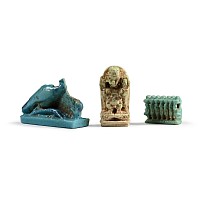
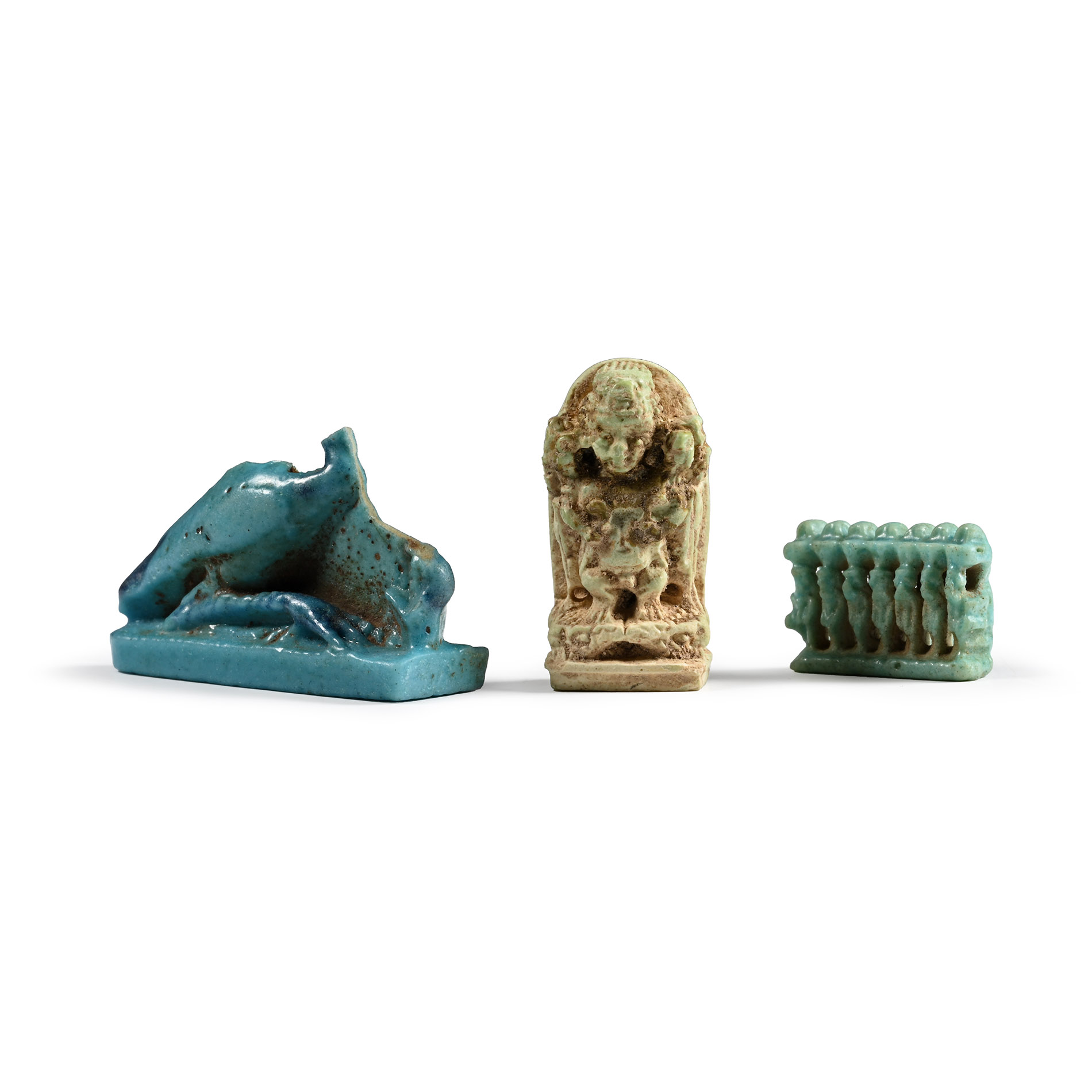
Egyptian Faience Amulet Collection
1ST MILLENNIUM B.C.
5/8 - 1 1/4 in. (6.5 grams total, 16-30 mm).
Comprising: an amuletic bead consisting of a row of seven Taweret figures on a rectangular base, pierced longitudinally; a seated ibis before a diminutive figure of Maat on a tongue-shaped base; a cippus amulet composed of the figure of Pataikos standing on two crocodiles, with two hawks perched on his shoulders, a scarab on his head, flanked by the figures of Isis and Nephthys, and on the back, a winged goddess standing on the crocodiles' tails. [3]
ProvenanceAcquired in the mid 1980s-1990s.
Private collection, Switzerland, thence by descent.
Private collection, since the late 1990s.
Cf. Reisner, G.A., Catalogue général des antiquités égyptiennes du Musée du Caire, Nos.12528-13595, Vol. II, Amulets, Cairo, 1958, pls. IX, XXV, for beads composed of multiple divine figures; Andrews, C., Amulets of Ancient Egypt, London, 1994, p.24, Fig. 21f, for a seated ibis amulet, and pp. 37-39, Figs. 34-35, for examples and discussion of the cippus-type amulet.
CONDITIONTimeLine Auctions follows a vetting process to ensure the authenticity and legality of all items, reinforcing our commitment to integrity and responsible trading. Each antiquity, antique, and coin lot undergoes thorough examination by a vetting committee of at least ten external specialists, professional trade association members, scientists, and archaeologists: Our Vetting Process
AUCTIONS:
TimeLine is a leading auction house specialising in antiquities, ancient art, collectables, natural history, coins, medals, and books. Our auctions offer museums, collectors, historians, and enthusiasts the opportunity to acquire unique and historically significant pieces.
LOT 0516
Egyptian Faience Amulet Collection
Estimate £450 - 650€520 - 750 (for guidance only)$610 - 880 (for guidance only)
-
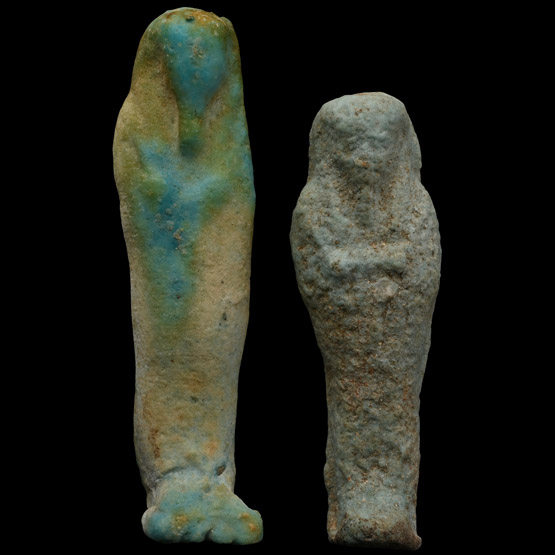
Egyptian Faience Shabti Group
Ptolemaic Period, 332-30 B.C.Sold for (Inc. bp): £117
Comprising two blue mummiform figures with their arms crossed at the chest and wearing a tripartite wig and a false beard. 20 grams total, 58-68 mm
Ex H Norri collection, Milton Keynes, Bedfordshire, UK, 1980s-1990s. -
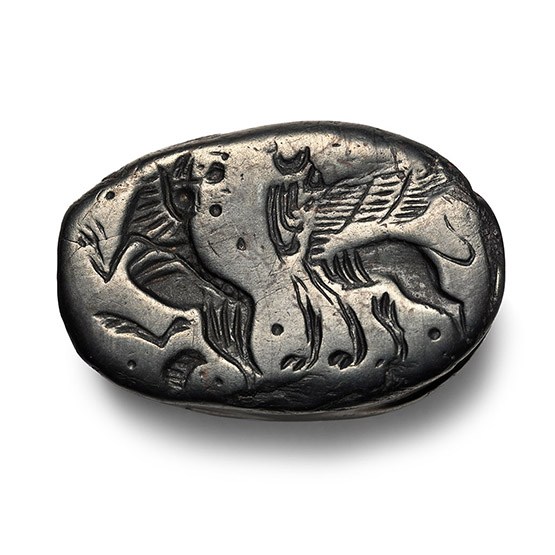
Egypto-Phoenician Haematite Scaraboid Seal
Circa 5th century B.C.Estimate: £2,000 - 3,000 (‡+bp*)
Opening Bid: £1,000
With rampant lion and statant winged gryphon. 8.35 grams, 21 mm
Acquired in the mid 1980s-1990s. Private collection, Switzerland, thence by descent. Private collection, since the late 1990s. Accompanied by a copy of an Art Loss Register certificate, no.3095.WW. This lot has been checked against the Interpol Database of stolen works of art and is accompanied by a search certificate number no.12715-234628. -
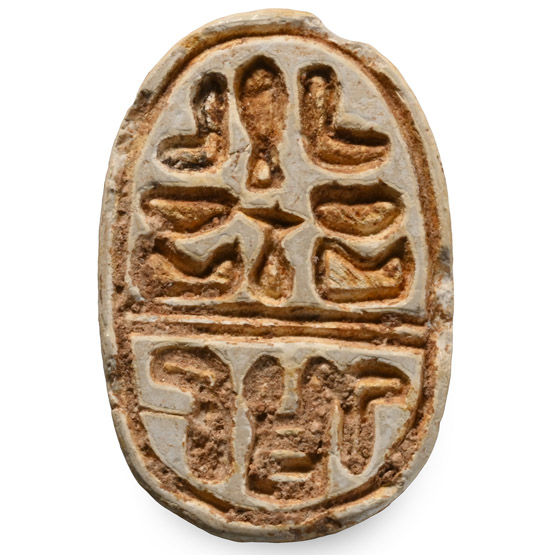
Egyptian White Stone Scarab with Hieroglyphs
Hyksos Period, 15th Dynasty, circa 1650-1550 B.C.Sold for (Inc. bp): £117
Plano-convex in section with scarab detailing to the upper face; underside featuring a hieroglyphic inscription, including addorsed stylised cobras, right-angled netjer and nefer signs; pierced longitudinally. 1.61 grams, 18 mm
Ex Constable collection, 1990s. Ex P. Morris collection.
