
Loading, please wait...

LOT 0506
Egyptian Faience Amulet Collection
1ST MILLENNIUM B.C.
5/8 - 1 1/4 in. (6.5 grams total, 16-30 mm).
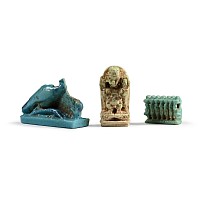
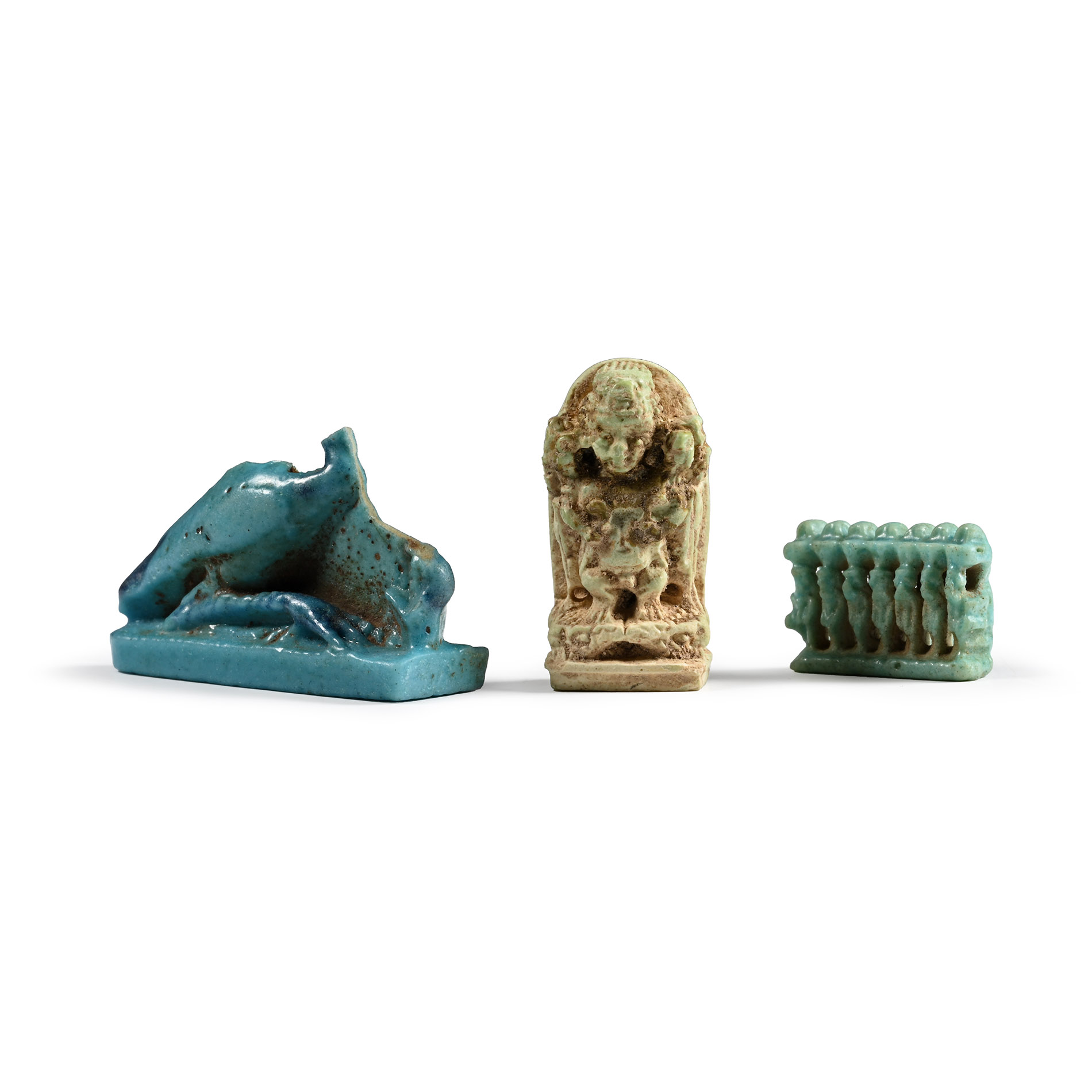
Comprising: an amuletic bead consisting of a row of seven Taweret figures on a rectangular base, pierced longitudinally; a seated ibis before a diminutive figure of Maat on a tongue-shaped base; a cippus amulet composed of the figure of Pataikos standing on two crocodiles, with two hawks perched on his shoulders, a scarab on his head, flanked by the figures of Isis and Nephthys, and on the back, a winged goddess standing on the crocodiles' tails. [3]
ProvenanceAcquired in the mid 1980s-1990s.
Private collection, Switzerland, thence by descent.
Private collection, since the late 1990s.
This lot is accompanied by an illustrated lot declaration signed by the Head of the Antiquities Department, Dr Raffaele D’Amato.
This lot is accompanied by an illustrated lot declaration signed by the Head of the Antiquities Department, Dr Raffaele D'Amato.
Cf. Reisner, G.A., Catalogue général des antiquités égyptiennes du Musée du Caire, Nos.12528-13595, Vol. II, Amulets, Cairo, 1958, pls. IX, XXV, for beads composed of multiple divine figures; Andrews, C., Amulets of Ancient Egypt, London, 1994, p.24, Fig. 21f, for a seated ibis amulet, and pp. 37-39, Figs. 34-35, for examples and discussion of the cippus-type amulet.
CONDITIONTimeLine Auctions follows a vetting process to ensure the authenticity and legality of all items, reinforcing our commitment to integrity and responsible trading. Each antiquity, antique, and coin lot undergoes thorough examination by a vetting committee of at least ten external specialists, professional trade association members, scientists, and archaeologists: Our Vetting Process
AUCTIONS:
TimeLine is a leading auction house specialising in antiquities, ancient art, collectables, natural history, coins, medals, and books. Our auctions offer museums, collectors, historians, and enthusiasts the opportunity to acquire unique and historically significant pieces.
LOT 0506
Egyptian Faience Amulet Collection
Estimate £500 - 700€580 - 810 (for guidance only)$680 - 950 (for guidance only)
-
Egyptian Faience Phallic Figure Amulet
Ptolemaic Period, 332-30 B.C.Sold for (Inc. bp): £130
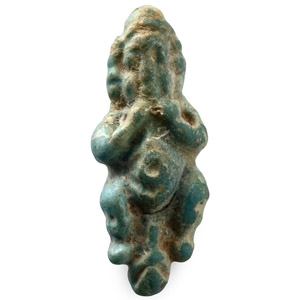
Blue glazed figure of a chubby dwarf with bent legs seated on emphasised phallus, both hands touching the chin, suspension loop to the reverse. 2.43 grams, 29 mm
From an early 20th century collection. This lot is accompanied by an illustrated lot declaration signed by the Head of the Antiquities Department, Dr Raffaele D'Amato. -
Egyptian Faience Amulet Representing Nephthys
Late Period, 664-332 B.C.Sold for (Inc. bp): £182
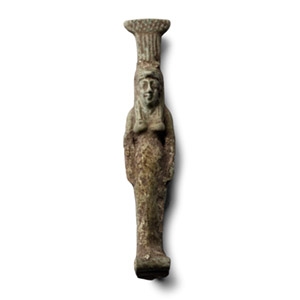
Modelled in the round on a small base, wearing columnar headdress, with dorsal pillar pierced behind the elbows. 4.15 grams, 55 mm
Private collection, Carouge, Switzerland, assembled in the 1980s-1990s. Thence by descent to the collection of Mr S.P., since 2020. This lot is accompanied by an illustrated lot declaration signed by the Head of the Antiquities Department, Dr Raffaele D'Amato.
Nephthys was a protective goddess linked to mourning, magic, and the afterlife. As the sister of Isis, she played a vital role in the funerary rites of Osiris. Amulets like this were placed on the deceased to invoke her protection and aid in rebirth. Typically made of faience or semi-precious stone, they were especially common in the Late Period. -
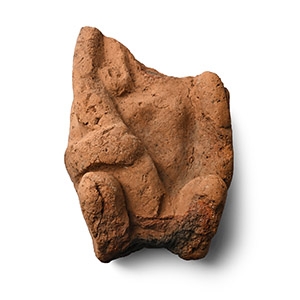
Egyptian Terracotta Fragment of Man Holding Elongated Phallus
Ptolemaic Period, 323-30 B.C.Sold for (Inc. bp): £59
Plano-convex in section with lateral folded legs, lower end of the sidelock at the shoulder, phallus extended across the body. 383 grams, 13 cm
Acquired in London, UK, 1980. From the collection of G.M.R.H., London, UK. This lot is accompanied by an illustrated lot declaration signed by the Head of the Antiquities Department, Dr Raffaele D'Amato.
