
Loading, please wait...
_900x900.jpg "Egyptian Faience Amulet Bust")
_200x200.jpg "Egyptian Faience Amulet Bust")
.jpg "Egyptian Faience Amulet Bust")
LOT 0480
Egyptian Faience Amulet Bust
LATE PERIOD, 664-332 B.C.
3/4 in. (1 1/3 in.) (3.7 grams total, 22 mm high (32 mm high including stand)).
A composition amulet fragment in the form of the head and upper torso of a goddess wearing a long lappet wig and remains of a crown, with stylised detailing to the face; mounted on a custom-made display stand.
ProvenanceFrom an earlier 20th century collection.
with Charles Ede, London, UK, stock number 2700.
Acquired circa 1999-2002.
Property of a South Oxfordshire private collector.
TimeLine Auctions follows a vetting process to ensure the authenticity and legality of all items, reinforcing our commitment to integrity and responsible trading. Each antiquity, antique, and coin lot undergoes thorough examination by a vetting committee of at least ten external specialists, professional trade association members, scientists, and archaeologists: Our Vetting Process
AUCTIONS:
TimeLine is a leading auction house specialising in antiquities, ancient art, collectables, natural history, coins, medals, and books. Our auctions offer museums, collectors, historians, and enthusiasts the opportunity to acquire unique and historically significant pieces.
-
.jpg)
Egyptian Black Hardstone Sphinx
Late Period-Ptolemaic Period, circa 500-31 B.C.Sold for (Inc. bp): £260
An Egyptian or Graeco-Roman hardstone female sphinx modelled in the round, sitting on a sub-rectangular base, her hair tied in a bun on the top of her head, circular socket to the top face behind the head; mounted on a custom-made antique wooden display base. 74 grams total, 50 mm long including base
Fine condition.
From Saqqara in the late 1960s. With John Cummings, Lincolnshire, UK, 1990s. Acquired 20 May 1997. Property of a South Oxfordshire private collector. Accompanied by an original invoice no.6469 dated 20 May 1997. Accompanied by a scholarly note by Egyptologist Paul Whelan.
This type of sphinx amulet is quite rare in Egypt, for instance, the vast output and variety of amulets identified from the Late Period industrial-scale workshops at Naukratis does not include three-dimensional winged sphinxes, only their image impressed in scarabs, suggesting that this example may have been an import and/or once the possession of a Greek person in Egypt. -
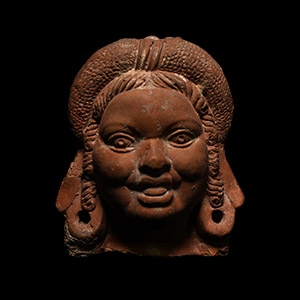
Graeco-Egyptian Head of Baubo Lamp
2nd century B.C.-2nd century A.D.Sold for (Inc. bp): £1,300
A terracotta oil lamp formed as the head of Baubo, with a smiling, plump face, wavy locks and taenia, two circular apertures at either side of her neck, expression formed with semi-naturalistic features and large extended earlobes accommodating circular apertures; circular hole to reverse and oval hole to top of head; trace remains of white gesso; vintage collection label to reverse. 245 grams, 10.4 cm
with ink inscribed label '1.2.27 CAS (22)'. From the deceased estate of N.A.C. Embiriscos, UK, 1950-1969. with Christie's London, 25 April 2001, lot 249. Accompanied by a copy of the relevant Christie's catalogue pages. -
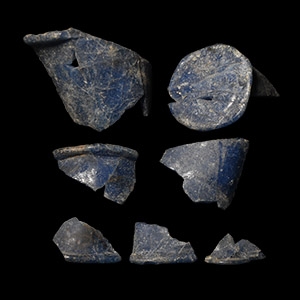
Egyptian Offering Cup Fragment Group
New Kingdom, 1550-1070 B.C.Sold for (Inc. bp): £46
A group of seven deep blue glass fragments from an offering cup. 27 grams total, 21-41 mm
From a UK private collection, 1975-1978.
