
Loading, please wait...
LOT 0412
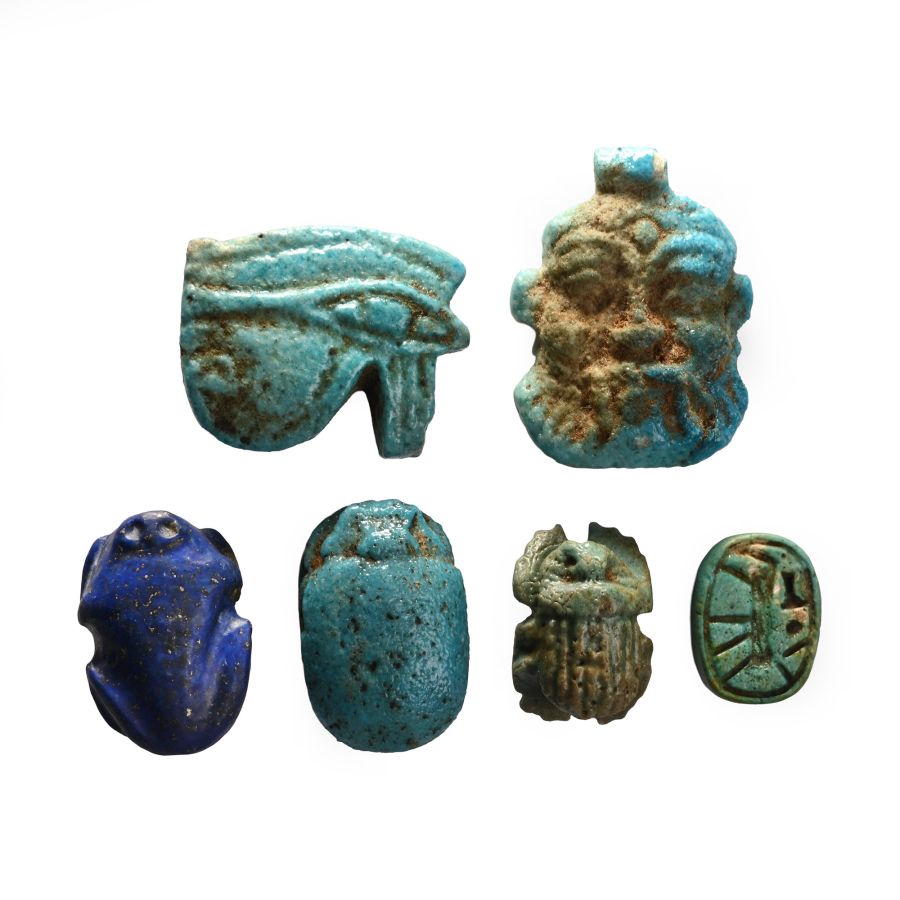
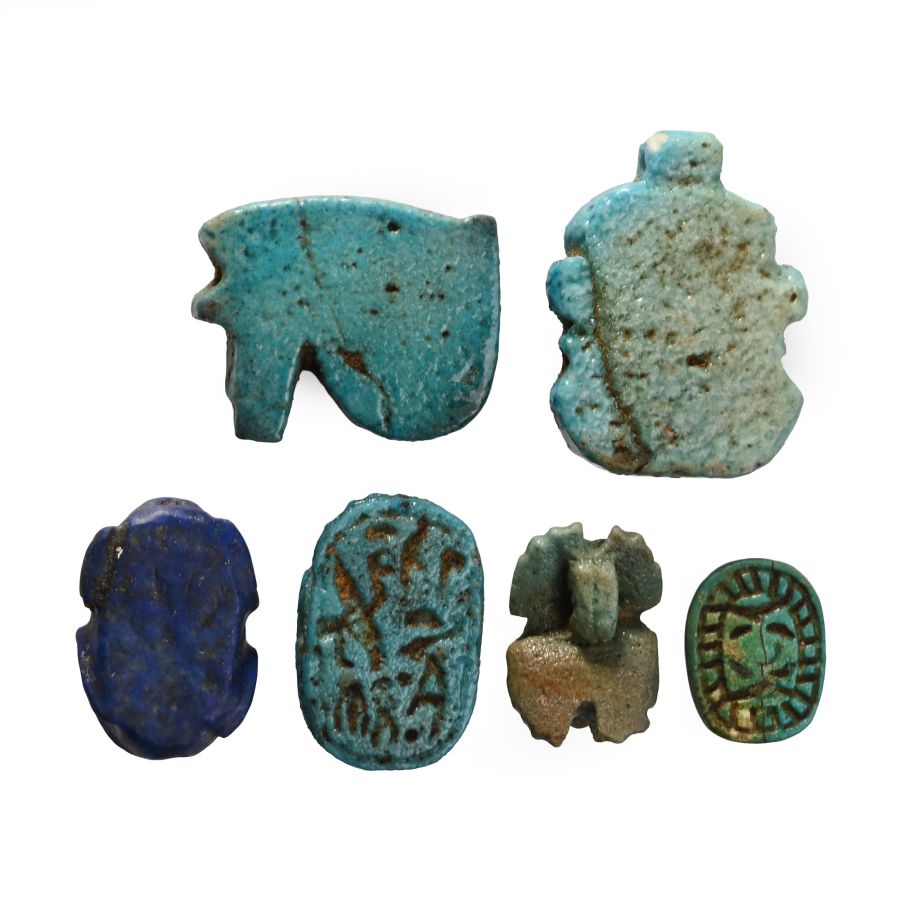
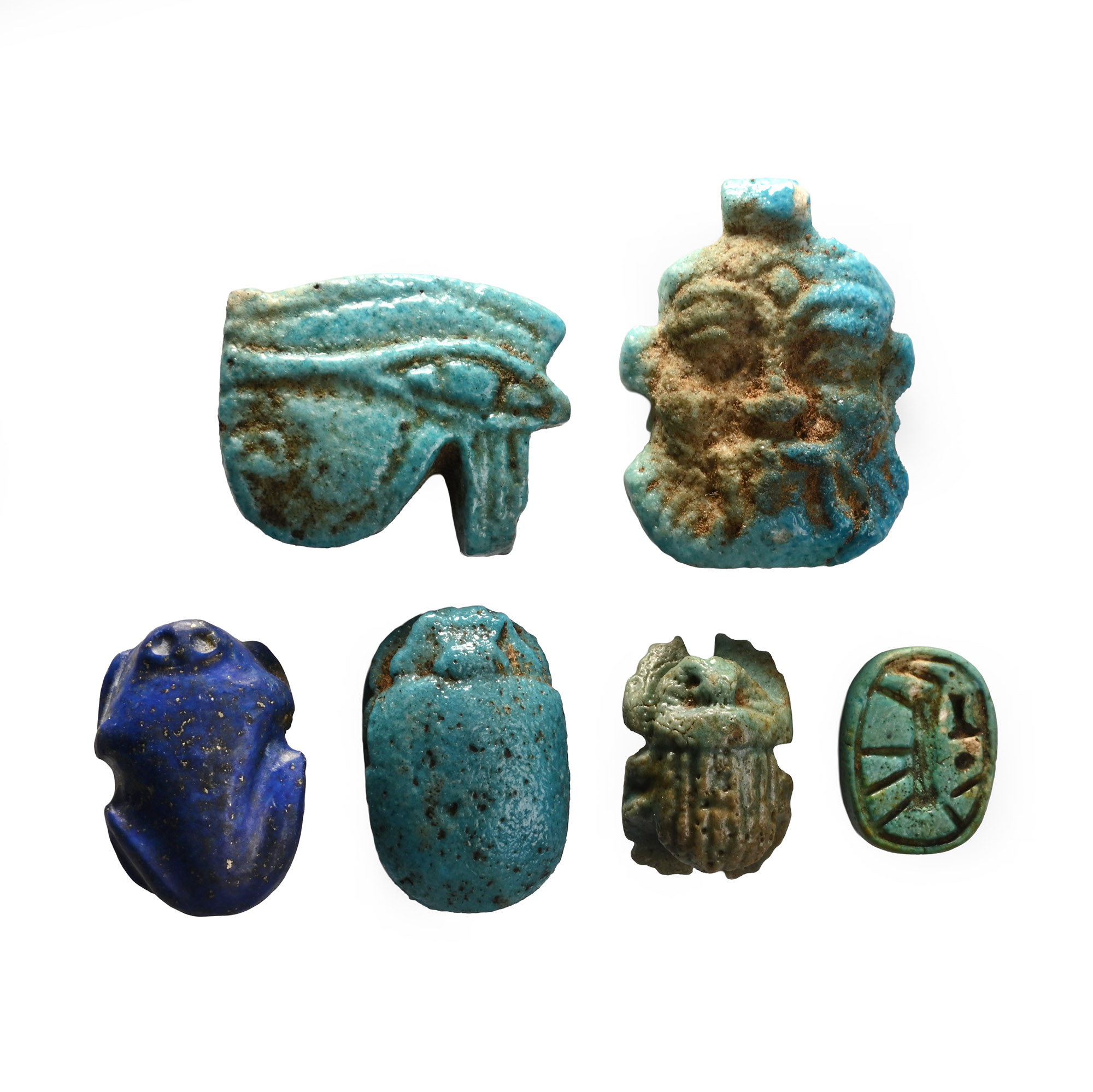
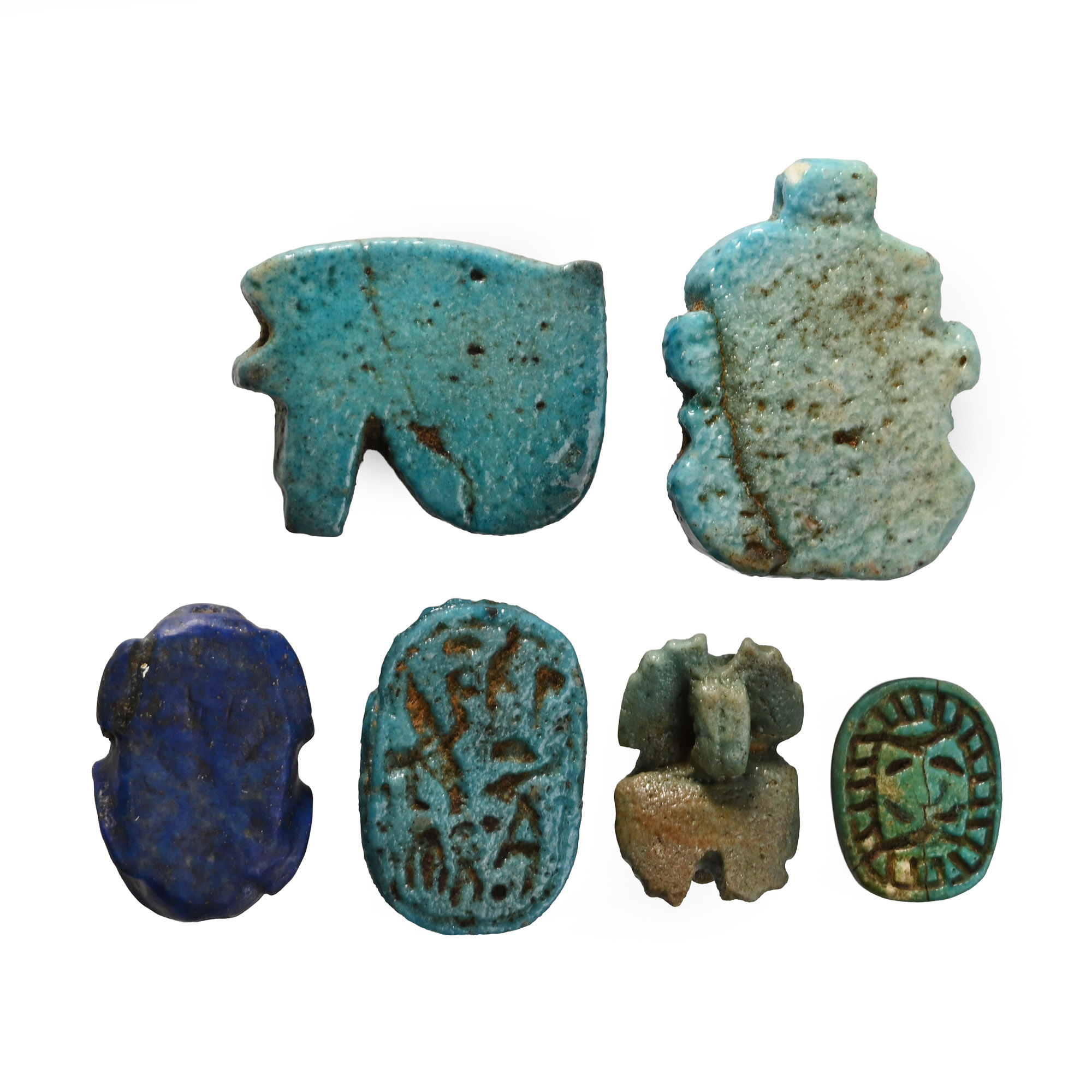
Egyptian Faience Amulet and Scarab Group
LATE PERIOD-PTOLEMAIC PERIOD, CIRCA 664-30 B.C.
1/2 - 1 1/8 in. (19.8 grams total, 15-29 mm).
Comprising: a Bes head amulet, a frog amulet, a wedjat-eye, a scaraboid plaque, and two scarabs. [6]
ProvenanceFrom the collection of a gentleman, acquired on the London art market in the 1990s.
LiteratureCf. Tinius, I., Altägypten in Braunschweig. Die Sammlungen des Herzog Anton Ulrich-Museums und des Städtischen Museums, Wiesbaden, 2011, p. 161, no. 304, for comparable wedjat-eye amulet; Petrie, W.M.F., Amulets. Illustrated by the Egyptian Collection in University College, London, 1914, pl. XXXIV, nos. 189c-d, for similar Bes head amulets.
CONDITIONTimeLine Auctions follows a vetting process to ensure the authenticity and legality of all items, reinforcing our commitment to integrity and responsible trading. Each antiquity, antique, and coin lot undergoes thorough examination by a vetting committee of at least ten external specialists, professional trade association members, scientists, and archaeologists: Our Vetting Process
AUCTIONS:
TimeLine is a leading auction house specialising in antiquities, ancient art, collectables, natural history, coins, medals, and books. Our auctions offer museums, collectors, historians, and enthusiasts the opportunity to acquire unique and historically significant pieces.
LOT 0412
Egyptian Faience Amulet and Scarab Group
Estimate £500 - 700€580 - 810 (for guidance only)$680 - 950 (for guidance only)
-
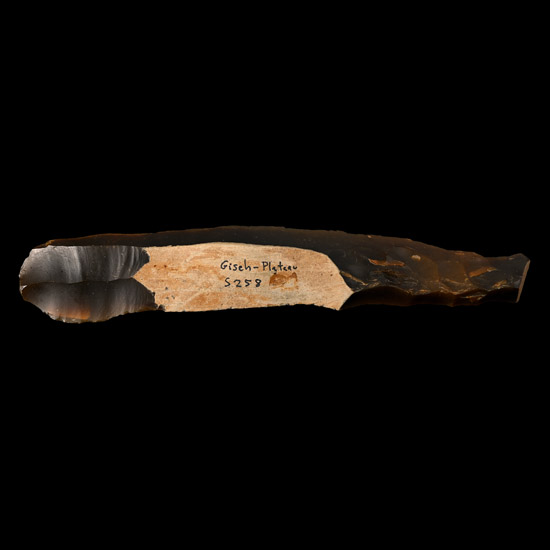
Exceptionally Long Egyptian Stone Age Knapped Flint Blade
Neolithic Period, circa 6,000 B.P.Sold for (Inc. bp): £293
Curved in profile, tongue-shaped with two cutting edges; from the Giza Plateau, Egypt. 77 grams, 19.8 cm
Ex J Dickey collection. Ex Jerry Sherman collection, acquired on the US art market. -
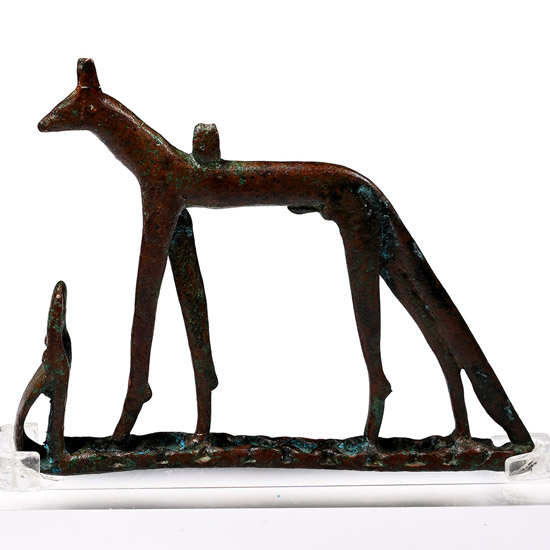
Large Egyptian Bronze Wepwawet Amulet
Third Intermediate-Late Period, 1069-332 B.C.Sold for (Inc. bp): £5,200
Showing the jackal deity Wepwawet standing with ears pricked on a sledge, the slender body modelled with long legs and a tail, suspension loop on the back; two rearing cobras before the jackal; mounted on a custom-made display stand. 54 grams, 91 mm (162 grams total, 11.7 cm including stand )
Ex Dr R. and Mrs L.B., Zumikon, Switzerland. with Galerie Rhéa, Zurich, Switzerland. This lot has been checked against the Interpol Database of stolen works of art and is accompanied by a search certificate number no.12627-236406.
This object may have been the decorative element of a ceremonial standard, examples of which have survived (cf. Petrie, W.M.F., Tanis: Part II / Nebesheh (Am) and Defenneh (Tahpanhes), London, 1886, pl. VII, no. 3). Wepwawet, meaning "Opener of the Ways," was an ancient Egyptian god associated primarily with warfare, protection, and funerary practices. Depicted as a jackal or a man with a jackal's head—often mistaken for Anubis—Wepwawet was believed to guide souls through the afterlife and open paths both in battle and in the spiritual realm. He originated in Asyut (ancient Lycopolis) in Upper Egypt and was one of the oldest deities in the Egyptian pantheon, with worship dating back to at least the First Dynasty (c. 3100–2900 BCE). Over time, Wepwawet became closely linked to Anubis, and the two were sometimes conflated, though Wepwawet retained his distinct identity as a god who preceded and cleared the way. In military contexts, Wepwawet was invoked to "open the way" for pharaohs and armies, ensuring victory and safe passage. In funerary texts, he was described as clearing the path to the afterlife, acting as a scout or guide for the deceased. -
.jpg)
Egyptian Wooden Stele for Pa-di-Amun-(em)-ipat with Ra-Horakhty
Late Period-Ptolemaic Period, 664-30 B.C.Sold for (Inc. bp): £20,800
Arch-topped and composed of two vertical boards, coated with gesso and skilfully painted on one side; the lunette decorated with a winged sun-disc and two pendant uraei; the central vignette depicting the deceased worshipping the falcon-headed god Ra-Horakhty with the Four Sons of Horus standing behind, each with their name written above; the lower register with six lines of hieroglyphic text providing an offering formula for the benefit of the deceased: Transliteration of the hieroglyphs: 1) ḥtp-dı-͗nsw rꜤ-ḥr-Ꜣḫtı͗nṯr Ꜥ nb pt sḥḏ [.....] wsır͗ ẖntt [ım͗ntt?] 2) nṯr Ꜥ nb Ꜣbḏw dı⸗͗f pr.t-ḫrw t ḥnḳt kꜢ Ꜣpd [....] ḫt nb(t) (n) fr(t) wꜢbt […] 3) ḫt nbt nḏm dı⸗͗f ḥtpw ḏfꜢw [...]f ḫꜢ m t dı⸗͗f ḫꜢ m 4) ḥnḳt dı⸗͗f ẖꜢ ır͗p [...] dı⸗͗f ḫꜢ m ı͗[...] dı⸗͗f ḫꜢ ı(͗Ꜣ)r(r)t dı⸗͗f 5) m snṯr ḥr ḫꜢwt [...] ḳrs nfr ḥr ım͗nt nfr 6) n [..] wsır͗ [......] pꜢ-dı-͗ım͗n(m) ıp͗ Ꜣ.t ms (n) ḫꜢ [....] Translation: 1) An offering that the king and Ra-Horakhty, Great God, Lord of Heaven, the illuminated [...] Osiris Foremost [of the West?] 2) Great God, Lord of Abydos (that) he may give a voice-offering (of) bread, beer, oxen, and fowl […] everything good and pure […] 3) everything sweet, he gives offerings of provisions […] a thousand of bread, he gives a thousand of 4) beer, he gives a thousand of wine […], he gives a thousand of vines, he gives a thousand of 5) incense on the altar […] a good burial in the beautiful West 6) for […] the Osiris[…] Pa-di-Amun-(em)-ipat born (to) Kha[…]; on the verso, an old handwritten collection label reading: 'From Harding & Sm[ith] Collection Sale Sotheby 2 Nov 1922 L.N. 234. A families [sic] stele, arched top, with the deceased worshipping a standing Horus attended by the four Children of Horus and six horizontal lines of inscription in colour. SP/10a'; mounted in a custom-made wooden frame. 1.94 kg, 45 cm high
From the collection of the late W. Harding Smith (1848-1922). with Sotheby, Wilkinson & Hodge, 34 & 35 New Bond Street, 2 November 1922, no.234. Old handwritten label to verso reading 'From Harding & Sm[ith] Collection collection Sale Sotheby 2 Nov 1922 L.N.234...' Accompanied by an academic report by Egyptologist Paul Whelan. Accompanied by a copy of the 1922 Sotheby, Wilkinson & Hodge catalogue pages. This lot has been checked against the Interpol Database of stolen works of art and is accompanied by search certificate number no.13251-253195.
The syncretism of two strong gods, Re and Horus, is one of the most significant events in Egyptian mythology, and it appears to have had a substantial iconographic impact on Egyptian history. Re's power was augmented by this, which consisted of a falcon-headed man crowned with a sun disc; in the mornings, Re was combined with Horus to become Re-Horakhty.
