
Loading, please wait...
_900x900.jpg "Egyptian Diorite Heart Scarab")
_200x200.jpg "Egyptian Diorite Heart Scarab")
_900x900.jpg "Egyptian Diorite Heart Scarab")
_200x200.jpg "Egyptian Diorite Heart Scarab")
_900x900.jpg "Egyptian Diorite Heart Scarab")
_200x200.jpg "Egyptian Diorite Heart Scarab")
.jpg "Egyptian Diorite Heart Scarab")
.jpg "Egyptian Diorite Heart Scarab")
.jpg "Egyptian Diorite Heart Scarab")
LOT 0007
Egyptian Diorite Heart Scarab
LATE PERIOD, 664-332 B.C.
1 in. (7.5 grams, 25 mm).
Finely carved, with naturalistic detailing to the upper body, legs shown folded beneath the body with suspension loop at centre.
ProvenanceFrom a 20th century UK collection.
FootnotesThe Egyptians saw the scarab as a symbol of renewal and rebirth. The beetle was associated with the sun god because scarabs roll large balls of dung in which to lay their eggs, a behaviour that the Egyptians thought resembled the progression of the sun through the sky from east to west. Scarab amulets were used for their magical rejuvenating properties by both the living and the dead. The regenerative powers of scarabs, such as the one offered here, could be used by either the living or the dead for healing and protection.
CONDITIONTimeLine Auctions follows a vetting process to ensure the authenticity and legality of all items, reinforcing our commitment to integrity and responsible trading. Each antiquity, antique, and coin lot undergoes thorough examination by a vetting committee of at least ten external specialists, professional trade association members, scientists, and archaeologists: Our Vetting Process
AUCTIONS:
TimeLine is a leading auction house specialising in antiquities, ancient art, collectables, natural history, coins, medals, and books. Our auctions offer museums, collectors, historians, and enthusiasts the opportunity to acquire unique and historically significant pieces.
-
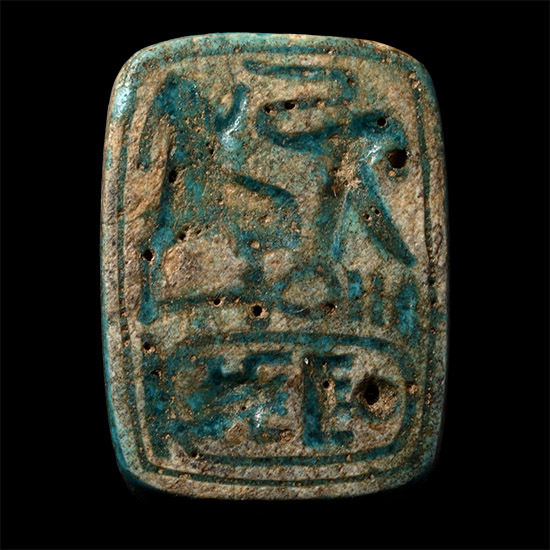
Egyptian Bifacial Steatite Amuletic Plaque with Cartouches for Tuthmoses III
New Kingdom, circa 1479-1425 B.C.Sold for (Inc. bp): £169
Amuletic bead, bifacial with designs: Side A - cartouche for Tuthmoses III with ankh, lion couchant, crown and other motifs; Side B - cartouche as on Side A with perching birds above and below. 2.93 grams, 18 mm
Ex John Cummings Ltd., Lincolnshire, UK. From the private collection of a Canadian gentleman living in Essex, UK, formed since the 1920s-circa 1990. Property of an Essex lady until the late 1990s; thence by descent. From the private collection of an Essex gentleman since the late 1990s. Accompanied by an old information card. -
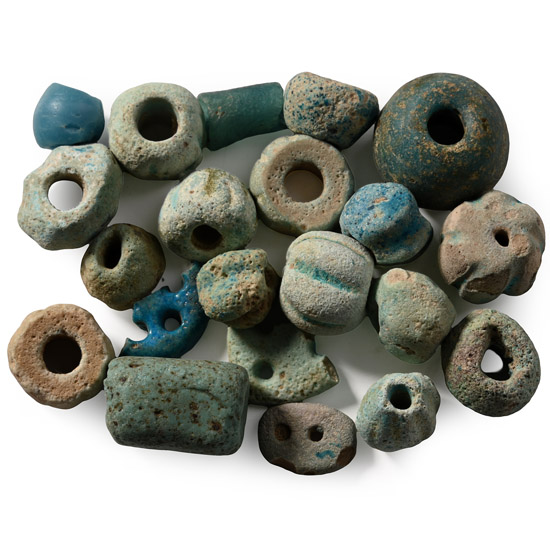
Romano-Egyptian Melon and Other Faience Beads
Roman Period, 30 B.C.-323 A.D.Sold for (Inc. bp): £52
Comprising blue and green glazed beads, mainly melon types. 39 grams total, 10-19 mm
Ex London, UK, art market, 1990s. -
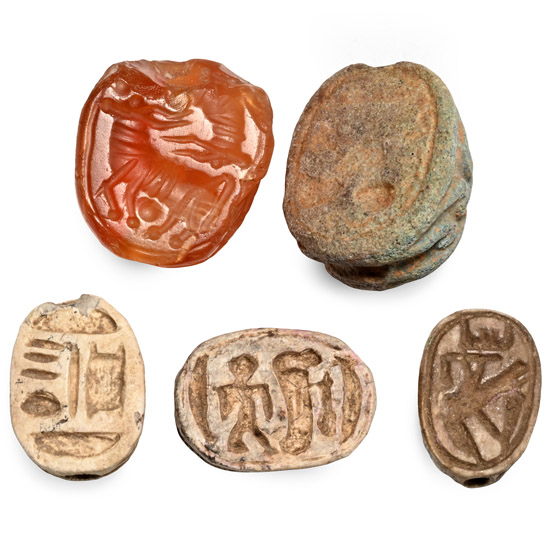
Egyptian Stone Scarab Group
Late Period-Ptolemaic Period, 664-30 B.C. and laterSold for (Inc. bp): £287
Comprising five scarabs with anatomical detailing: one carnelian with two antelopes tête-bêche; one with worn hieroglyphs on the underside; one with two neb signs flanking others; one with two neb signs flanking a standing human figure, uraeus and nefer; and one with the Horus falcon above the sign for gold (nbw). 7.5 grams total, 12-16 mm
From the private collection of a European gentleman (1942-2024), formed since the 1970s.
The falcon on the sign of gold, meaning 'Golden Horus (or falcon)', is found in the titles of Egyptian kings and was therefore considered a potent symbolic motif on scarabs.
