
Loading, please wait...
LOT 0017
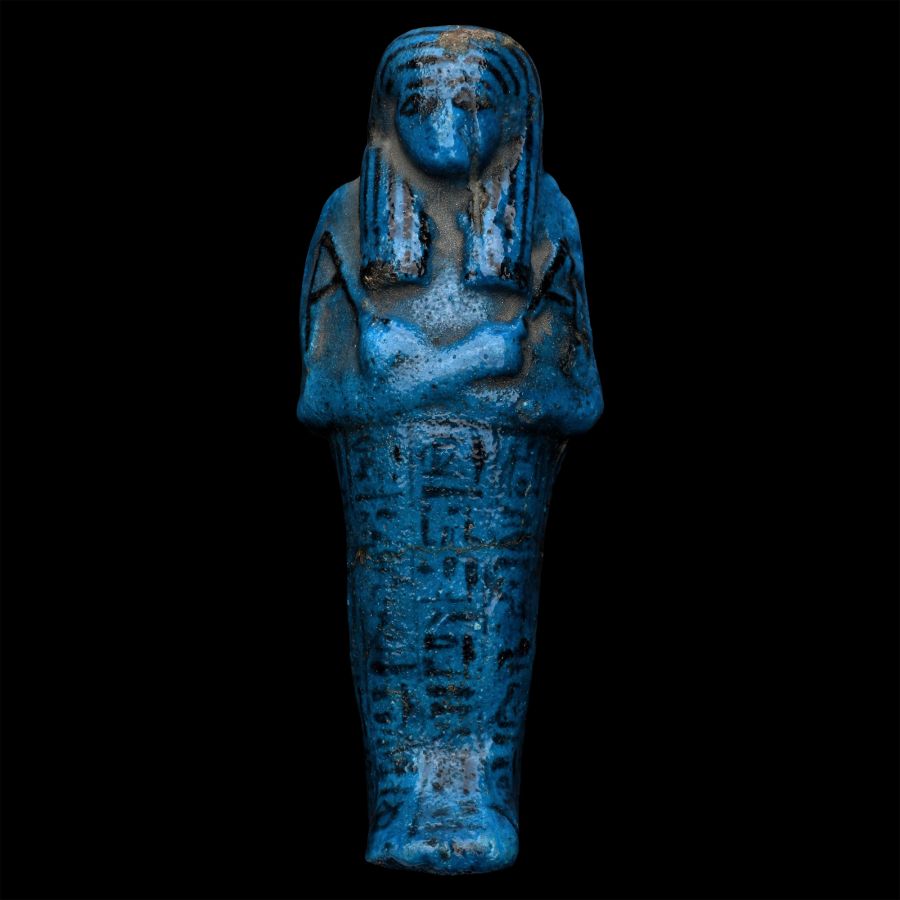
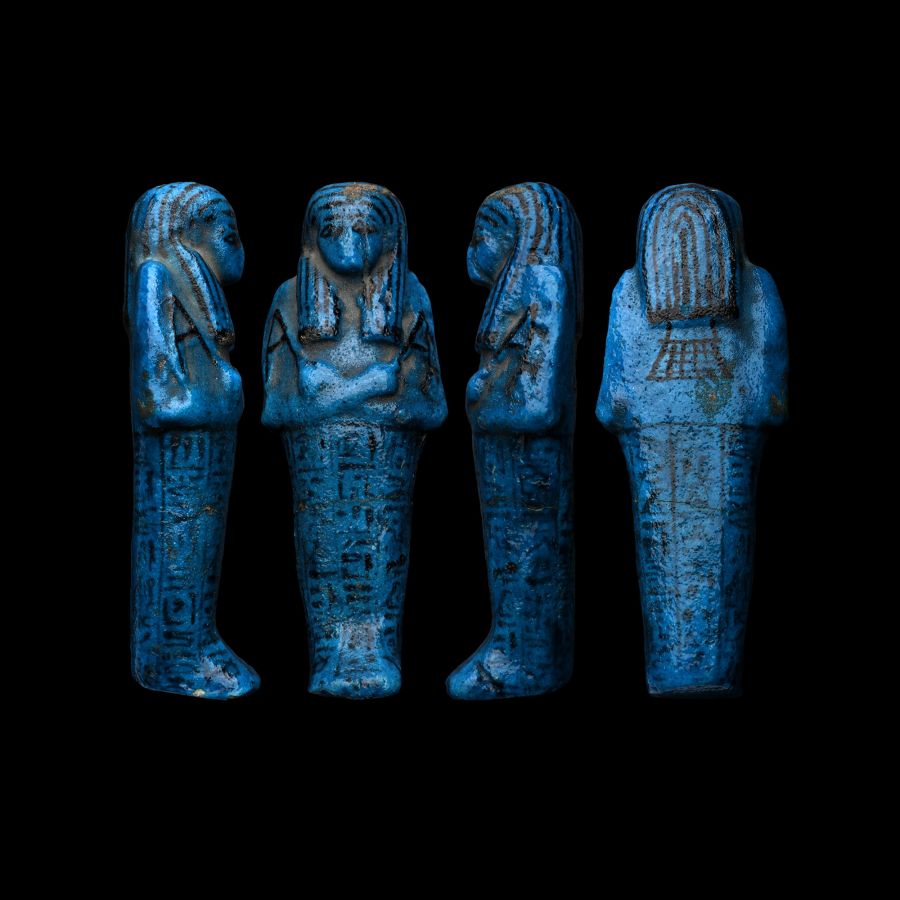
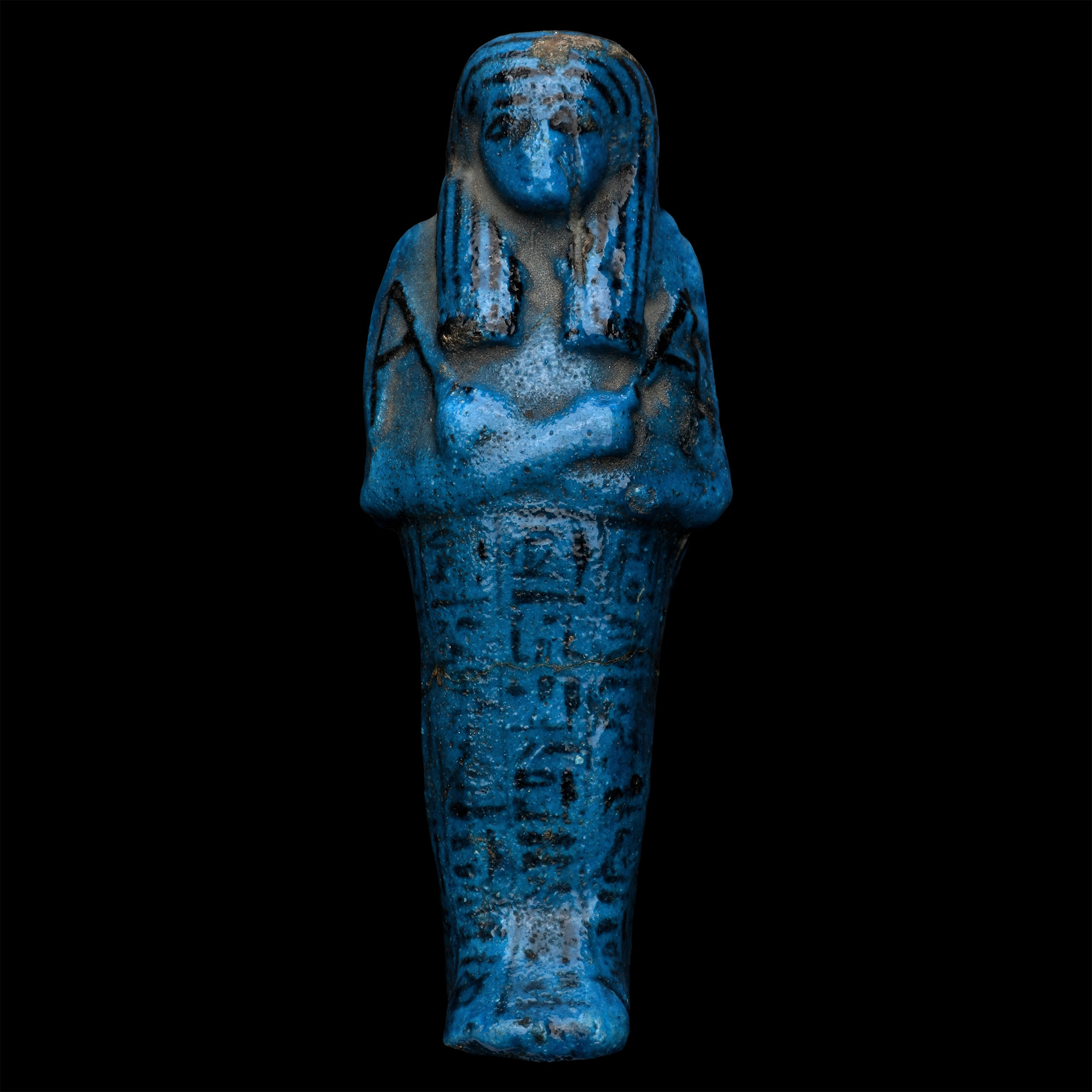
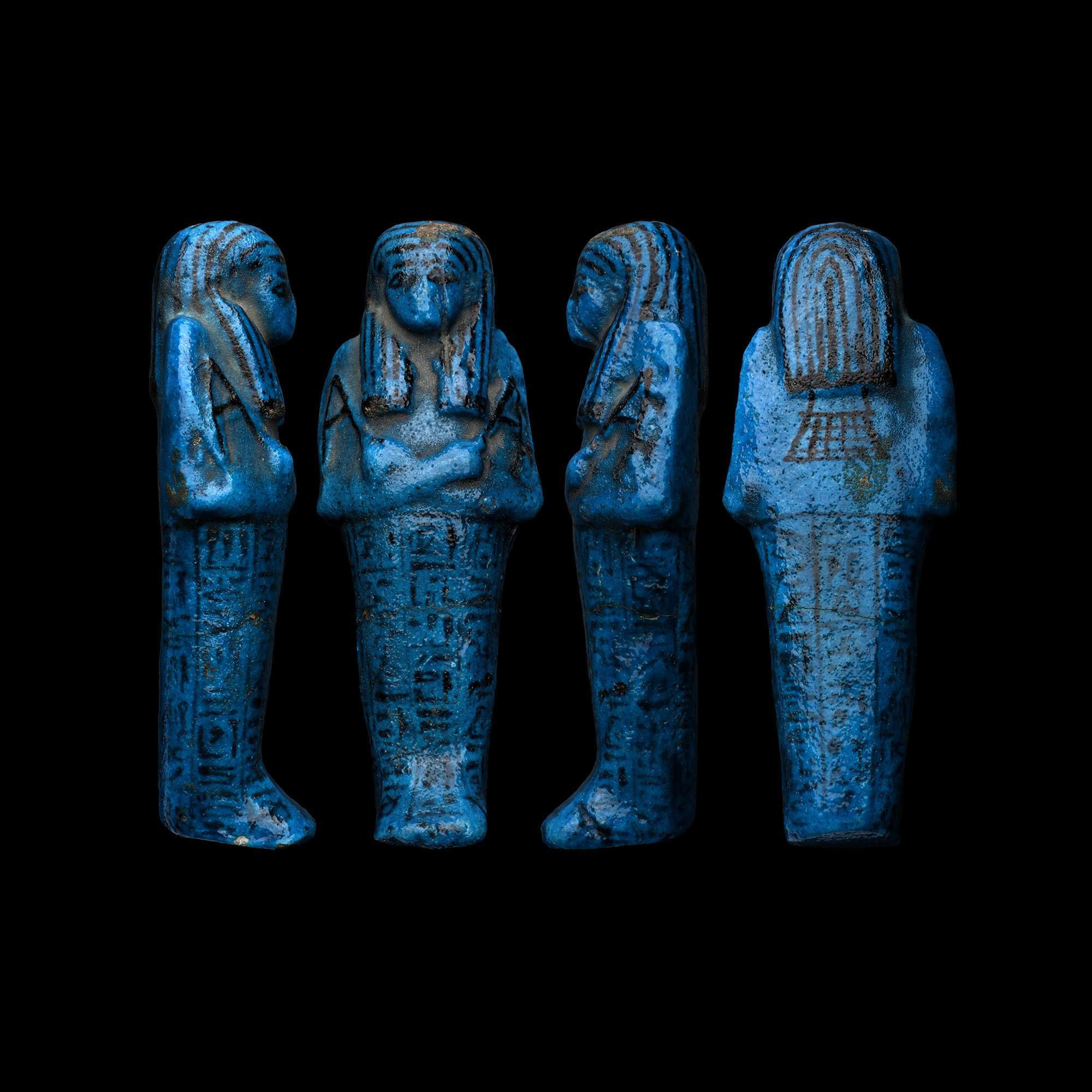
Egyptian Deir el-Bahari Bright Blue Glazed Faience Shabti of Nesitanebisheru, Daughter of Pinedjem II, High Priest of Amun, and Neskhons
THIRD INTERMEDIATE PERIOD, 21ST DYNASTY, CIRCA 980-935 B.C.
6 in. (229 grams, 15.1 cm).
Deep blue, lustrous-glazed mummiform shabti with a tripartite wig and modelled arms; each hand holding a hoe, with the implements, wig, and facial details rendered in black; on the back of the figure, below the wig, hangs a centrally positioned trapezoidal seed bag in black; the bottom half of the figure bears eight columns of hieroglyphic text in black, giving a version of the shabti spell. [No Reserve]
ProvenanceFrom the cache of mummies of the priests of Amun at Deir el-Bahari, found by the Abdul Rassoul family circa 1910.
E.E.S. sale, November 1967, sold for £5.00.
Acquired from Richardson, St Christopher’s Place, Wigmore Street. London, late 1960s, for £7.00 and 10 shillings.
From the private collection of Peter Clayton, FCILIP, Dip, Arch, FSA, FRNS, Hemel Hempstead, Hertfordshire, UK; formed since the late 1950s.
Accompanied by an academic report by Paul Whelan.
Accompanied by an old handwritten information card by Peter Clayton, collection no.122.
This lot has been checked against the Interpol Database of stolen works of art and is accompanied by search certificate no.13491-262881.
Cf. Moje, J., Schabtis und verwandte Figurinen. Mit den Beständen der Berliner Antikensammlung, des Museums für Vor- und Frühgeschichte und des Vorderasiatischen Museums, Dritte Zwischenzeit, Teil 1, Ägyptisches Museum und Papyrussammlung, Staatliche Museen zu Berlin, Band 4, Corpus Antiquitatum Aegyptiacarum, London, 2024, pp. 180-183, for several examples of Nesitanebisheru shabtis in Berlin.
CONDITIONTimeLine Auctions follows a vetting process to ensure the authenticity and legality of all items, reinforcing our commitment to integrity and responsible trading. Each antiquity, antique, and coin lot undergoes thorough examination by a vetting committee of at least ten external specialists, professional trade association members, scientists, and archaeologists: Our Vetting Process
AUCTIONS:
TimeLine is a leading auction house specialising in antiquities, ancient art, collectables, natural history, coins, medals, and books. Our auctions offer museums, collectors, historians, and enthusiasts the opportunity to acquire unique and historically significant pieces.
LOT 0017
Egyptian Deir el-Bahari Bright Blue Glazed Faience Shabti of Nesitanebisheru, Daughter of Pinedjem II, High Priest of Amun, and Neskhons
Estimate £6,000 - 8,000€6,960 - 9,280 (for guidance only)$8,100 - 10,800 (for guidance only)
-
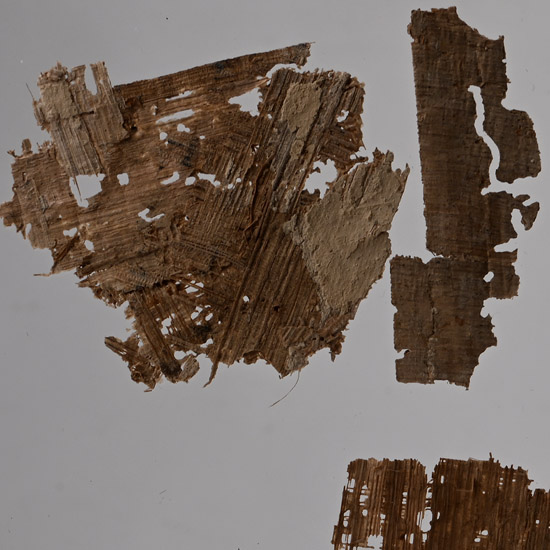
Egyptian Papyrus Fragments in Display Stand
Demotic, 300 B.C.-300 A.D.Estimate: £50 - 70 (+bp*)
Opening Bid: £5
Irregular papyrus fragments with faint traces of Demotic script; mounted in a protective acrylic display. 81 grams total, 16 cm including stand
with a privately curated collection, 1980s-early 2000s. From the private collection and estate of Christine Simons (1943-2025), West Midlands, UK. -
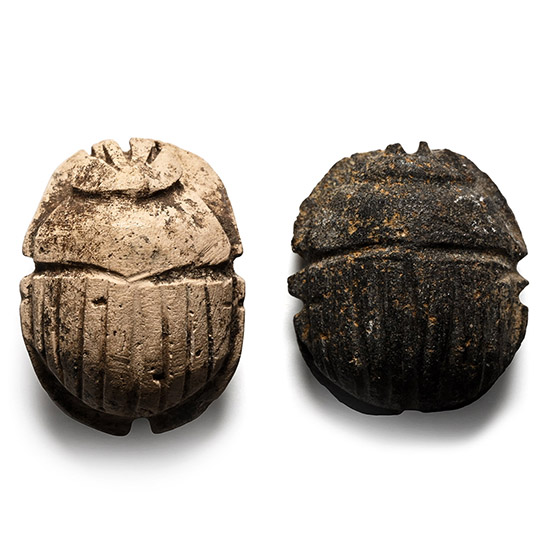
Egyptian Heart Scarab Group
Late Period, 664-332 B.C.Estimate: £120 - 170 (+bp*)
Opening Bid: £60
Comprising two naturalistically modelled scarabs with striated wing cases and ribbed undersides. 7.5 grams total, 18-20 mm
From the collection of a gentleman, acquired on the London art market in the 1990s.
The scarab amulet was a powerful symbol of rebirth, transformation, and protection in ancient Egypt. Modeled after the beetle associated with the sun god Khepri, it represented the cycle of life and regeneration. From the Middle Kingdom (c. 2050 BCE) onwards, scarabs served as funerary amulets, personal charms, and seals—often inscribed with prayers or names—reflecting both spiritual beliefs and daily life. -
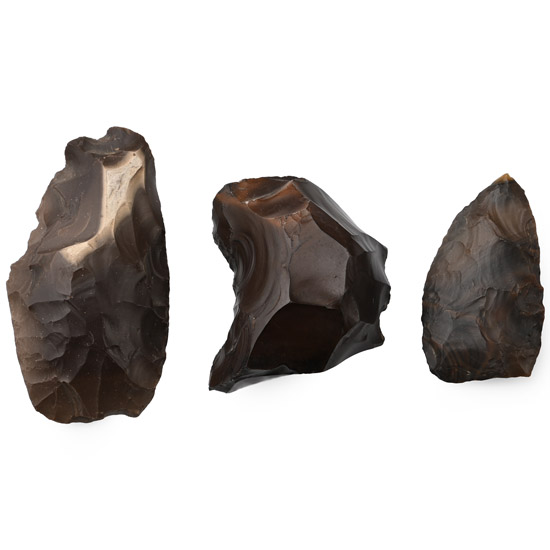
Egyptian Stone Age Knapped Tool Group from Thebes
Neolithic Period, 11,000-5,200 B.P.Estimate: £60 - 80 (+bp*)
Opening Bid: £5
Comprising three knapped tools, each with an inked inscription 'W.Thebes 1912'. 216 grams total, 61-85 mm
Found Thebes. From the collection of A.D.Passmore (1879-1958), his collection of flints from the area of Stonehenge was donated to the Ashmolean Museum in the 1950s. From the private collection of Peter Clayton, FCILIP, Dip, Arch, FSA, FRNS, Hemel Hempstead, Hertfordshire, UK; formed since the late 1950s. Accompanied by a copy of an old handwritten information card by Peter Clayton.
