
Loading, please wait...
_900x900.jpg "Egyptian Decorated Wooden Mask From a Mummy")
_200x200.jpg "Egyptian Decorated Wooden Mask From a Mummy")
_900x900.jpg "Egyptian Decorated Wooden Mask From a Mummy")
_200x200.jpg "Egyptian Decorated Wooden Mask From a Mummy")
.jpg "Egyptian Decorated Wooden Mask From a Mummy")
.jpg "Egyptian Decorated Wooden Mask From a Mummy")
LOT 0013
Egyptian Decorated Wooden Mask From a Mummy
LATE PERIOD, 4TH-3RD CENTURY B.C.
14 in. (677 grams, 36 cm).
Displaying semi-naturalistic detailing in relief, beneath a band of headdress ornament composed of rows of architectural dot-and-dash and zig-zag patterns over a segmental panel, possible hieroglyphs to the top tier; attachment pegs to the sides of the face and through the head; extensive remains of painted black pigmentation and composition fill to the eyes.
ProvenanceFrom a French estate, acquired between 1960 and 1980.
with SAS Cornette de Saint Cyr Auction, Paris, Vente 882, Mobilier et Objets d'art, 2 December 2014, lot 69.
Accompanied by a copy of a French cultural passport no.167062.
Accompanied by an academic report by Dr Alberto Maria Pollastrini.
This lot has been checked against the Interpol Database of stolen works of art and is accompanied by search certificate no.11807-206837.
This lot has been cleared against the Art Loss Register database, and is accompanied by an illustrated lot declaration signed by the Head of the Antiquities Department, Dr Raffaele D’Amato.
TimeLine Auctions follows a vetting process to ensure the authenticity and legality of all items, reinforcing our commitment to integrity and responsible trading. Each antiquity, antique, and coin lot undergoes thorough examination by a vetting committee of at least ten external specialists, professional trade association members, scientists, and archaeologists: Our Vetting Process
AUCTIONS:
TimeLine is a leading auction house specialising in antiquities, ancient art, collectables, natural history, coins, medals, and books. Our auctions offer museums, collectors, historians, and enthusiasts the opportunity to acquire unique and historically significant pieces.
-
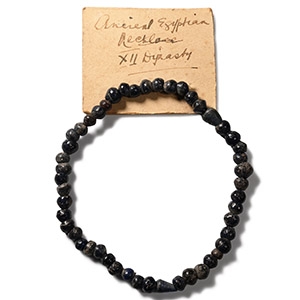
Egyptian Blue Glass Bead Bracelet
New Kingdom, circa 1400 B.C. or laterSold for (Inc. bp): £221
Mainly blue glass biconvex and spherical beads; with old collector's card erroneously dated 'Ancient Egyptian Necklace. XII Dynasty'. 18 grams, 24 cm long
From a 19th century English collection. Ex Helios Gallery, Worcestershire, UK, 2011. Ian Wilkinson collection, Nottinghamshire, UK, formed since 1985. Accompanied by an old handwritten identification card. This lot is accompanied by an illustrated lot declaration signed by the Head of the Antiquities Department, Dr Raffaele D’Amato. -
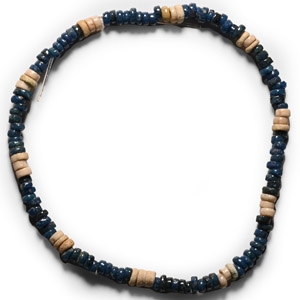
Egyptian Faience Bead Bracelet
Late Period, 664-332 B.C.Sold for (Inc. bp): £78
A restrung group of annular beads in shades of blue and white; mainly faience, but some possibly shell. 2.01 grams, 17.8 cm long
From the private collection of the late Mrs Belinda Ellison, a long time member of the Egyptian Exploration Society, c.1940-2020. This lot is accompanied by an illustrated lot declaration signed by the Head of the Antiquities Department, Dr Raffaele D’Amato. -
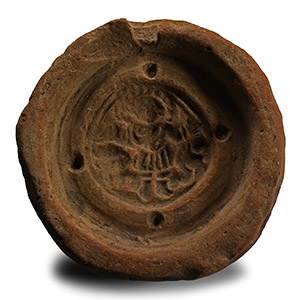
Coptic Terracotta Clay Mould
6th-7th century A.D.Sold for (Inc. bp): £72
Discoid receptacle with a military saint in Roman armour (Saint Menas), with muscular cuirass and pteryges, arms open in the manner of the orans pose, animals (camels?) on his side. 198 grams, 89 mm
Maurice Bouvier, Alexandrie, prior 1959. This lot is accompanied by an illustrated lot declaration signed by the Head of the Antiquities Department, Dr Raffaele D’Amato.
The majority of the terracotta ampullae come from Egypt and bear representations of St. Menas or Mennas, an Egyptian Christian officer decapitated during the persecutions of Diocletian's time. The legend relates that the saint's body was placed upon a camel which was let loose to follow what course it chose; in the place where the camel stopped, some miles from Alexandria, a grave and a shrine were subsequently built. In allusion to this legend, St. Menas is often represented as standing between two camels, though the animals are often of so fantastic a form as to be very difficult to recognise.
