
Loading, please wait...
LOT 0656
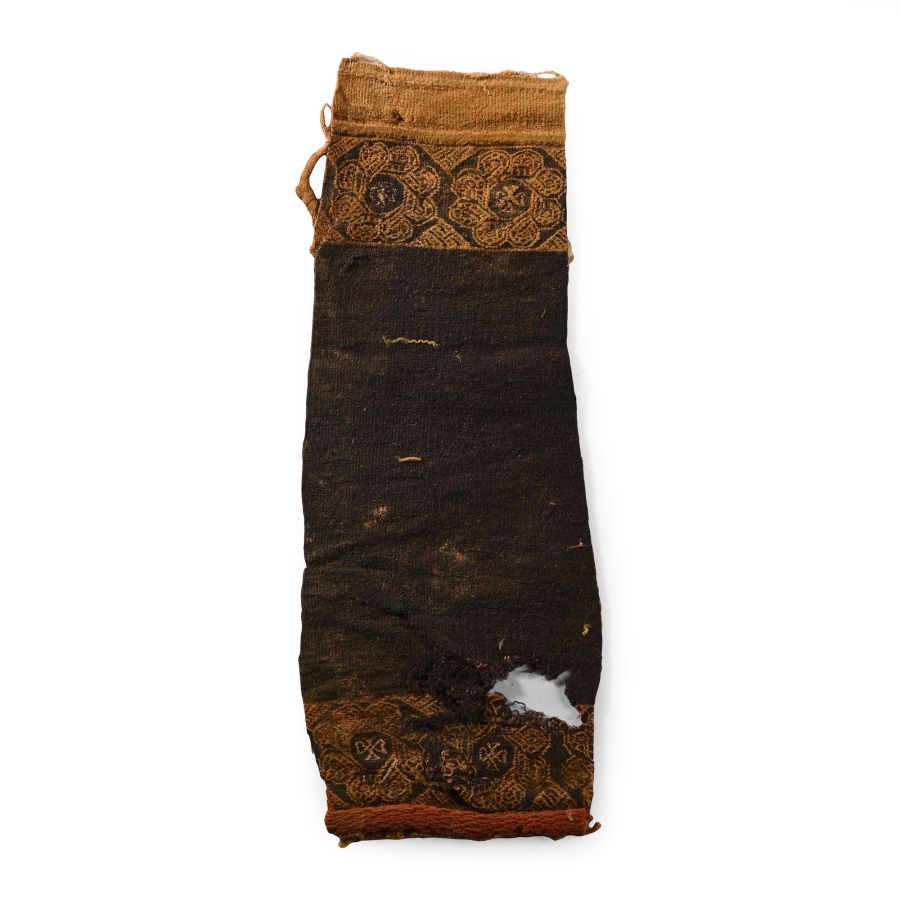
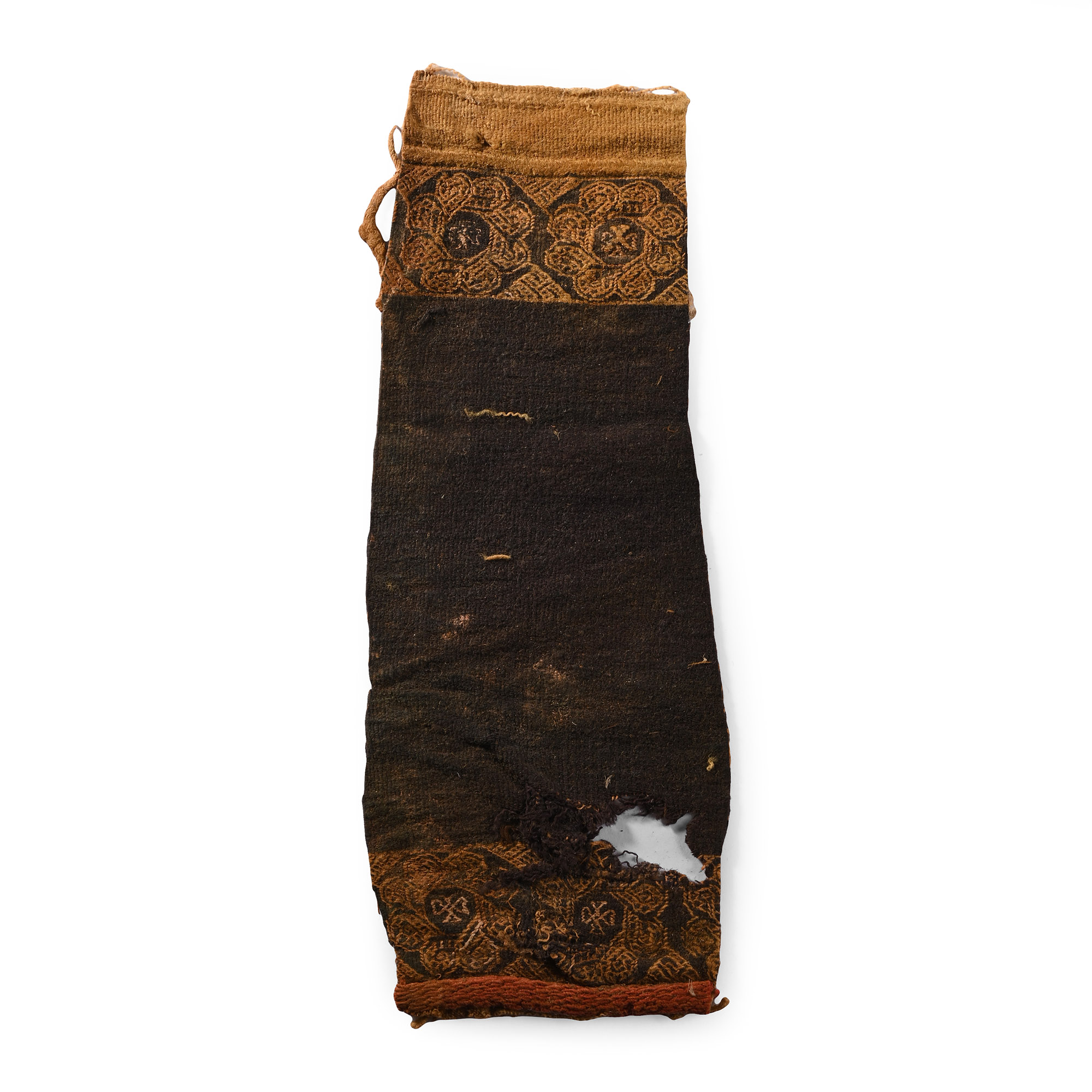
Egyptian Coptic Tunic Textile Fragment with Segmenta Decorated with Crosses
CIRCA 6TH-7TH CENTURY A.D.
12 in. (27 grams, 30.5 cm).
Comprising a long element from a tunic, possibly a sleeve from a child’s garment, in brown wool with a red edge, a pair of segmenta at both sides in purple and yellow, ornamented with crosses inside lozenges and spirals. [No Reserve]
ProvenanceAcquired 1970s-1996.
Property of a North American collector.
London collection, 2016.
Cf. Del Francia Barocas, L., Museo dell'Alto Medioevo, Roma, I materiali Copti, p.100-101, for similar textiles.
FootnotesThis decorative part of a tunic is possibly a part of the sleeve of a child's garment, and the crosses reiterate the fact that these fabrics were produced in a by then heavily Christianised Roman Empire.
CONDITIONTimeLine Auctions follows a vetting process to ensure the authenticity and legality of all items, reinforcing our commitment to integrity and responsible trading. Each antiquity, antique, and coin lot undergoes thorough examination by a vetting committee of at least ten external specialists, professional trade association members, scientists, and archaeologists: Our Vetting Process
AUCTIONS:
TimeLine is a leading auction house specialising in antiquities, ancient art, collectables, natural history, coins, medals, and books. Our auctions offer museums, collectors, historians, and enthusiasts the opportunity to acquire unique and historically significant pieces.
LOT 0656
Egyptian Coptic Tunic Textile Fragment with Segmenta Decorated with Crosses
Estimate £60 - 80€70 - 93 (for guidance only)$81 - 108 (for guidance only)
Opening Bid
£5 (EUR 6; USD 7) +BP*
-
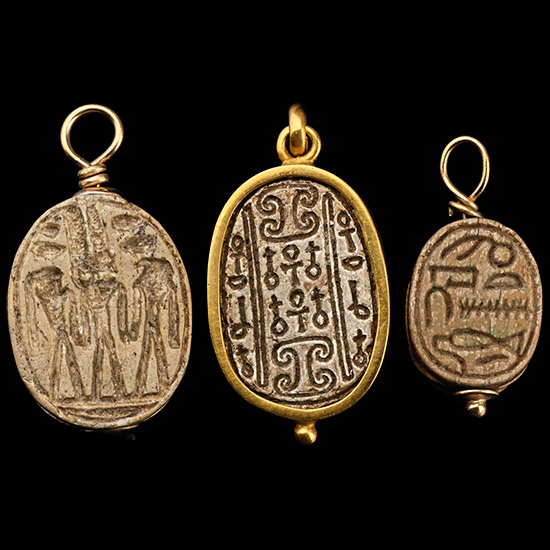
Collection of Egyptian Faience and Steatite Scarabs with Gold Mounts
Second Intermediate Period-Late Period, 1782-332 B.C.Estimate: £400 - 600 (‡+bp*)
Opening Bid: £200
Comprising: grey scarab with gold mounting pin, frame and loop, three panels on the underside with ankh and other motifs; grey scarab with traces of turquoise surface, gold mounting pin and loop, hieroglyphs on the underside; cream scarab with gold mounting pin and loop, frieze of three figures on the underside, the middle figure wearing an atef crown. 9.85 grams total, 24-32 mm
Private collection of Kal Noselson, New York, acquired between 1976 and the late 1990s; thence by descent. Accompanied by the collector's original inked images. -
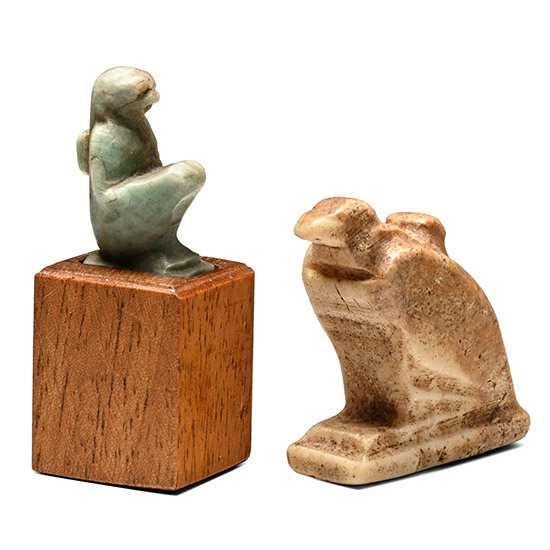
Egyptian Stone Amulet Collection
New Kingdom-Late Period, circa 1100-500 B.C.Estimate: £700 - 900 (‡+bp*)
Opening Bid: £365
Comprising: a feldspar amulet of the crouching god Sokar with falcon head and human body, custom-made display stand; a carved vulture amulet on a rectangular base; suspension loop on the back. 19.5 grmas total, 28-41 mm
Sokar: Ex Roger Liechti (1934-2010), Petit-Lancy, Switzerland (inv.no. E.601); acquired from Galerie Elsa-Bloch Diener, Bern. Thence by family descent. Vulture: Ex Roger Liechti (1934-2010), Petit-Lancy, Switzerland (inv.no. E. 772); acquired in 1984 from Mr Cohen, Galerie La Reine Margot, Paris. Thence by family descent, Switzerland.
Vulture representations are among the oldest amulet types, found in burials dating to the late Third millennium B.C. They provide apotropaic protection for the deceased. The vulture is associated with various Egyptian deities, especially with the goddess Nekhbet. Sokar, the hawk-god originally of the Memphite necropolis and deity of fertility and artisans, became closely linked with Osiris and Ptah, forming the syncretic deity Ptah-Sokar-Osiris. -
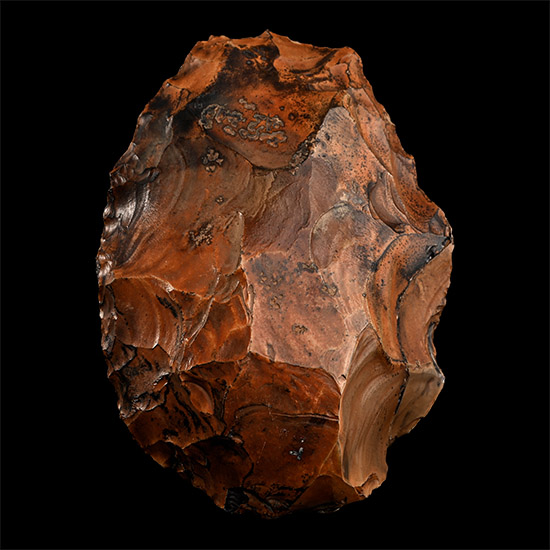
Egyptian Stone Age Knapped Handaxe
Lower Palaeolithic Period, circa 500,000-250,000 B.P.Estimate: £150 - 200 (+bp*)
Opening Bid: £5
Expertly shaped through percussion flaking, creating zigzagging lateral edges, with a roughly ovate or teardrop form and a heavy, thick butt, tapering down to a distinct working edge. 363 grams, 12.5 cm
From the collection of A.D. Passmore (1879-1958), his collection of flints from the area of Stonehenge was donated to the Ashmolean Museum in the 1950s. From the private collection of Peter Clayton, FCILIP, Dip, Arch, FSA, FRNS, Hemel Hempstead, Hertfordshire, UK; formed since the late 1950s. Accompanied by a copy of an old handwritten information card by Peter Clayton.
The Egyptian flint hand axe, or biface, is a prehistoric stone tool with two faces. This tool holds the record for being the longest-used tool in human history. The technical term 'biface' comes from the archetypal model, generally a bifacial Lithic flake with an almond-shaped morphology. Hand axes typically have a pointed end and a rounded base, giving them their characteristic shape, and both faces have been knapped to remove the natural cortex, at least partially.
