
Loading, please wait...
LOT 0700
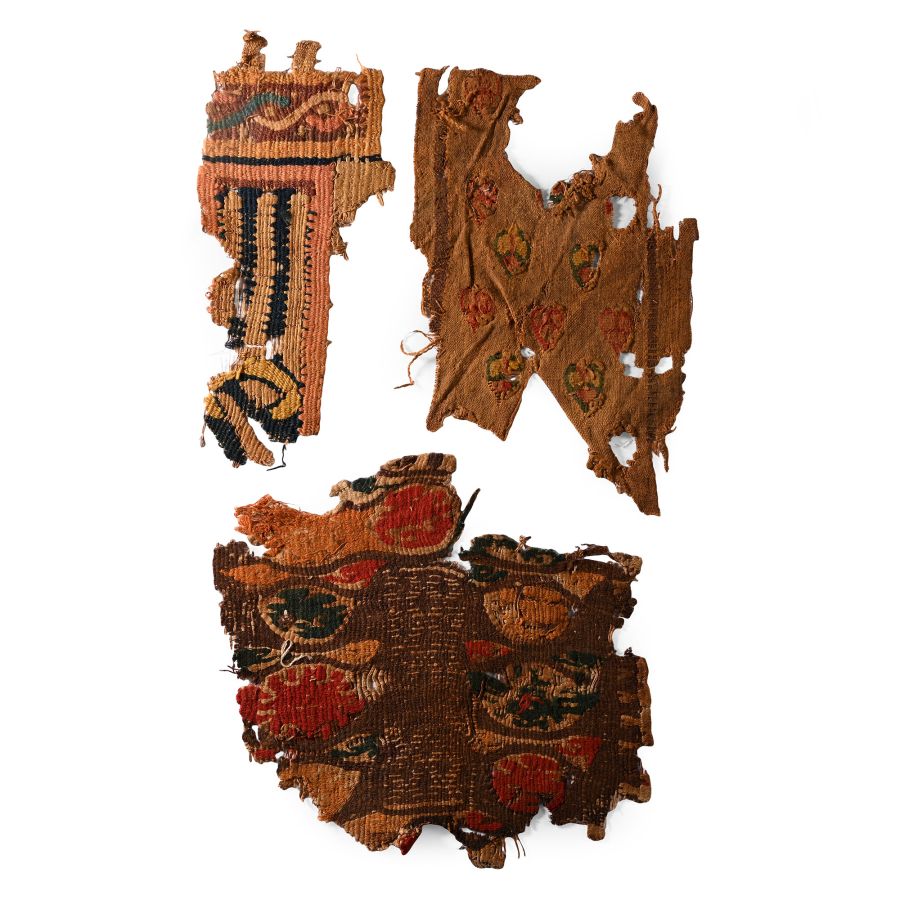
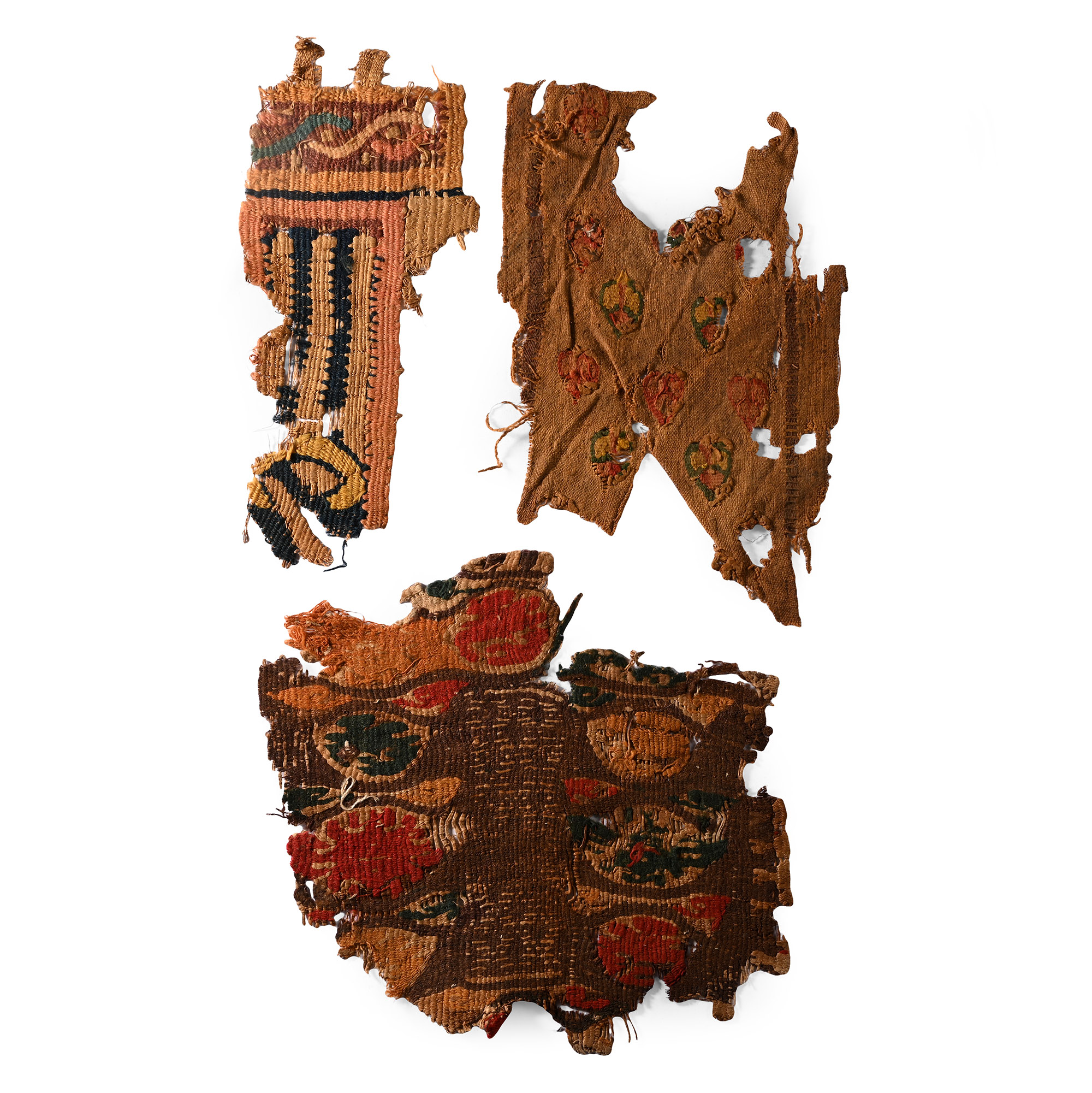
Egyptian Coptic Tunic and Tapestry Textile Fragments with Flowers and Geometric Ornaments
CIRCA 6TH-8TH CENTURY A.D.
8 1/4 - 10 1/4 in. (33 grams total, 21-26 cm).
Comprising a fragment of a clavus decorated with rows of heart-shaped buds in green, red, and yellow wool on linen, with edges marked by brown bands; a large fragment of coarse wool, consisting of a central rectangle with lozenge ornamentation in yellow and brown wool, surrounded by rectangular sections enclosing images of rabbits within yellow, green, and red medallions, facing left; and a textile fragment with geometric decoration in purple, yellow, light red, green, and black wool. [No Reserve]
ProvenanceAcquired 1970s-1996.
Property of a North American collector.
London collection, 2016.
Cf. Del Francia Barocas, L., Museo dell'Alto Medioevo, Roma, I materiali Copti, pp.200-201, for similar textiles.
FootnotesThe large fragment featuring lozenge decoration, despite displaying figures associated with the Dionysian retinue (rabbits or hares), may date to the early period of the Islamic conquest, when tunic ornamentation began to take on an increasingly abstract and geometric character.
CONDITIONTimeLine Auctions follows a vetting process to ensure the authenticity and legality of all items, reinforcing our commitment to integrity and responsible trading. Each antiquity, antique, and coin lot undergoes thorough examination by a vetting committee of at least ten external specialists, professional trade association members, scientists, and archaeologists: Our Vetting Process
AUCTIONS:
TimeLine is a leading auction house specialising in antiquities, ancient art, collectables, natural history, coins, medals, and books. Our auctions offer museums, collectors, historians, and enthusiasts the opportunity to acquire unique and historically significant pieces.
LOT 0700
Egyptian Coptic Tunic and Tapestry Textile Fragments with Flowers and Geometric Ornaments
Estimate £80 - 100€93 - 116 (for guidance only)$108 - 135 (for guidance only)
Opening Bid
£5 (EUR 6; USD 7) +BP*
-
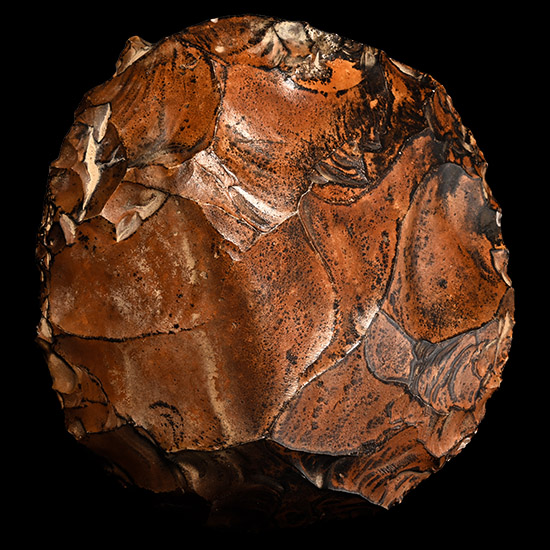
Egyptian Stone Age Knapped Ovate Hand Axe from Thebes
Lower Palaeolithic Period, circa 40,000-35,000 B.P.Estimate: £300 - 400 (+bp*)
Opening Bid: £5
Biconvex in profile with inked findspot to the butt: 'Desert West of Thebes 1912'. 385 grams, 10.4 cm
Found in the desert west of Thebes, Egypt, 1912. Acquired from Sotheby's, 16 June 1959 (part), £4.10. From the private collection of Peter Clayton, FCILIP, Dip, Arch, FSA, FRNS, Hemel Hempstead, Hertfordshire, UK; formed since the late 1950s. Accompanied by a copy of an old handwritten identification card written by Peter Clayton. -
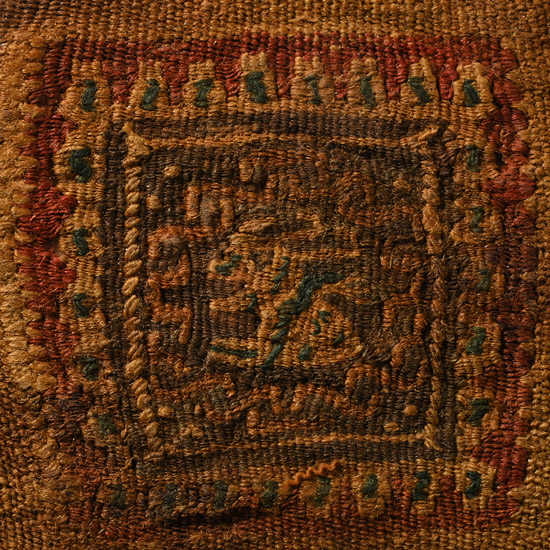
Egyptian Coptic Textile Fragment of a Tunic Tablion with Hare
Circa 6th-7th century A.D.Estimate: £40 - 60 (+bp*)
Opening Bid: £5
Comprising a tablion in coarse wool of red, green, yellow, violet and blue over white linen, scalloped borders, tapestry work (S-twist), featuring an animal (hare?) inside a square, surrounded by vegetal ornaments. 5.59 grams, 10.5 cm
Acquired 1970s-1996. Property of a North American collector. London collection, 2016.
The tabula, or tablion, was a square embroidery used to decorate tunics or mantles. The theme of rabbits or hares, in association with other characters and animals of the Dionysian Thiasos, has notable parallels. Such representations are linked to narratives of the Dionysian cycle. -
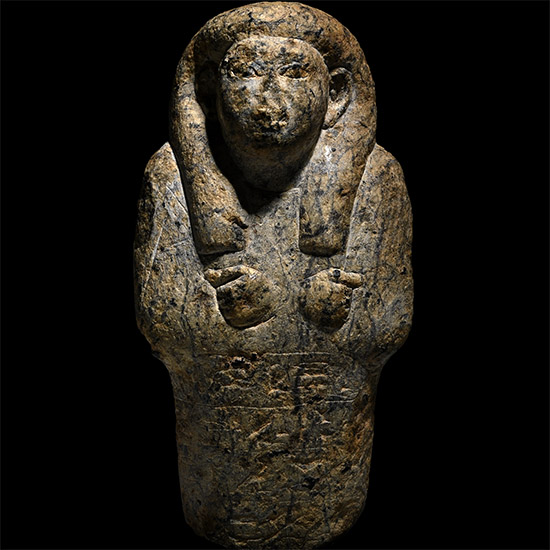
Egyptian Yellow and Black Serpentine Hieroglyphic Shabti
25th-26th Dynasty, circa 650-525 B.C.Estimate: £1,500 - 2,000 (+bp*)
Bids: 1 | Current Bid: £5
Fragment of a mummiform shabti wearing a heavy tripartite wig, with crossed hands on the chest holding faintly incised agricultural implements; four lightly incised horizontal lines of hieroglyphic text on the lower body; mounted on a custom-made stand. 455 grams total, 13.3 cm including stand
From the private collection of Peter Clayton, FCILIP, Dip, Arch, FSA, FRNS, Hemel Hempstead, Hertfordshire, UK; formed since the late 1950s.
Hardstone shabtis appear in the burials of certain high officials in the late 25th and early 26th Dynasties, after which faience became the predominant material for all shabti statuettes.
