
Loading, please wait...
LOT 0493
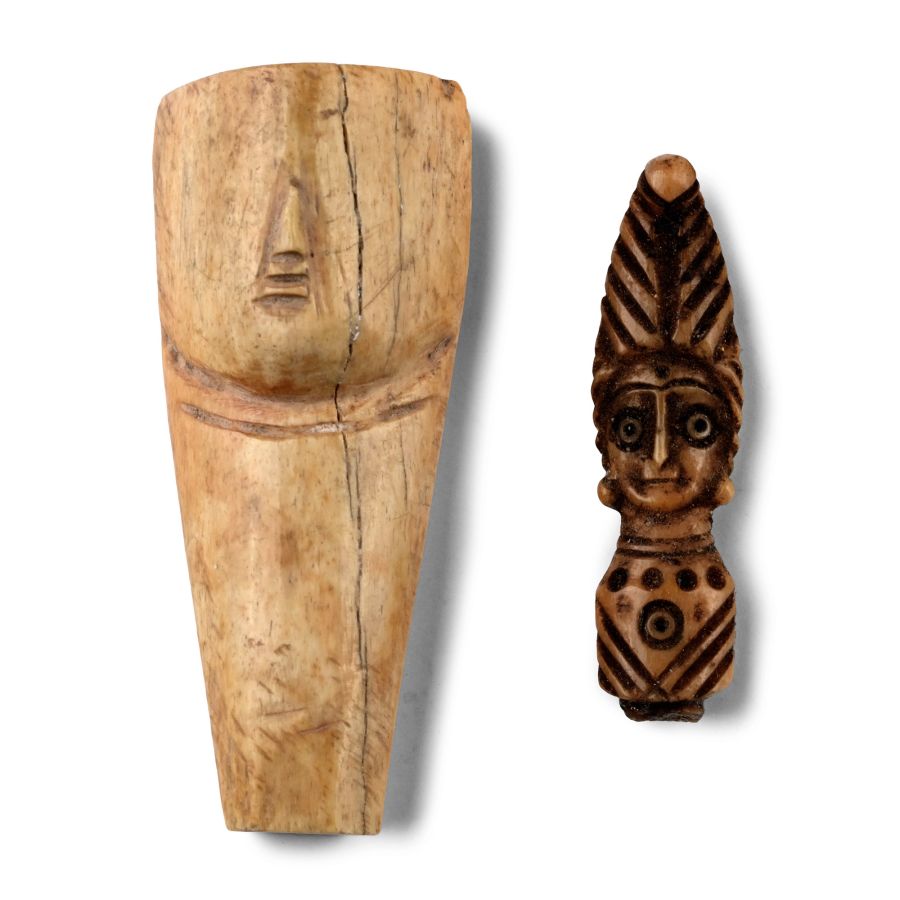
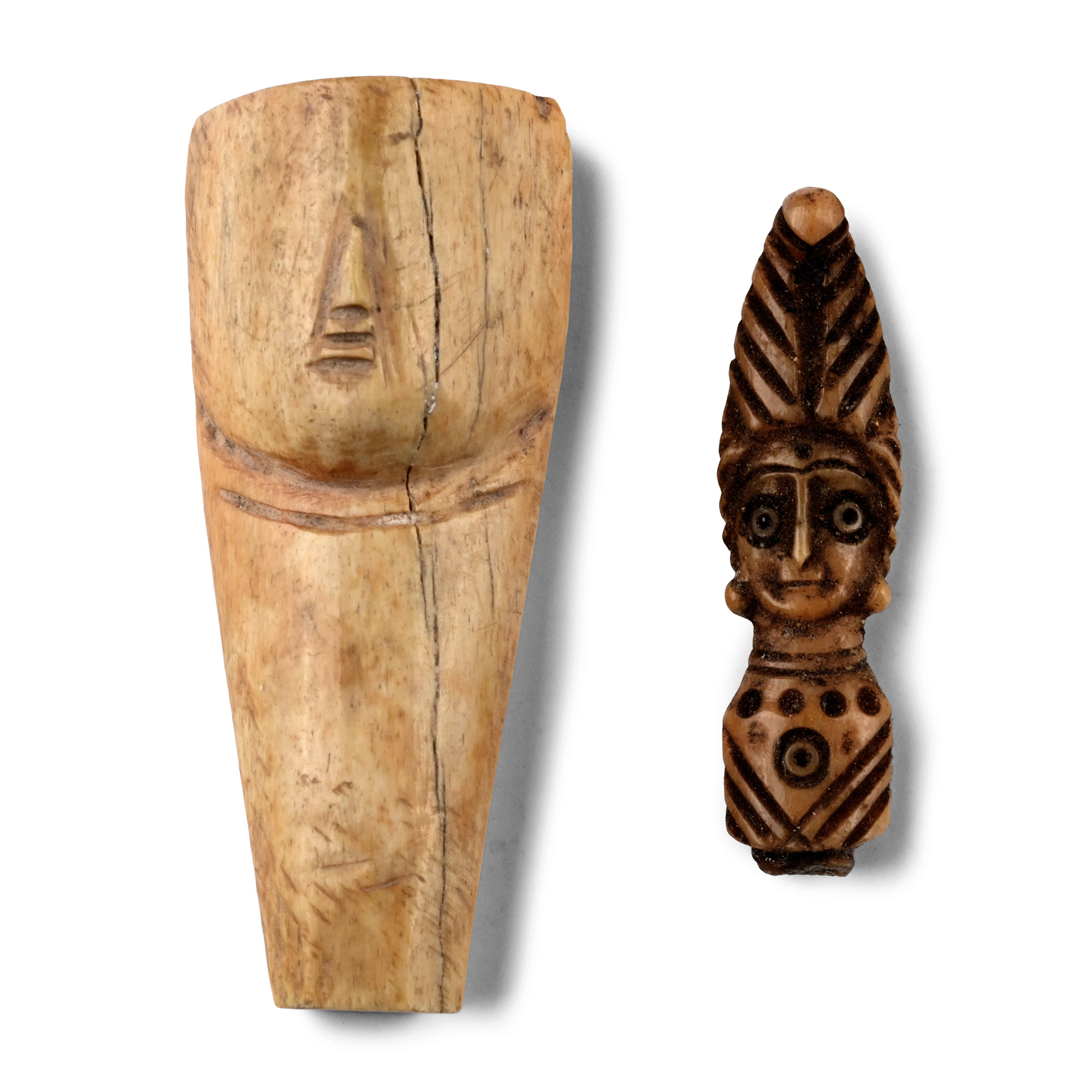
Egyptian Coptic Bone Items
3RD-6TH CENTURY A.D.
1 1/4 - 1 5/8 in. (9.45 grams total, 32-43 mm).
Comprising: a tapering plano-convex section body with D-shaped face, nose and mouth; tag or lace-end with carved female bust. [2, No Reserve]
ProvenanceFrom the collection of a gentleman, acquired on the London art market in the 1990s.
This lot is accompanied by an illustrated lot declaration signed by the Head of the Antiquities Department, Dr Raffaele D'Amato.
Cf. Shatil, A., ‘Bone figurines of the early Islamic period: the so-called “Coptic dolls” from Palestine and Egypt’, in Vitezović, S. (ed), Close to the Bone: current studies in bone technologies, Belgrade, 2016, for a discussion of the emergence of Coptic bone figurines, including examples similar to the larger figurine.
FootnotesThe smaller item is possibly the finial from a decorative hair pin (Cf. Petrie, W.M.F., Objects of Daily Use, Warminster, 1972, pl. XIX, no. 81, for a complete example).
CONDITIONTimeLine Auctions follows a vetting process to ensure the authenticity and legality of all items, reinforcing our commitment to integrity and responsible trading. Each antiquity, antique, and coin lot undergoes thorough examination by a vetting committee of at least ten external specialists, professional trade association members, scientists, and archaeologists: Our Vetting Process
AUCTIONS:
TimeLine is a leading auction house specialising in antiquities, ancient art, collectables, natural history, coins, medals, and books. Our auctions offer museums, collectors, historians, and enthusiasts the opportunity to acquire unique and historically significant pieces.
-
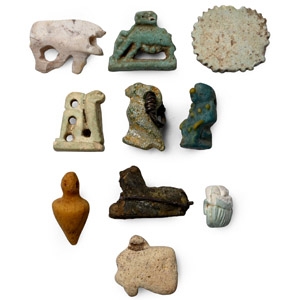
Egyptian Faience and Hardstone Amulet Group
Late-Ptolemaic Period, 664-30 B.C.Sold for (Inc. bp): £221
Including two wedjat eyes, a seated baboon, plumb bob, uraeus, scarab, falcon, recumbent lion, suckling sow (representing Nut), and a fringe-edged disc bead. 8.08 grams total, 9-18 mm
From an early 20th century collection. This lot is accompanied by an illustrated lot declaration signed by the Head of the Antiquities Department, Dr Raffaele D'Amato. -
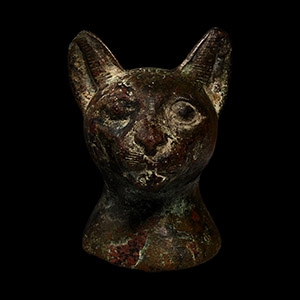
Egyptian Bronze Cat Head with Incised Scarab
Late Period, 664-332 B.C.Sold for (Inc. bp): £5,777
The head of goddess Bastet modelled in the round with alert ears and eyes, fine whisker detailing to the gently elongated muzzle, hair detailing to the inner edges of the ears and the lower outer edges pierced to accept separate earrings, incised scarab on the top of the head. 92.5 grams, 58 mm
Elizabeth Helene Demarest Osten Driesen (1892-1931). Given as a gift to her granddaughter, Lady Annabel Sutherland, by descent in the late 1960s. This lot has been checked against the Interpol Database of stolen works of art and is accompanied by search certificate number no.12762-237137. This lot has been cleared against the Art Loss Register database, and is accompanied by an illustrated lot declaration signed by the Head of the Antiquities Department, Dr Raffaele D'Amato.
In ancient Egypt, the cat was venerated as the sacred animal of the goddess Bastet, whose principal cult centre was Bubastis in the Nile Delta. Although cats were once part of folk practice, their veneration as part of formal cults spread across Egypt during the Late Period. Bastet was closely linked to lion-headed goddesses like Sekhmet, Tefnut, and Pakhet, and the cat itself became associated with solar imagery: the Book of the Dead portrays the sun god as a Great Cat vanquishing Apophis beneath the sacred Ished Tree. The cat could also embody the Eye of the Sun or, more often in Bastet’s case, the Eye of the Moon. Mummified cats were frequently dedicated as votive offerings, and some of their feline-shaped coffins were adorned with finely crafted bronze heads to enhance their divine likeness. -
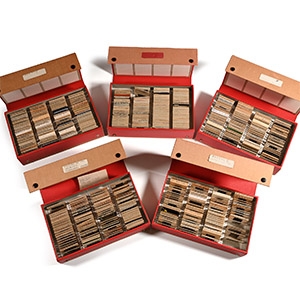
Historic Collection of 794 Slides of Archaeological Sites in Egypt
1960s-1980s A.D.Sold for (Inc. bp): £780
Housed in five linen-covered boxes, covering Karnak, Hypostyle Hall, Ptah Khonsu, Tombs of the Nobles, Rekh Mire Ramuse, Deir el Medina, and general sites etc. 4.11 kg total, 26.5 x 16.5 x 6.5 cm each box
Property of archaeologist Stephanie Gee, N.W. London, UK, 1960s-1980s. This lot is accompanied by an illustrated lot declaration signed by the Head of the Antiquities Department, Dr Raffaele D'Amato.
Stephanie Gee was a prominent archaeologist who took part in several expeditions in Egypt. She was a trusted assistant to the British-Australian archaeologist Veronica Seton-Williams, who excavated in Egypt, Britain, and the Near East. Stephanie also took part in the Tell El-Farâ'în expeditions of 1965-1968, and assisted Seton-Williams with preparing the 1966 expedition report. Their collaboration continued and Stephanie helped with the manuscript of Seton-Williams’ book ‘The Road to El-Aguzein’, a narrative account of her life that was first published in 1988.
