
Loading, please wait...
LOT 0531
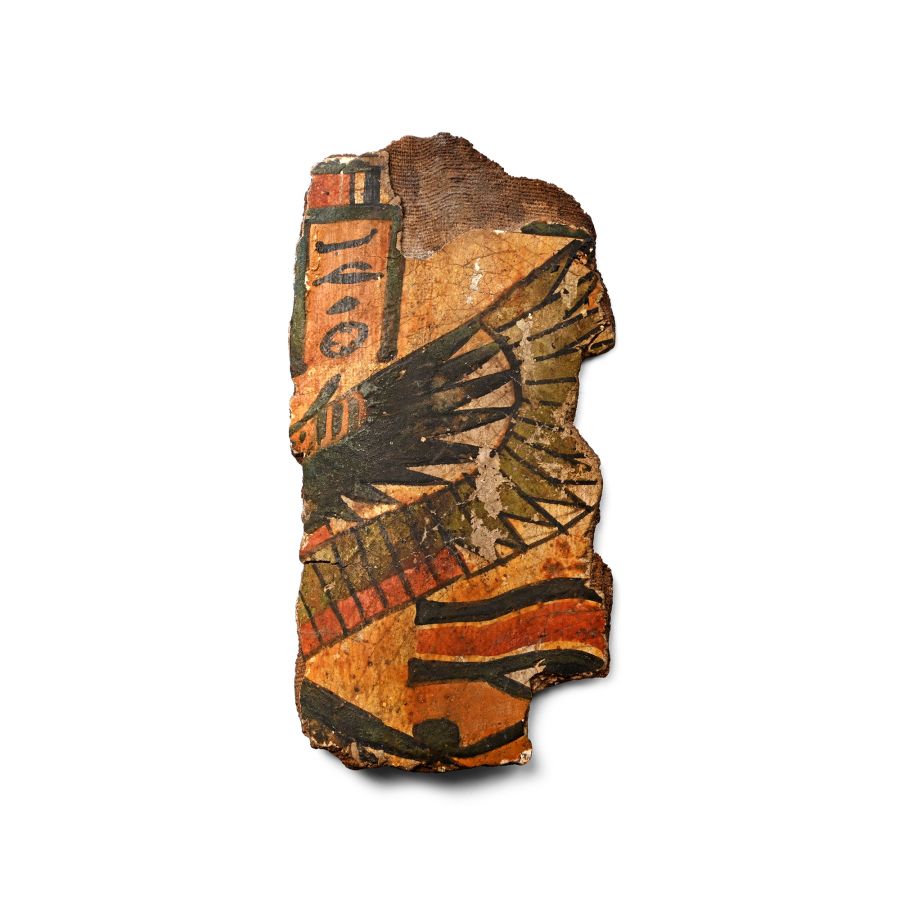
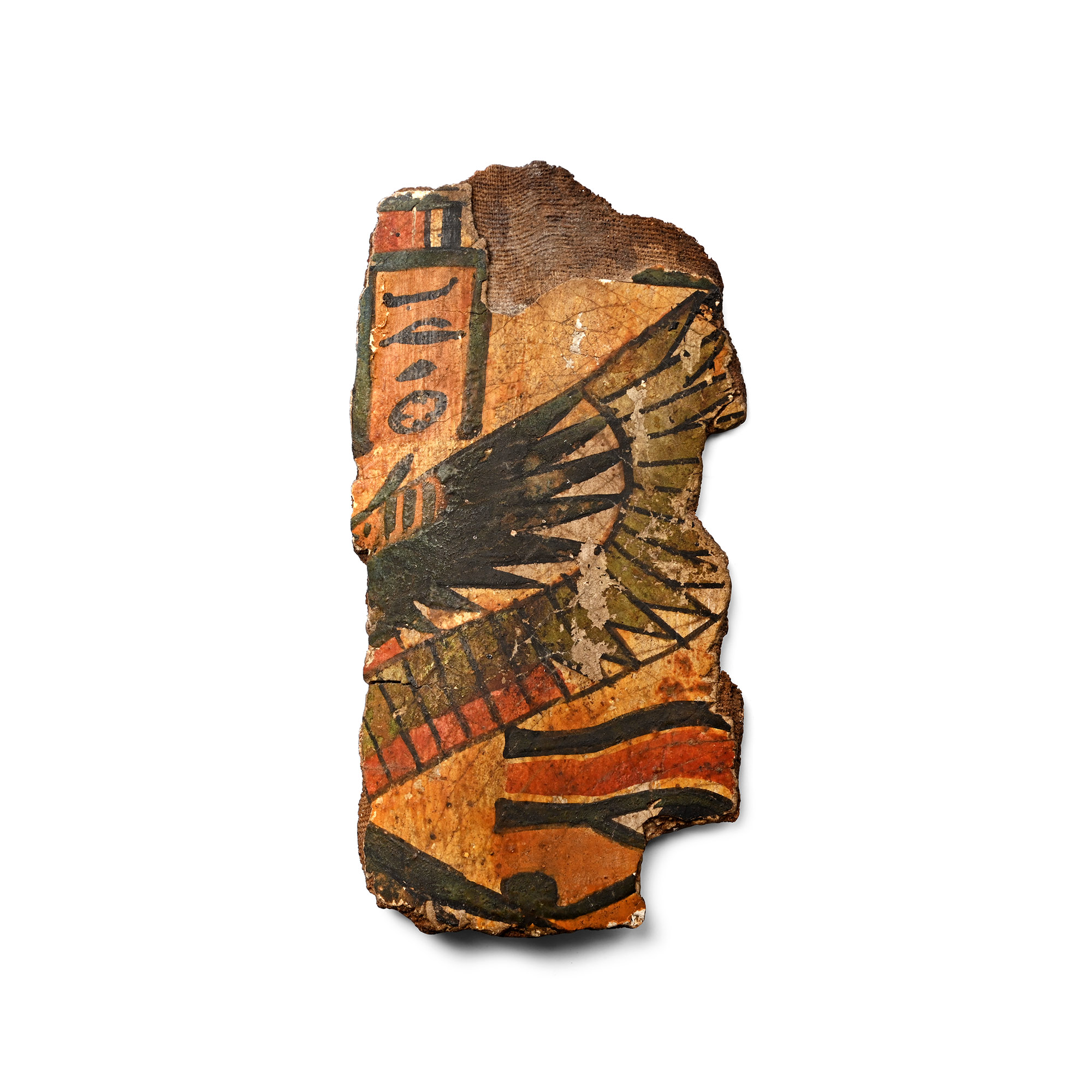
Egyptian Cartonnage Section with Eye and Wing
THIRD INTERMEDIATE PERIOD, CIRCA 1069-860 B.C.
6 3/4 in. (48 grams, 17 cm).
Sub-rectangular in plan with irregular and fragmented edge; prepared plaster surface featuring a line-bordered column with four cursive hieroglyphs naming Behedet (bḥdt); a section of finely painted outstretched wing with feather detailing to lower edge in red and blue; below, a wedjat eye in black with red medial band; fabric back to reverse.
ProvenanceFormerly from an old collection of a Wiltshire, UK, collector, acquired before 1980.
Property of a private collector, West London, UK.
This lot is accompanied by an illustrated lot declaration signed by the Head of the Antiquities Department, Dr Raffaele D'Amato.
Cf. Sousa, R., "Yellow" Coffins from Thebes, BAR 3010, Oxford, 2020, p. 27, for the coffin of Heritubekhet with a similar feather design and colouring.
FootnotesThis fragment most likely originates from the lower chest section of a so-called anthropoid 'yellow coffin' from the Third Intermediate Period. The wing belongs to a protective deity; as Behedet is a name given to several locations (Edfu, Tell el-Balamun, and Lepidotonpolis) associated with Horus, it seems probable that the wing belongs to the falcon form of this god.
CONDITIONTimeLine Auctions follows a vetting process to ensure the authenticity and legality of all items, reinforcing our commitment to integrity and responsible trading. Each antiquity, antique, and coin lot undergoes thorough examination by a vetting committee of at least ten external specialists, professional trade association members, scientists, and archaeologists: Our Vetting Process
AUCTIONS:
TimeLine is a leading auction house specialising in antiquities, ancient art, collectables, natural history, coins, medals, and books. Our auctions offer museums, collectors, historians, and enthusiasts the opportunity to acquire unique and historically significant pieces.
-
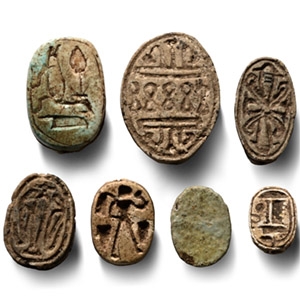
Egyptian Mixed Scarab and Scaraboid Collection
2nd-1st millennium B.C.Sold for (Inc. bp): £468
Comprising (from left to right, top to bottom): 1) a scarab with an oval border containing a goose, nefer(?), and a reed leaf; 2) a scarab with an oval border featuring a triple lotus flower motif at the top and bottom, with a middle row of floral bundles; 3) a scaraboid with a long oval border containing a cross pattern incorporating scrolls, coiled cords, and floral elements; 4) a scarab with an oval border featuring a hes-jar flanked by two cobras; 5) a scarab with a standing male figure holding a sceptre/mace and a flail, flanked by two highly stylised rearing cobras; 6) a plain scarab; 7) and a scarab with an oval border containing the name Amun-Re, a neb symbol, and a lotus flower. 13 grams total, 11-23 mm
From the collection of a gentleman, acquired on the London art market in the 1990s. This lot is accompanied by an illustrated lot declaration signed by the Head of the Antiquities Department, Dr Raffaele D'Amato. -
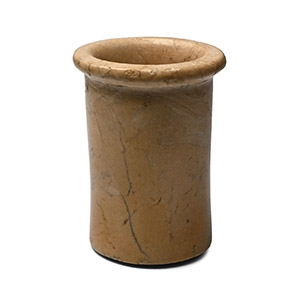
Egyptian Cylindrical Breccia Vase
Early Dynastic Period-Old Kingdom, 3050-2181 B.C.Sold for (Inc. bp): £338
Columnar in form with thick everted rim, slightly domed underside. 534 grams, 10.7 cm
From the private collection of a Canadian gentleman living in Essex, UK, formed since the 1920s-circa 1990. Property of an Essex lady until the late 1990s; thence by descent. From the private collection of an Essex gentleman since the late 1990s. This lot is accompanied by an illustrated lot declaration signed by the Head of the Antiquities Department, Dr Raffaele D'Amato. -
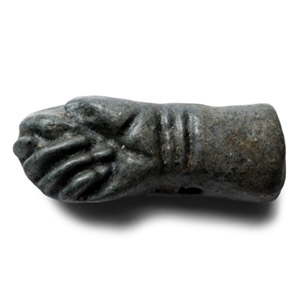
Egyptian Faience Fist Amulet
Ptolemaic-Roman Period, 323 B.C.-323 A.D.Sold for (Inc. bp): £124
Modelled as a right hand in fica protective gesture; pierced at wrist. 1.48 grams, 20 mm
From an early 20th century collection. This lot is accompanied by an illustrated lot declaration signed by the Head of the Antiquities Department, Dr Raffaele D'Amato.
