
Loading, please wait...
LOT 0011
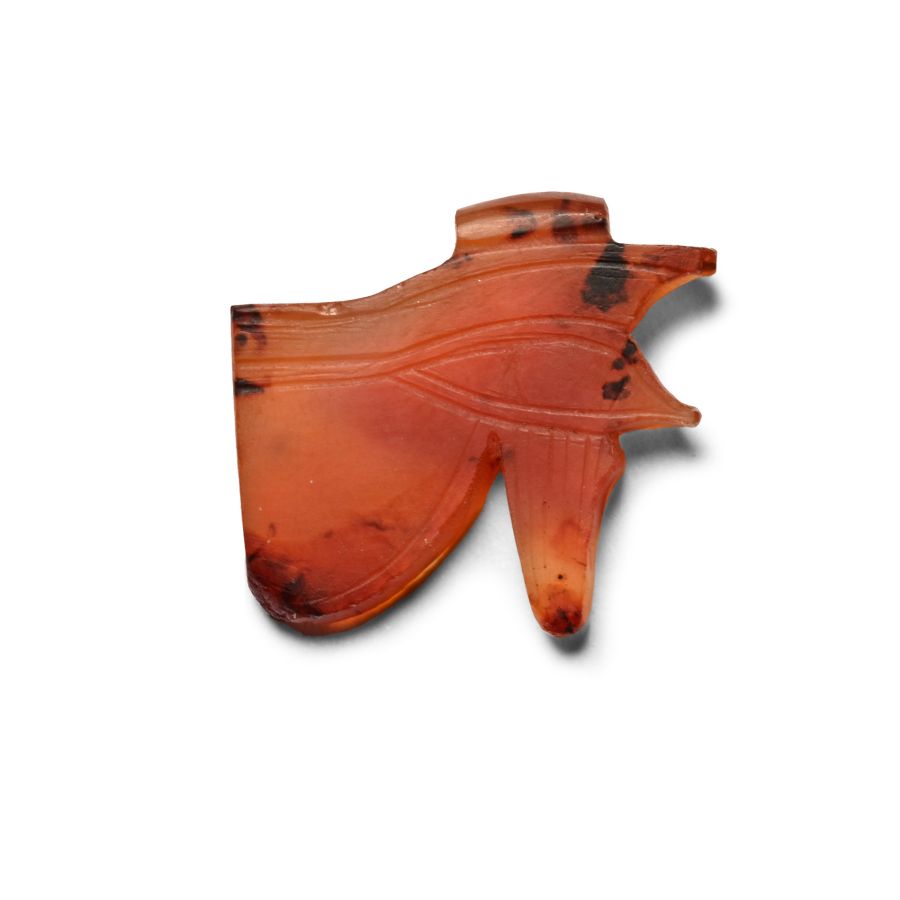
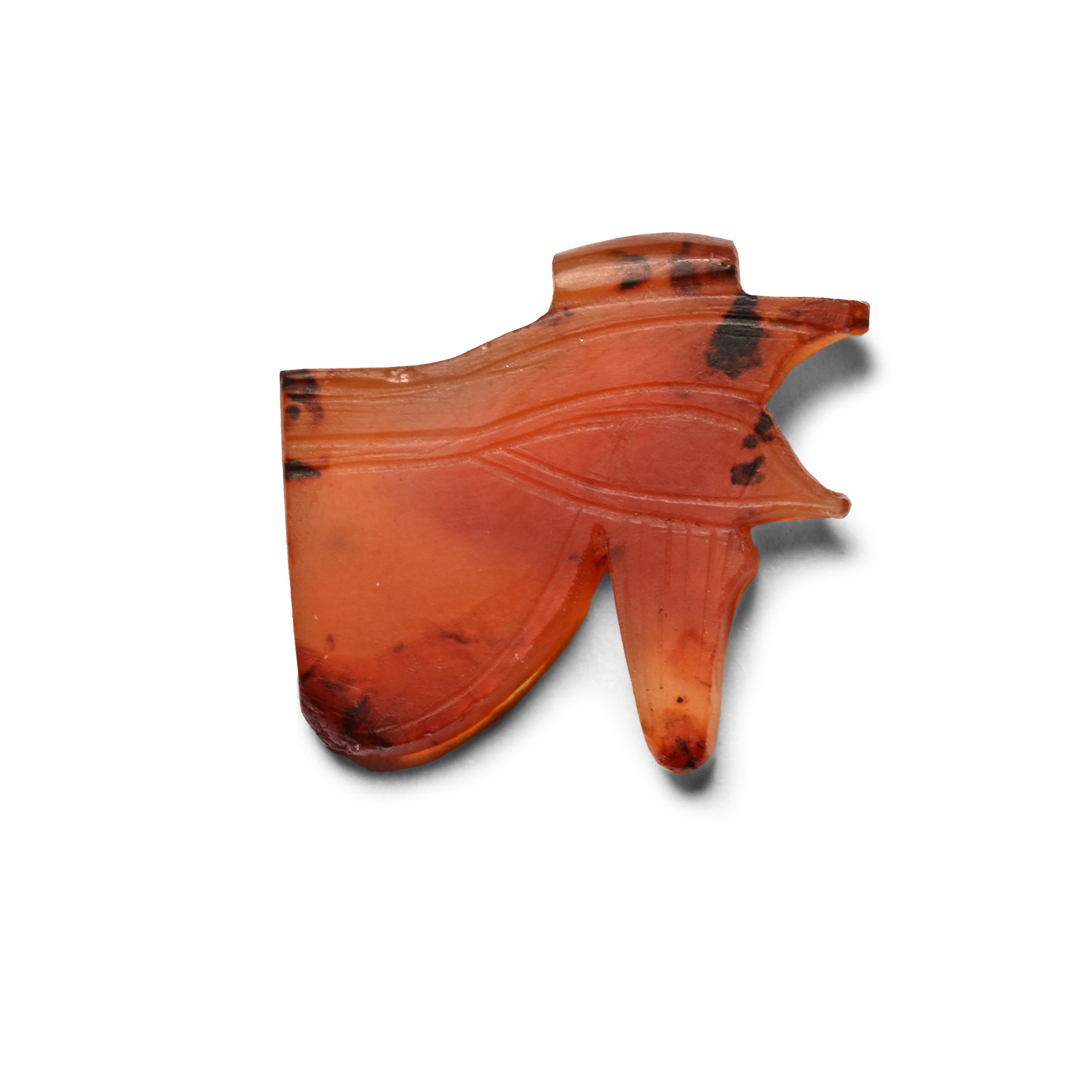
Egyptian Carnelian Eye of Horus Amulet
CIRCA 1000 B.C.
3/4 in. (1.64 grams, 19 mm).
With exceptional eye detailing carved in low-relief to one face.
ProvenanceEx R. Liechti (1934-2010) Geneva, Switzerland, formed between 1950-1990s.
Accompanied by a copy of an old collection inventory note.
Cf. Petrie, W.M.F., Amulets. Illustrated by the Egyptian Collection in University College, London, 1914, pl. XXV, no. 138z, for a wedjat-eye amulet of similar style.
FootnotesThe wedjat-eye amulet is a representation of the healed eye of the god Horus, featuring both human and falcon elements. The name wedjat in ancient Egyptian means ‘the one that is sound.’ According to Egyptian mythology, Horus' eye was wounded or taken by the god Seth and restored by Thoth. The wedjat-eye amulet was thought to protect its wearer and bestow the power of recovery and regeneration onto them. It was very popular and used by both the living and the dead.
CONDITIONTimeLine Auctions follows a vetting process to ensure the authenticity and legality of all items, reinforcing our commitment to integrity and responsible trading. Each antiquity, antique, and coin lot undergoes thorough examination by a vetting committee of at least ten external specialists, professional trade association members, scientists, and archaeologists: Our Vetting Process
AUCTIONS:
TimeLine is a leading auction house specialising in antiquities, ancient art, collectables, natural history, coins, medals, and books. Our auctions offer museums, collectors, historians, and enthusiasts the opportunity to acquire unique and historically significant pieces.
-
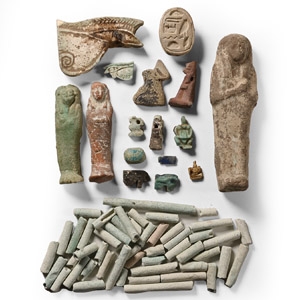
Egyptian Faience Amulet and Bead Group
Mainly Late Period, 664-332 B.C.Sold for (Inc. bp): £390
Comprising tubular beads, wedjat-eye amulets, shabtis, scarabs, and other items. 57 grams total, 8-71 mm
From the private collection of H. Norry, 1980s-1990s. -
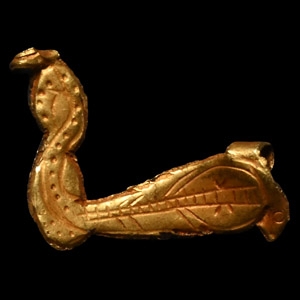
Egyptian Gold Cobra Amulet
Late Period, 664-332 B.C.Sold for (Inc. bp): £195
Depicting a rearing cobra with incised detailing and a suspension loop behind the head. 0.17 grams, 11 mm
From the private collection of the late Mrs Belinda Ellison, a long time member of the Egyptian Exploration Society, c.1940-2020. -
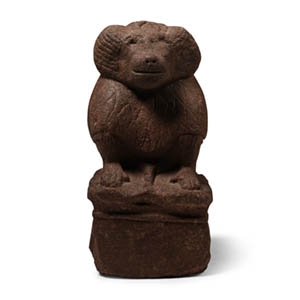
Egyptian Brown Quartzite Baboon Animal Figurine
New Kingdom, circa 1550-1070 B.C.Estimate: £6,000 - 8,000 (‡+bp*)
Opening Bid: £3,000
Carved in a typical pose, sitting on its haunches with its tail curving around the right side, its front paws resting on its knees and protruding beneath its thick furry pelt, with incised detailing, its feet either side of the phallus, the head with bulbous, striated hair on either side, chipped, snout restored; seated on a high shrine-shaped plinth with squared front and rounded back, featuring a cavetto cornice and roll detailing on the upper part. 1.15 kg, 15 cm
From a deceased American estate, 1970-1989. with Bonham's, London, 28 October 2009, no.35. Accompanied by copies of the relevant Bonham's catalogue pages. This lot has been checked against the Interpol Database of stolen works of art and is accompanied by a search certificate number no.12368-226706.
The baboon was an animal manifestation of the god Thoth, who was revered for his association with knowledge, writing, and healing.
