
Loading, please wait...
LOT 0456
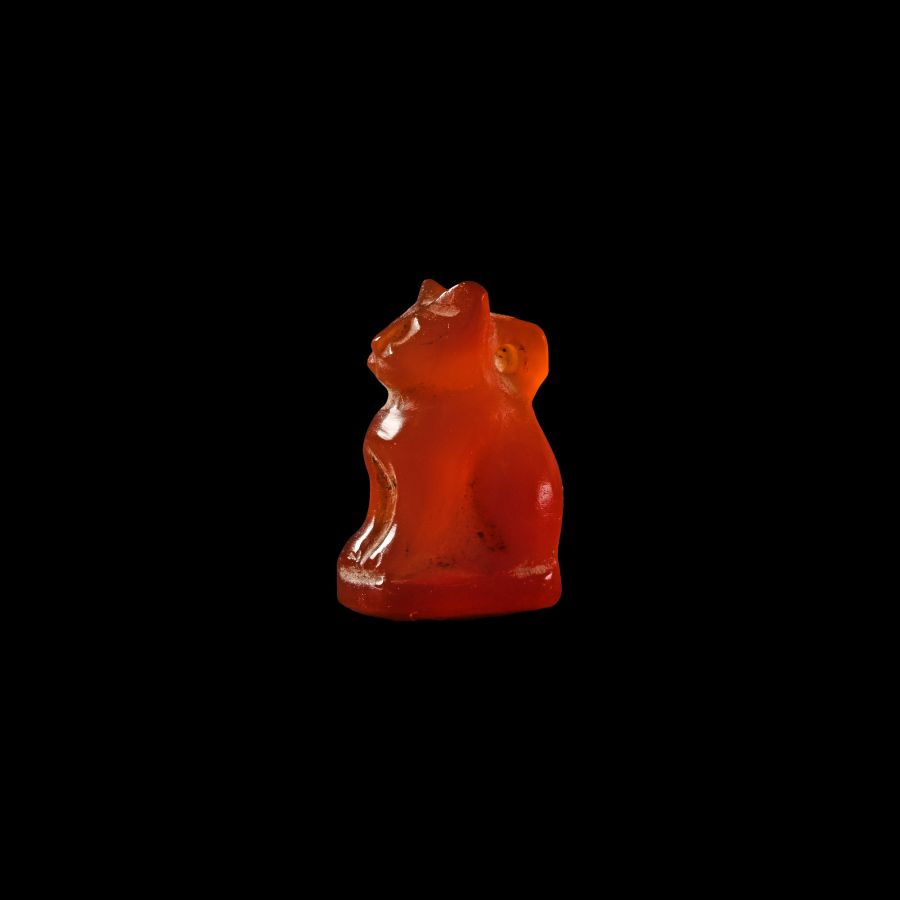
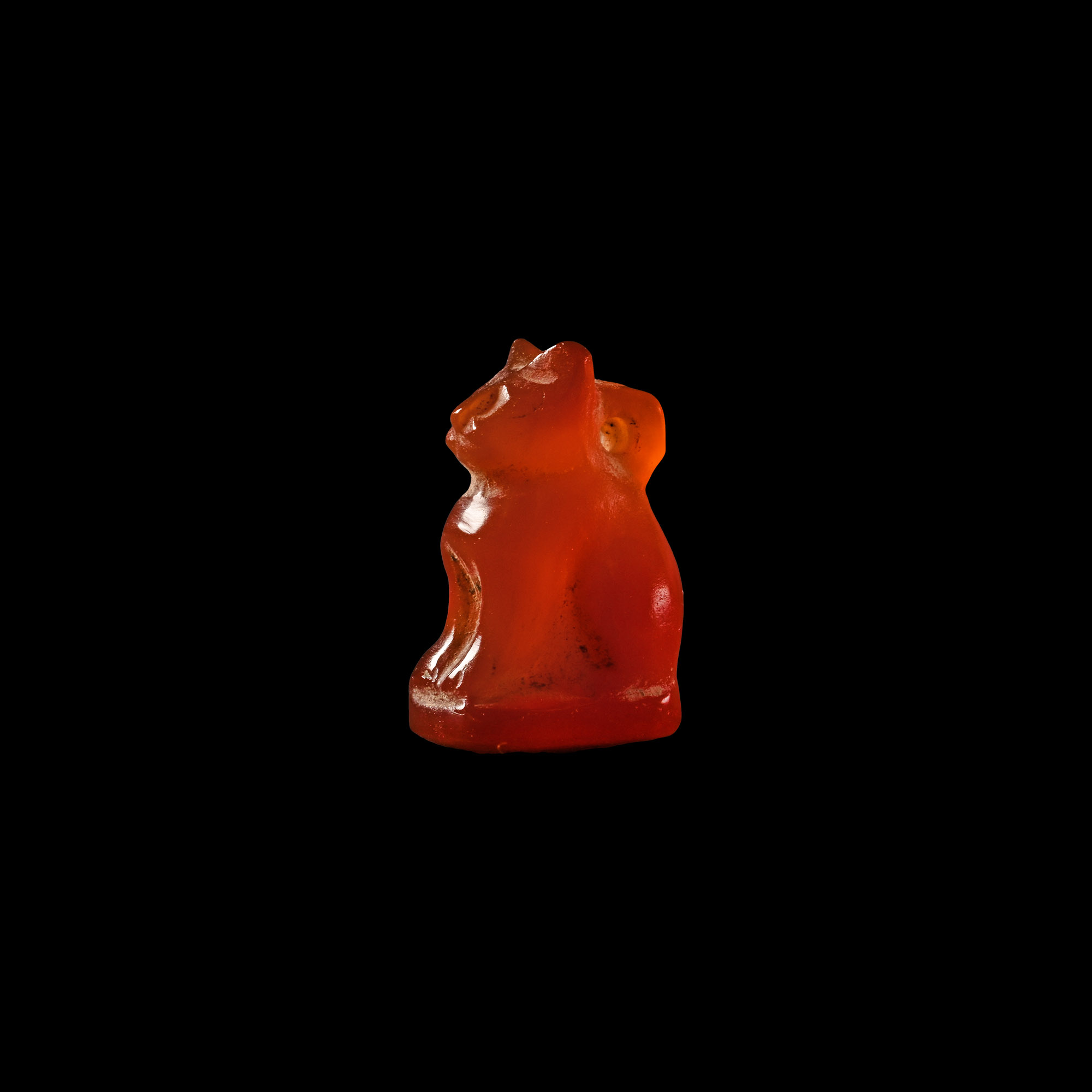
Egyptian Carnelian Cat Amulet
PTOLEMAIC PERIOD, 332-30 B.C. OR LATER
1/2 in. (1.82 grams, 16 mm).
Amuletic pendant of the cat goddess Bastet, sitting on a rectangular base, suspension loop behind the shoulders. [No Reserve]
ProvenanceAcquired 1990s.
Property of a Staffordshire lady collector.
Ex Quercus of Quonians, Lichfield, UK, 2018.
Property of a Sussex, UK, teacher.
Private collection, London.
This lot is accompanied by an illustrated lot declaration signed by the Head of the Antiquities Department, Dr Raffaele D'Amato.
Cf. Andrews, C., Amulets of Ancient Egypt, London, 1994, pp. 32-33, for discussion, and figs. 28f, 29d for examples of small cat amulets in stone and faience.
FootnotesThe cat was sacred to Bastet, a protective mother goddess and the daughter of the sun god Re. Amulets provided the wearer with the goddess's protection.
Her name means ‘she of the bast [ointment jar],’ which may have contained a substance favoured by or exclusive to royalty. Originally, Bastet was depicted as a woman with the head of a lioness, but by the late New Kingdom, she was typically depicted with a cat's head. She is sometimes shown with kittens, emphasising her maternal role as a fierce protector of offspring.
TimeLine Auctions follows a vetting process to ensure the authenticity and legality of all items, reinforcing our commitment to integrity and responsible trading. Each antiquity, antique, and coin lot undergoes thorough examination by a vetting committee of at least ten external specialists, professional trade association members, scientists, and archaeologists: Our Vetting Process
AUCTIONS:
TimeLine is a leading auction house specialising in antiquities, ancient art, collectables, natural history, coins, medals, and books. Our auctions offer museums, collectors, historians, and enthusiasts the opportunity to acquire unique and historically significant pieces.
-
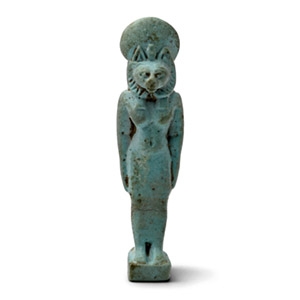
Egyptian Faience Amulet Representing Sekhmet
Late Period, 664-332 B.C.Sold for (Inc. bp): £650
With rectangular base and dorsal pillar pierced behind the shoulders, standing figure of the goddess in lioness-headed form with tripartite wig and solar disc, human body. 9.98 grams, 60 mm
Private collection, Carouge, Switzerland, assembled in the 1980s-1990s. Thence by descent to the collection of Mr S.P., since 2020. This lot is accompanied by an illustrated lot declaration signed by the Head of the Antiquities Department, Dr Raffaele D'Amato. -
.jpg)
Egyptian Basalt Statue Base For The Priest Hor-sa-aseti
Late Period, 664-332 B.C.Estimate: £4,000 - 6,000 (+bp*)
Opening Bid: £2,000
Fragment of the rectangular base of a statue, preserving an integral pair of feet on the upper surface; lower end of dorsal column inscription at the rear with two hieroglyphs; below, a horizontal band of hieroglyphic text extending onto both short sides including part of an offering formula for the ḥm-nṯr ı͗wnw-smꜤ ḥr-sꜢ-Ꜣstı͗ (the priest [of the] Southern Heliopolis [i.e., Thebes], Hor-sa-aseti); old collectors' labels on the underside; supplied with a custom-made wooden display stand. 1.37 kg, 12.9 cm (4.08 kg total, 25 cm including stand)
Private New York, USA, collection, 1970. Ex Adrian Burns, Columus, Ohio, USA, from an old estate collection. Ex Art for Eternity gallery, New York, USA. Ex Art Primativo, Auction 16, 2001, no.430. Ex private New York, USA, collection. Private collection, London, UK. Accompanied by an academic report by Egyptologist Paul Whelan. This lot has been checked against the Interpol Database of stolen works of art and is accompanied by a search certificate number no.12832-240779. This lot has been cleared against the Art Loss Register database, and is accompanied by an illustrated lot declaration signed by the Head of the Antiquities Department, Dr Raffaele D'Amato. -
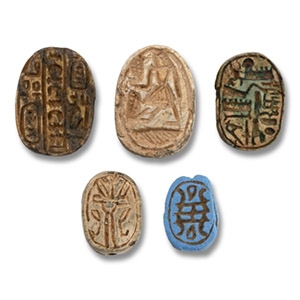
Egyptian Steatite Scarab Group
Mainly Second Intermediate Period–New Kingdom, circa 1660-1069 B.C.Sold for (Inc. bp): £286
Designs include: a tripartite design with ankh, water, nwb, and men signs, with indistinct cartouches possibly of Thutmose III, and signs spelling the phrase 'powerful is the justice of Re' (user-Maat-Re); a line border enclosing the stylised depiction of a striding figure grasping a crocodile, with a neb sign below; a line border enclosing a multitude of signs, including Thutmose III’s throne name (men-kheper-Re), and that of Amun; A line border enclosing central Hathoric sistrum; a line border enclosing a symmetrical motif in contrasting black glaze. 10.6 grams total, 13-19 mm
Acquired on the European art market in the early 2000s. with Galerie Rhéa, Zurich, Switzerland. This lot is accompanied by an illustrated lot declaration signed by the Head of the Antiquities Department, Dr Raffaele D'Amato.
