
Loading, please wait...
LOT 0494
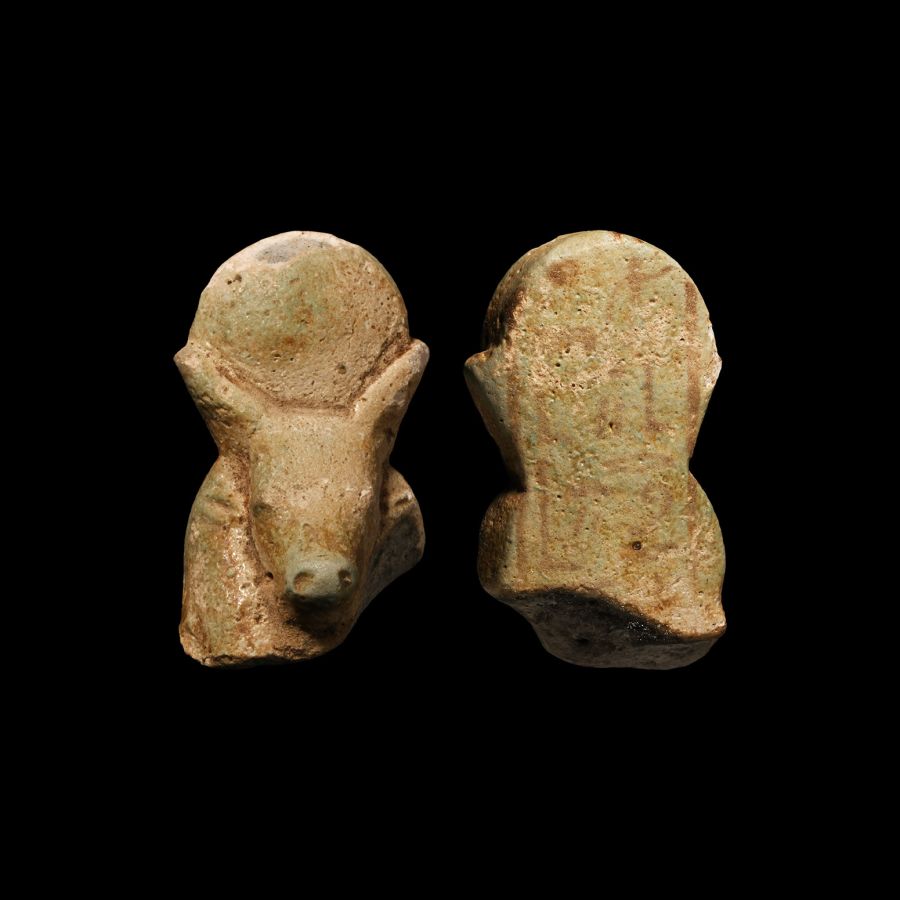
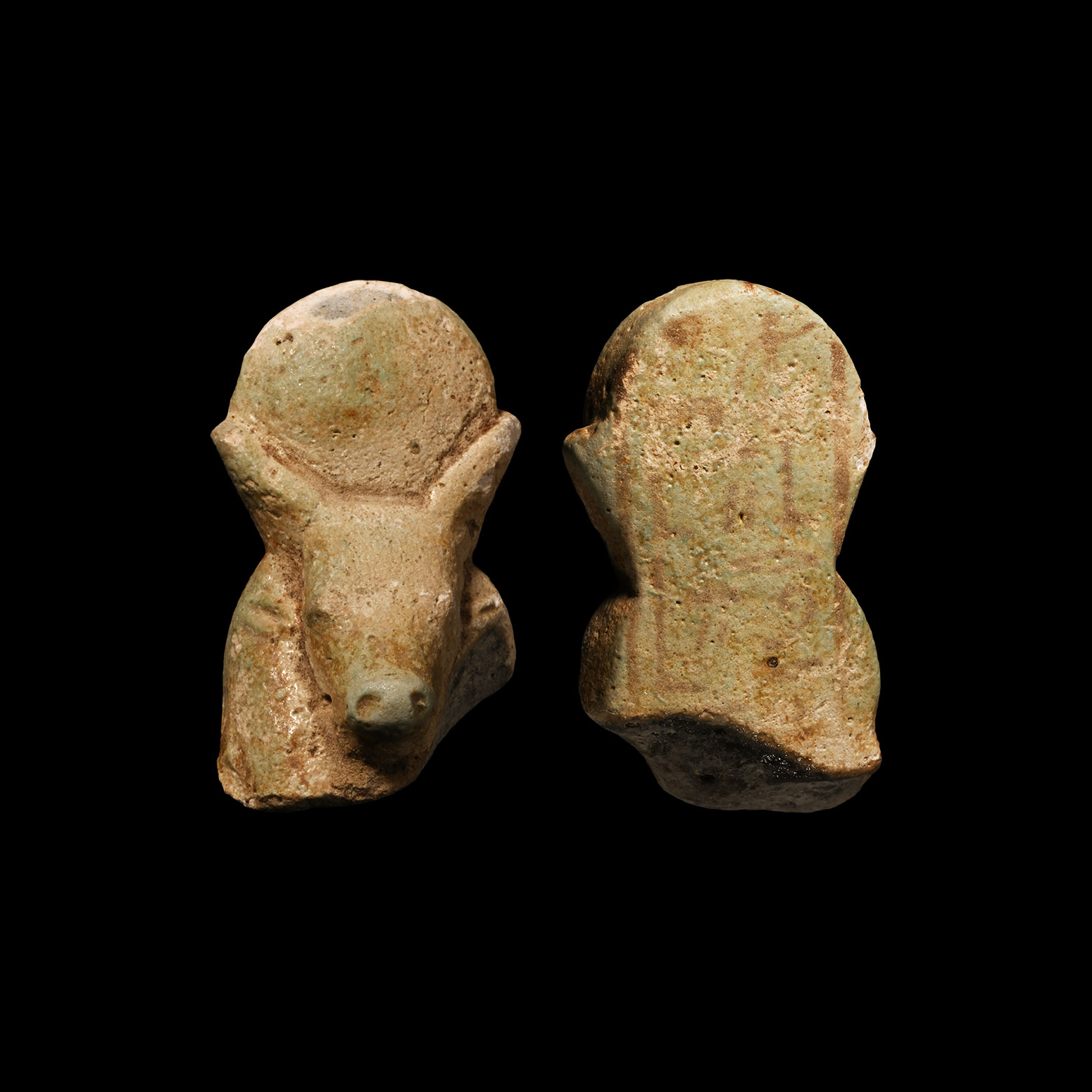
Egyptian Bull-Headed Apis Shabti Head
NEW KINGDOM, RAMESSIDE PERIOD, 1295-1069 B.C.
2 3/8 in. (34 grams, 60 mm).
A glazed composition shabti fragment representing the head of a bull surmounted by a sun-disc between its horns, wearing a lappet wig and with human arms crossed over the chest; the missing lower portion continued the shape of a mummiform human body; the back of the figure
flat and bearing faint traces of inscription, the opening begins with a common shabti introduction which appears to be followed (as would be expected) by the name of syncretic deity Osiris Apis.
Acquired early 1990s.
Ex private American collection; thence by descent.
Private collection since 1998.
Accompanied by a scholarly note by Egyptologist Paul Whelan.
Cf. Mariette, A., Le Sérapéum de Memphis, Paris 1857, pl. 22, no. 11; Musée du Louvre, Paris, inventory number S 1823, for a similar fragment.
FootnotesThe figure comes from the catacombs at Saqqara where the sacred Apis bulls were buried, known today as the Serapeum. The Apis bull was associated principally with the gods Ptah, patron deity of Memphis, and Osiris, and when one died it was afforded the kind of lavish burial
befitting a pharaoh. All bull-headed shabtis date to the 19th and 20th Dynasties and were left as offerings beside the huge granite sarcophagi of the deified bulls. These shabtis were among hundreds of objects recovered from the catacombs by Auguste Mariette during his excavations there between 1850-1853. The Musée du Louvre in Paris holds the largest collection of artefacts from the Serapeum outside Egypt, including around 120 Apis shabtis. They reveal that the this fragment with its sun-disc is from a rare variant of this shabti type; just 5 of the Louvre examples have sun-discs (S 1823, N 5234 51-54), the remaining shabtis have a bull’s head with short stubby horns and no sun-disc.
TimeLine Auctions follows a vetting process to ensure the authenticity and legality of all items, reinforcing our commitment to integrity and responsible trading. Each antiquity, antique, and coin lot undergoes thorough examination by a vetting committee of at least ten external specialists, professional trade association members, scientists, and archaeologists: Our Vetting Process
AUCTIONS:
TimeLine is a leading auction house specialising in antiquities, ancient art, collectables, natural history, coins, medals, and books. Our auctions offer museums, collectors, historians, and enthusiasts the opportunity to acquire unique and historically significant pieces.
-
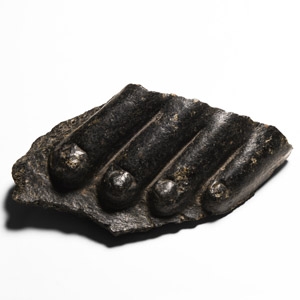
Egyptian Black Granite Foot Fragment
Late New Kingdom, 1550-1070 B.C.Sold for (Inc. bp): £585
A carved black granite statue base fragment with four toes modelled in the round, with delineated nails of a left foot. 253 grams, 11.8 cm
Acquired from France, 2015. English private collection. Accompanied by a copy of the French cultural passport no.167713. Accompanied by an academic report by Dr Alberto Maria Pollastrini. -
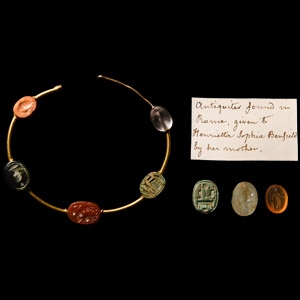
Egyptian and Later Scarab and Intaglio Collection
Late Period, 664-332 B.C.Sold for (Inc. bp): £1,950
A mixed group of scarabs and intaglios comprising: carnelian plaque with helmetted warrior holding shield with right hand and winged Nike on his left; green glazed composition scarab with enigmatic hieroglyphs on base; onyx scarab with an armed running warrior on base, cut in Rome; a later gold bracelet with an Etruscan scarab; one wedjat eye scaraboid; an Etruscan scarab with a centaur; one stone scarab with seated Ra-Horakhty above nb reading 'lord Ra Horakhty'; one pink stone scarab with bird. 4.13 grams total, 12-15 mm
Supplied with small a handwritten note: 'Antiquities found in Rome, given to Henrietta Sophia Benfield by her mother'. Henrietta Sophia Benfield (1796-1857) was the daughter of Paul Benfield and his wife, Mary Frances, daughter of Henry Swinburne (1743-1803). Property of the Berkeley collection. With Sotheby's, London, 11 December 2019, lot 182. English private collection. -
.jpg)
Egyptian Faience Scaraboid of Seti I and Thutmose III
New Kingdom, 19th Dynasty, 1314-1304 B.C.Sold for (Inc. bp): £1,040
A blue glazed bifacial scaraboid; one side bearing the cartouche of Thutmose III and the legend “Enduring image of Re” and the other side Seti I’s throne name Men-Maat-Re (meaning “Eternal is the Justice of Re”) with other signs for an epithet that perhaps reads as “truly praised (of Re)”; pierced for suspension. 4.11 grams, 23 mm
From an old UK collection. From the private collection of Alf Baxendale (1941-2016) part 2, keen Egyptologist, member of the Egyptology Society, trustee of the Amarna Trust; thence by descent. Accompanied by an identification display card. Accompanied by a copy of his obituary published in Horizon, The Amarna Project and Amarna Trust newsletter, Issue 18, 2017, p.21, by Barry John Kemp, CBE, FBA, Professor Emeritus of Egyptology at the University of Cambridge and directing excavations at Amarna in Egypt.
Seti I's reign saw the production of many scarabs, scaraboids and plaques bearing his name as well as that of Thutmose III - who was considered a great warrior king.
