
Loading, please wait...
_900x900.jpg "Egyptian Brown Quartzite Figure of the Baboon God Thoth")
_200x200.jpg "Egyptian Brown Quartzite Figure of the Baboon God Thoth")
_900x900.jpg "Egyptian Brown Quartzite Figure of the Baboon God Thoth")
_200x200.jpg "Egyptian Brown Quartzite Figure of the Baboon God Thoth")
_900x900.jpg "Egyptian Brown Quartzite Figure of the Baboon God Thoth")
_200x200.jpg "Egyptian Brown Quartzite Figure of the Baboon God Thoth")
.jpg "Egyptian Brown Quartzite Figure of the Baboon God Thoth")
.jpg "Egyptian Brown Quartzite Figure of the Baboon God Thoth")
.jpg "Egyptian Brown Quartzite Figure of the Baboon God Thoth")
LOT 0469
Egyptian Brown Quartzite Figure of the Baboon God Thoth
NEW KINGDOM, CIRCA 1550-1070 B.C.
5 7/8 in. (1.15 kg, 15 cm).
Carved in a typical pose, sitting on its haunches with its tail curving around the right side, its front paws resting on its knees and protruding beneath its thick furry pelt, with incised detailing, its feet either side of the phallus, the head with bulbous, striated hair on either side, chipped, snout restored; seated on a high shrine-shaped plinth with squared front and rounded back, featuring a cavetto cornice and roll detailing on the upper part.
ProvenanceFrom a deceased American estate, 1970-1989.
with Bonhams, London, 28 October 2009, no.35.
Accompanied by copies of the relevant Bonhams catalogue pages.
This lot has been checked against the Interpol Database of stolen works of art and is accompanied by a search certificate number no.12368-226706.
Cf. seated baboon of brown quartzite, Kozloff, A.P. & Bryan, B.M., Egypt's Dazzling Sun, Cleveland, 1992, fig 36, p.227.
FootnotesThe baboon was an animal manifestation of the god Thoth, the patron deity of Hermopolis Magna, who was revered for his association with knowledge, writing, and healing.
CONDITIONTimeLine Auctions follows a vetting process to ensure the authenticity and legality of all items, reinforcing our commitment to integrity and responsible trading. Each antiquity, antique, and coin lot undergoes thorough examination by a vetting committee of at least ten external specialists, professional trade association members, scientists, and archaeologists: Our Vetting Process
AUCTIONS:
TimeLine is a leading auction house specialising in antiquities, ancient art, collectables, natural history, coins, medals, and books. Our auctions offer museums, collectors, historians, and enthusiasts the opportunity to acquire unique and historically significant pieces.
LOT 0469
Egyptian Brown Quartzite Figure of the Baboon God Thoth
Estimate £4,000 - 6,000€4,640 - 6,960 (for guidance only)$5,400 - 8,100 (for guidance only)
-
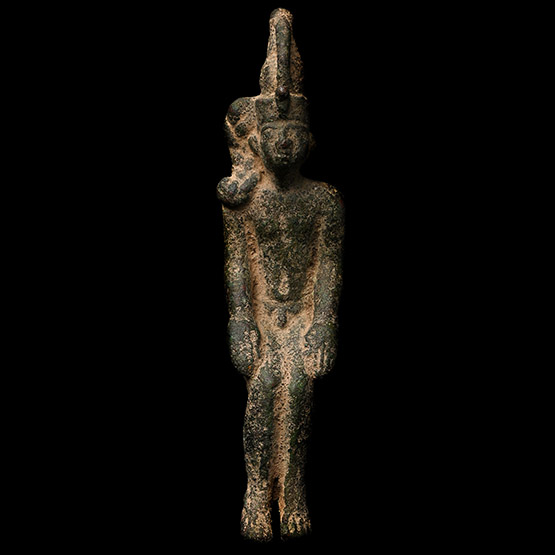
Egyptian Bronze Seated Harpocrates
Late Period, 664-332 B.C.Estimate: £800 - 1,000 (+bp*)
Opening Bid: £428
Substantial cast figurine modelled in the round of Harpocrates sitting with hands on his thighs, double crown and sidelock. 389 grams, 16.2 cm
From the collection of a gentleman, acquired on the London art market in the 1990s.
Harpocrates is the Greek rendering of the Egyptian Hor-pa-khered, which means ‘Horus the Child’. This name refers to Horus as the divine infant of Isis and Osiris. Wearing an amulet of Harpocrates was believed to give the wearer the same protection that Isis offered to her beloved son. Larger bronze statuettes probably served as votive offerings to Harpocrates to secure his favour and protection. -
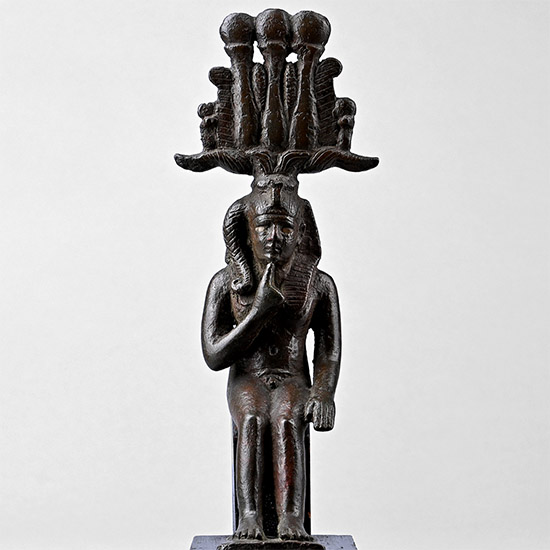
Egyptian Bronze Harpocrates Statue
26th Dynasty, 664-525 B.C.Estimate: £5,000 - 7,000 (+bp*)
Opening Bid: £2,500
Modelled in the round, shown nude, seated with his left arm by his side and his right forefinger on his chin, wearing a sidelock of youth, nemes headdress surmounted by an elaborate hem-hem crown; mounted on a custom-made stand with dealer's label to underside. 480 grams total, 19.8 cm including stand
Ex Fitzthum collection, Vermont, New England. Acquired New York, USA, 2000. Acquired from Royal Athena Galleries, New York, USA, 20 March 2008. Ex Keane collection, UK. Accompanied by a copy of the original Royal Athena Galleries invoice no.11164. This lot has been checked against the Interpol Database of stolen works of art and is accompanied by search certificate number no.13272-252852.
Harpocrates is the Greek equivalent of the Egyptian name Hor-pa-khered, which means ‘Horus the Child’. This name refers to Horus as the divine infant of Isis and Osiris. Wearing an amulet of Harpocrates was believed to provide the same protection that Isis granted to her beloved son. Larger bronze statuettes were probably votive offerings to Harpocrates, intended to secure his favour and protection. -
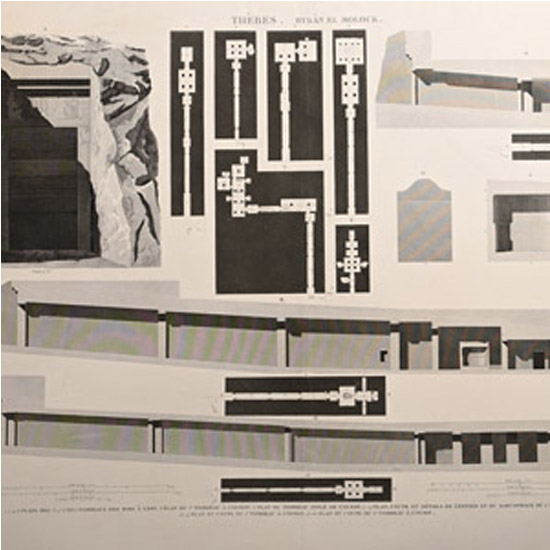
Very Large Egyptian Expedition Lithograph of Bayban el Molouk at Thebes
Early 19th century A.D.Sold for (Inc. bp): £91
Proof etching on laid paper of plate 79 Thèbes - Byban el Molouk entitled Plan des 2e, 4e, 2e et 1er tombeaux des rois a l'Est. Plan du 3e tombeau a l'Ouest. Plan du Tombeau isolé de l'Ouest. Plan, coupe et détails de l'entrée et du sarcophage du 2e tombeau a l'Ouest. Plan et coupe du 1er tombeau a l'Ouest. Plan et coupe du 6e tombeau a l'Ouest. 208 grams, 102.5 x 69 cm
From the collection of a North American priest. Acquired between 1981-1996. Property of a North American collector.
Produced between February 1802 and 1830 on the orders of Napoleon Bonaparte; published between 1809 and 1828. Just 1,000 copies were distributed to various institutions, printed on laid paper with an 'Égypte ancienne et moderne' watermark. The book is subtitled Recueil des observations et des recherches qui ont été faites en Égypte pendant l’expédition de l’Armée française, publié par les ordres de Sa Majesté l’Empereur Napoléon le Grand (Gathering of observations and discoveries which were made in Egypt during the expedition of the French army, published on the orders of His Majesty the Emperor Napoleon the Great). It was the world's first encyclopedia devoted exclusively to the remains of ancient Egypt. The plates of this book are the first to present the archaeological sites of Thebes (Luxor). This plate shows plans and sections of some of the royal tombs in the Valley of the Kings.
