
Loading, please wait...
_900x900.jpg "Egyptian Bronze Uraeus Mount")
_200x200.jpg "Egyptian Bronze Uraeus Mount")
.jpg "Egyptian Bronze Uraeus Mount")
LOT 0468
Egyptian Bronze Uraeus Mount
LATE PERIOD-PTOLEMAIC PERIOD, CIRCA 664-30 B.C.
1 3/8 in. (6.54 grams, 35 mm).
Formed as a rearing cobra with the hood divided into cells to accept inlay. [No Reserve]
ProvenanceFrom the collection of a gentleman, acquired on the London art market in the 1990s.
LiteratureCf. Tinius, I., Altägypten in Braunschweig. Die Sammlungen des Herzog Anton Ulrich-Museums und des Städtischen Museums, Wiesbaden, 2011, p. 93, no. 143, for a similar, fragmentary example.
FootnotesThe uraeus depicts a rearing cobra and symbolises royal power and authority, as well as the Lower Egyptian goddess Wadjet.
CONDITIONTimeLine Auctions follows a vetting process to ensure the authenticity and legality of all items, reinforcing our commitment to integrity and responsible trading. Each antiquity, antique, and coin lot undergoes thorough examination by a vetting committee of at least ten external specialists, professional trade association members, scientists, and archaeologists: Our Vetting Process
AUCTIONS:
TimeLine is a leading auction house specialising in antiquities, ancient art, collectables, natural history, coins, medals, and books. Our auctions offer museums, collectors, historians, and enthusiasts the opportunity to acquire unique and historically significant pieces.
-
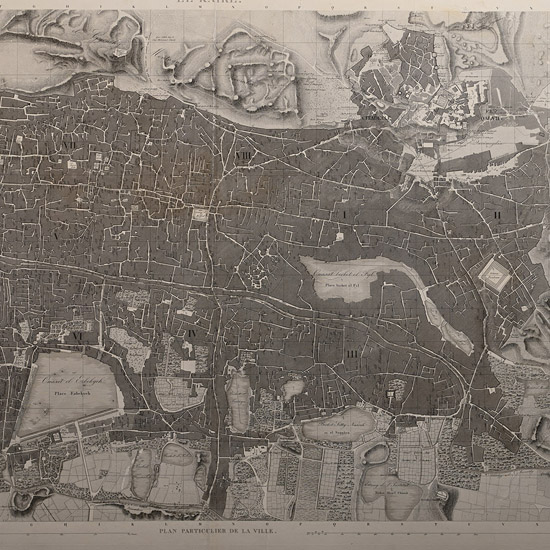
Very Large Egyptian Expedition Lithograph of the Plan of Cairo
Early 19th century A.D.Sold for (Inc. bp): £130
Proof etching on laid paper of plate 50 from Vol I of Description de l'Égypte : ou, Recueil des observations et des recherches qui ont été faites en Égypte pendant l'expédition de l'armée française, titled Le Kaire. Plan particulier de la ville. 231 grams, 106 x 69.5 cm
From the collection of a North American priest. Acquired between 1981-1996. Property of a North American collector.
Produced between February 1802 and 1830 on the orders of Napoleon Bonaparte; published between 1809 and 1828. Just 1,000 copies were distributed to various institutions, printed on laid paper with an 'Égypte ancienne et moderne' watermark. The book is subtitled Recueil des observations et des recherches qui ont été faites en Égypte pendant l’expédition de l’Armée française, publié par les ordres de Sa Majesté l’Empereur Napoléon le Grand (Gathering of observations and discoveries which were made in Egypt during the expedition of the French army, published on the orders of His Majesty the Emperor Napoleon the Great). It was the world's first encyclopedia devoted exclusively to the remains of ancient Egypt. The plates of this book are the first to present the archaeological sites of Thebes (Luxor). The papyrus manuscript was recovered from the underground chambers (hypogea). -
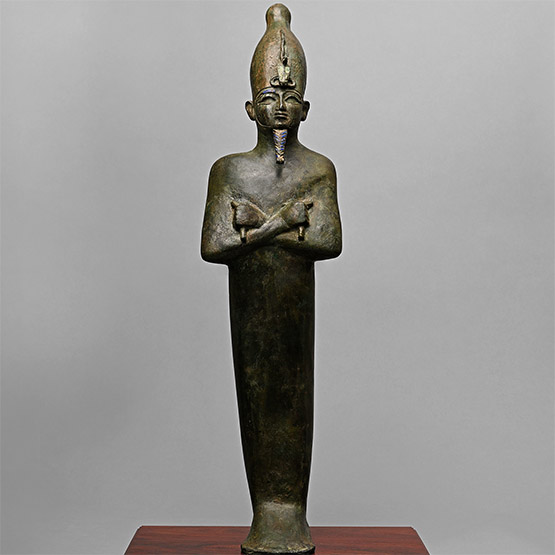
Large Egyptian Bronze Figure of Osiris with Lapis Lazuli Inlays
Late Period, 664-525 B.C.Estimate: £80,000 - 100,000 (+bp*)
Opening Bid: £40,000
Standing mummiform figure of Osiris wrapped in a body-hugging shroud; the figure wearing a tall Hedjet crown – representing the central element of Osiris’s lateral plume-flanked Atef crown; three vertical slots visible on either side of the preserved crown represent the mortices for the attachment of the separately cast plumes; a raised uraeus at the front of the crown, with a body coil on each side and a slightly undulating tail extending vertically up the crown; the broad face rendered with deeply recessed eyebrows, one still retaining a portion of lapis-lazuli inlay, almond-shaped eyes deeply recessed for inlay, a straight nose, and a small, closed mouth; once inlayed chin straps run from the temples to the chin, where a separately cast divine beard is attached, with deep chevron-like recesses, some retaining traces of blue inlay; arms crossed over the chest, with the hands emerging from the wrappings to hold the god’s traditional attributes – the crook (heka) and flail (nekhakha) – of which only the lowest portions are visible; holes for insertion of the separately fashioned upper parts present at the top of the fists; mounted on wooden base and supplied with custom fitted case. 19 kg total, the case: 89.5 x 36 x 41 cm (10.65 kg total, 69.5 cm high including stand)
with Seiyou Kobijyutsu, Osaka, Japan, 20th century. The acquisition was facilitated by Ichikawa Kiyoshi (September 1897–1976), a prominent consultant to the firm at the time. Private Japanese collection, Kumamoto, Kyushu, Japan, acquired in the 1960s by a medical doctor residing in Kumamoto, reportedly on the recommendation of Ichikawa Kiyoshi; thence by descent within the family until 2023. Accompanied by an academic report by Egyptologist Paul Whelan. The sculpture is accompanied by a Japanese wooden fitted box bearing the signature and seal (hanko) of Ichikawa Kiyoshi, supporting the attribution and authenticity. This lot has been checked against the Interpol Database of stolen works of art and is accompanied by search certificate number no.13192-250114.
As the principal god of the underworld, Osiris was worshipped continuously for more than 2,500 years, from the late Old Kingdom to the Roman period. The deity played a central role in Egyptian funerary belief, and his consistently mummiform imagery became widely incorporated into both royal and non-royal iconography. A major phase in the development of his cult occurred during the Middle Kingdom, when Abydos in Upper Egypt emerged as the principal cult centre and an important pilgrimage site for both royal and non-elite individuals. By the Late Period, the influence of the Osirian cult is clearly reflected in the material record, most notably in the widespread distribution of bronze statuettes across temple sites in Egypt. While such objects are often interpreted as expressions of personal devotion, their standardised forms and large-scale production may equally point to more formalised, institutionally mediated ritual practices. -
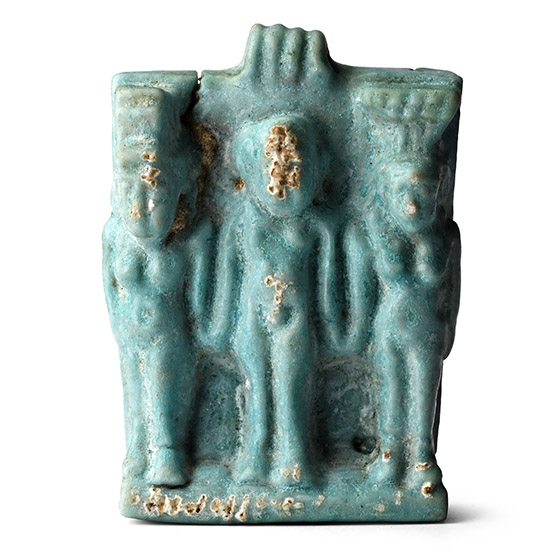
Egyptian Faience Triad Amulet
Late Period, 664-332 B.C.Estimate: £400 - 600 (+bp*)
Opening Bid: £200
Depicting in high-relief the Osirian triad (Isis, Horus, Nephthys) standing side by side on an integral plinth against a dorsal pillar; Nephthys (right) and Isis (left) are shown frontally, wearing headdresses with their specific attributes, each holding the hands of the central Horus figure, shown naked and with the side-lock of youth; a ribbed loop at the top for suspension. 8.56 grams, 33 mm
From the collection of a Swedish noble family, 1920s.
Isis and Nephthys operate as complementary sister deities who guard both Osiris and the deceased through mourning, magical protection, and ritual lamentation, while Horus, the child of Isis, signifies renewal and legitimate kingship. On amulets, the triad translates into a compact visual statement of protection: the deceased is imagined as being held within the sisters’ magical and ritual care, while Horus embodies the successful outcome of that protection in the form of rebirth and continuity.
