
Loading, please wait...
_900x900.jpg "Egyptian Bronze Statuette of Young Horus")
_200x200.jpg "Egyptian Bronze Statuette of Young Horus")
_900x900.jpg "Egyptian Bronze Statuette of Young Horus")
_200x200.jpg "Egyptian Bronze Statuette of Young Horus")
.jpg "Egyptian Bronze Statuette of Young Horus")
.jpg "Egyptian Bronze Statuette of Young Horus")
LOT 0003
Egyptian Bronze Statuette of Young Horus
LATE PERIOD, 664-332 B.C.
5 in. (202 grams total, 12.8 cm including stand).
Modelled in the round in striding pose with one arm resting along the body and the right hand raised to his mouth, wearing an elaborate side-lock of youth and Pschent crown fronted by uraeus; mounted on a display stand.
Provenancewith R.H. Blanchard's Egyptian Museum, Cairo, early 20th century.
Private collection, London, UK.
Accompanied by its original base, retaining the Blanchard label.
Cf. Daressy, G., Catalogue général des antiquités égyptiennes du Musée du Caire N° 38001-39384 Statues de divinités, Cairo, 1906, pl. X, no. 38182, for a comparable complete statuette of Harpocrates.
FootnotesHarpocrates is the Greek equivalent of the Egyptian name Hor-pa-khered, which means 'Horus the Child'. This name refers to Horus as the divine infant of Isis and Osiris. Wearing an amulet of Harpocrates was believed to provide the same protection that Isis granted to her beloved son. Larger bronze statuettes, such as this, were probably votive offerings to Harpocrates, intended to secure his favour and protection.
CONDITIONTimeLine Auctions follows a vetting process to ensure the authenticity and legality of all items, reinforcing our commitment to integrity and responsible trading. Each antiquity, antique, and coin lot undergoes thorough examination by a vetting committee of at least ten external specialists, professional trade association members, scientists, and archaeologists: Our Vetting Process
AUCTIONS:
TimeLine is a leading auction house specialising in antiquities, ancient art, collectables, natural history, coins, medals, and books. Our auctions offer museums, collectors, historians, and enthusiasts the opportunity to acquire unique and historically significant pieces.
-
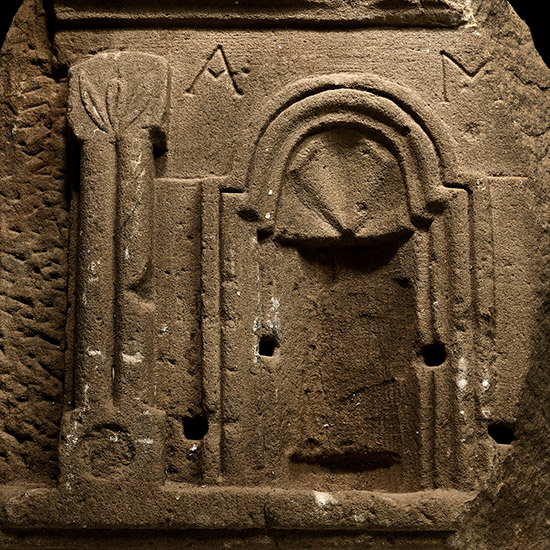
Romano-Egyptian Limestone Funerary Niche
Coptic, 5th-6th century A.D.Sold for (Inc. bp): £2,340
Carved architectural block fragment comprising: a shallow niche with arched top and parallel sides, with concentric mouldings to create a reveal and ledge below to accept offerings; horizontal tiered base; attachment sockets for two figurines (absent) flanking the niche; to left, a column modelled in the half-round with two parallel vertical stems, shallow roundel to the base and stylised foliage at the top; pediment above with scooped profile; above each figurine recess an incised initial, 'A' and 'M'; facing surface keyed for plaster finish. 57.55 kg, 49 cm
From the estate and private collection of Matthew Upham (1962-2025), an antiques trader from Budleigh Salterton, Devon, UK. Acquired at an estate sale at auction. Property of a Cambridgeshire, UK, gentleman. Accompanied by an academic report by Dr Raffaele D'Amato. This lot has been checked against the Interpol Database of stolen works of art and is accompanied by a search certificate number no. 13297-255939.
In the Christian Roman Empire, the stelae in the form of aedicula, which could be funerary monuments with crosses or the images of the deceased, or devotional niches with images of saints, appear to be independent sculptures. These stelae consisted of a rectangular body surmounted by a circular arch or trapezoidal structure. At the centre of the niche, the deceased was often depicted full-length, in a praying position (orans). Devotional stelae were also placed inside a church or shrine, with images of the Virgin and Child, or saints. -
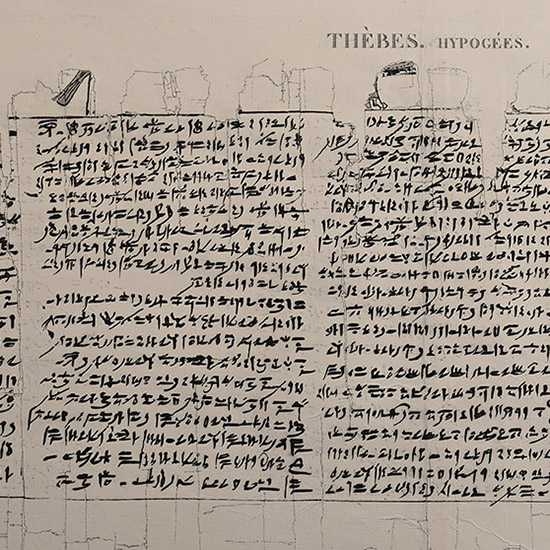
Very Large Egyptian Expedition Lithograph of the Hypogees Papyrus Manuscript from Thebes
Early 19th century A.D.Estimate: £80 - 100 (+bp*)
Opening Bid: £40
Proof etching on laid paper of plate 66 from Vol.II of Description de l'Égypte : ou, Recueil des observations et des recherches qui ont été faites en Égypte pendant l'expédition de l'armée française entitled Thèbes. Hypogées. Manuscrit sur papyrus. 230 grams, 102 x 69 cm
From the collection of a North American priest. Acquired between 1981-1996. Property of a North American collector.
Produced between February 1802 and 1830 on the orders of Napoleon Bonaparte; published between 1809 and 1828. Just 1,000 copies were distributed to various institutions, printed on laid paper with an 'Égypte ancienne et moderne' watermark. The book is subtitled Recueil des observations et des recherches qui ont été faites en Égypte pendant l’expédition de l’Armée française, publié par les ordres de Sa Majesté l’Empereur Napoléon le Grand (Gathering of observations and discoveries which were made in Egypt during the expedition of the French army, published on the orders of His Majesty the Emperor Napoleon the Great). It was the world's first encyclopedia devoted exclusively to the remains of ancient Egypt. The plates of this book are the first to present the archaeological sites of Thebes (Luxor). The papyrus manuscript was recovered from an underground tomb chamber (hypogeum). The text is written in hieratic, a cursive form of hieroglyphs, often used for religious papyrus documents. -
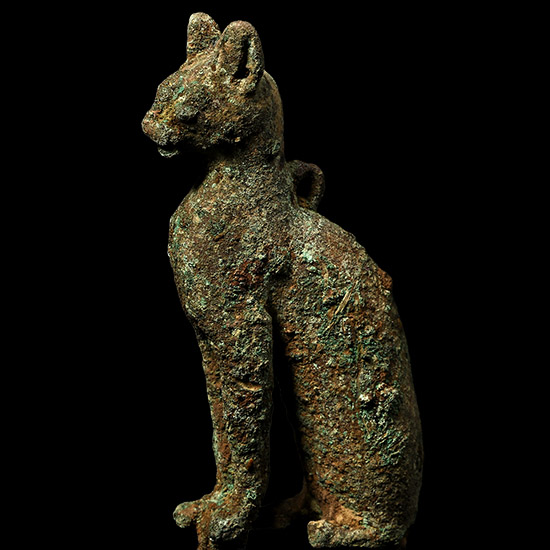
Egyptian Bronze Seated Cat Statuette
Late Period, 664-332 B.C.Sold for (Inc. bp): £1,040
Bastet in squatting pose, ears pricked and alert with her tail wrapped close to right side of her body, two short lugs beneath for attachment to a separate base, and a suspension loop behind the shoulders. 74 grams, 87 mm
Acquired on the UK art market, 1990s. Private collection, New York, USA.
