
Loading, please wait...

LOT 0029
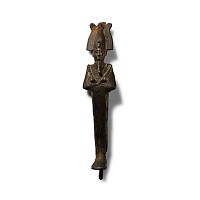
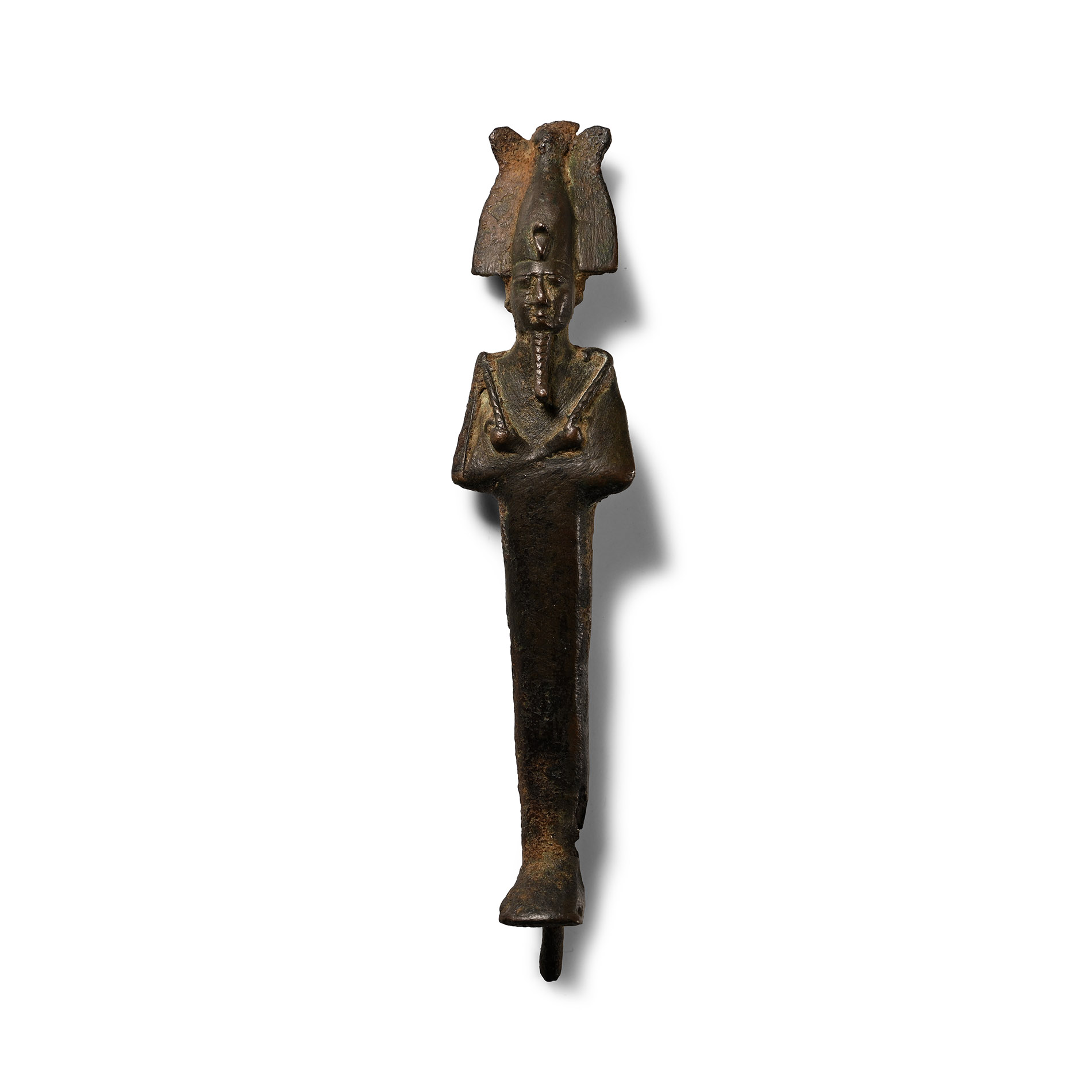
Egyptian Bronze Statuette of Osiris
LATE PERIOD, 664-332 B.C.
5 7/8 in. (63 grams, 15 cm).
A slender standing figure of Osiris in iconic mummiform appearance, wearing the tall conical Atef crown with its flanking Ostrich plumes, and central uraeus, a long, internally-detailed divine beard, and holding the crook (heka) and flail (nekhakha) regalia; with tang under feet for attachment.
ProvenanceAcquired on the German art market, 1989-1995.
with The Museum Gallery, 19 Bury Place, London, WC1, UK, 1998-2003.
Property of a London based academic, 2003-present.
Cf. Tinius, I., Altägypten in Braunschweig. Die Sammlungen des Herzog Anton Ulrich-Museums und des Städtischen Museums, Wiesbaden, 2011, p.107, no. 161, for a similar example from Aswan.
FootnotesOsiris is a deity who represents death and fertility and is commonly regarded as the quintessential god of rebirth. Though he was once a mortal ruler, as a deceased entity, his domain was the Underworld. Abydos was the primary centre of Osiris’ cult, where a renowned yearly celebration of the god was held.
CONDITIONTimeLine Auctions follows a vetting process to ensure the authenticity and legality of all items, reinforcing our commitment to integrity and responsible trading. Each antiquity, antique, and coin lot undergoes thorough examination by a vetting committee of at least ten external specialists, professional trade association members, scientists, and archaeologists: Our Vetting Process
AUCTIONS:
TimeLine is a leading auction house specialising in antiquities, ancient art, collectables, natural history, coins, medals, and books. Our auctions offer museums, collectors, historians, and enthusiasts the opportunity to acquire unique and historically significant pieces.
-
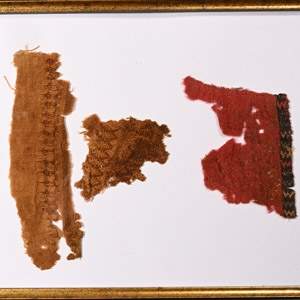
Egyptian Framed Coptic Fabric Collection
Circa 5th-7th century A.D.Sold for (Inc. bp): £85
Three fragments of tabby-weave linen fabric, two with embroidered ornament, one with a woven polychrome border; mounted in a glazed wooden frame with gilt inner border. 578 grams total, fragments: 6.5-15.5 cm (frame: 26 x 31 cm)
From the private collection of H. Norry, 1980s-1990s. -
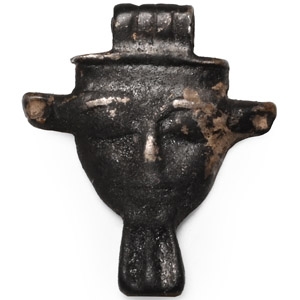
Egyptian Silver Hathor Head Amulet
Late Period, 664-332 B.C.Sold for (Inc. bp): £124
A finely detailed head of the goddess Hathor with a human face, divine beard, and cow ears, with a ribbed suspension loop on top. 0.68 grams, 11 mm
From an early 20th century collection. -
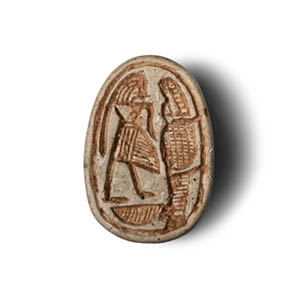
Egyptian Steatite Scarab
Second Intermediate Period, 17th-16th century B.C.Sold for (Inc. bp): £572
Finely carved scarab with naturalistically detailed legs and head, the underside decorated with a standing figure atop a neb hieroglyph facing a stylised crocodile. 4.06 grams, 21 mm
with Archeological Centre, 2015. Private collection, Europe.
Scarabs with this design have been discovered in the northern Delta of Egypt and Palestine. The influence of the crocodile god Sobek on the production of late middle Bronze Age settlers at Avaris in the Egyptian Delta likely contributed to the popularity of Egyptian-themed scarabs with crocodiles and standing figures found in Palestinian sites.
