
Loading, please wait...
LOT 0019
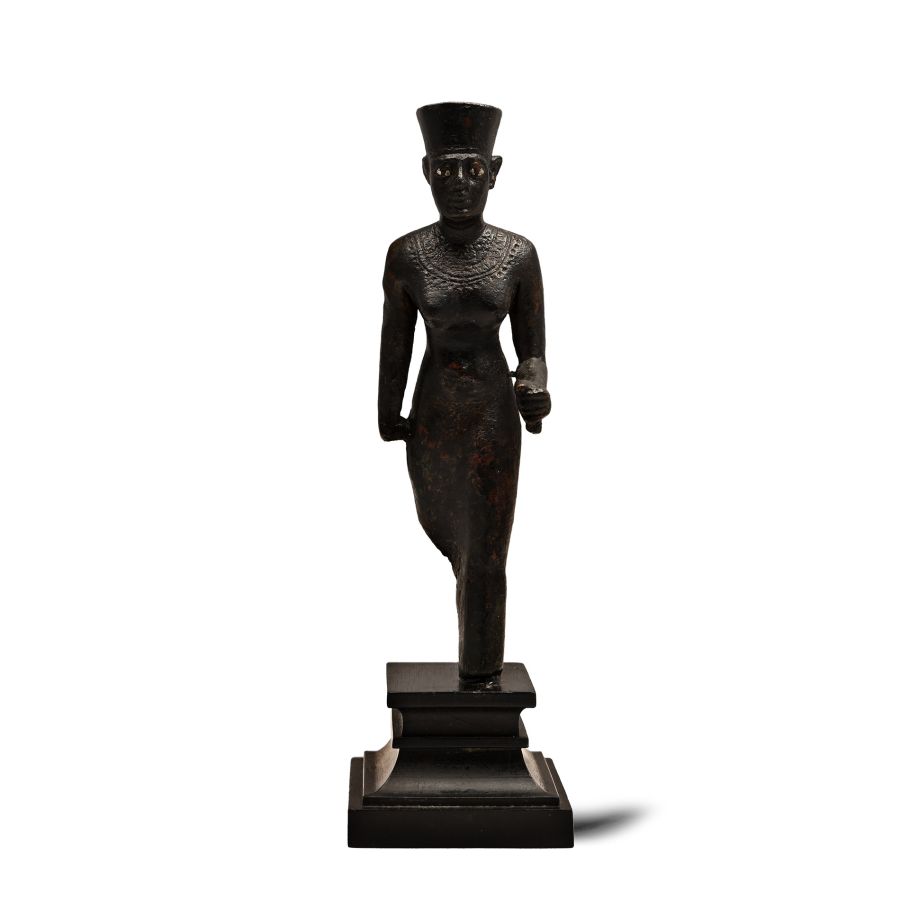
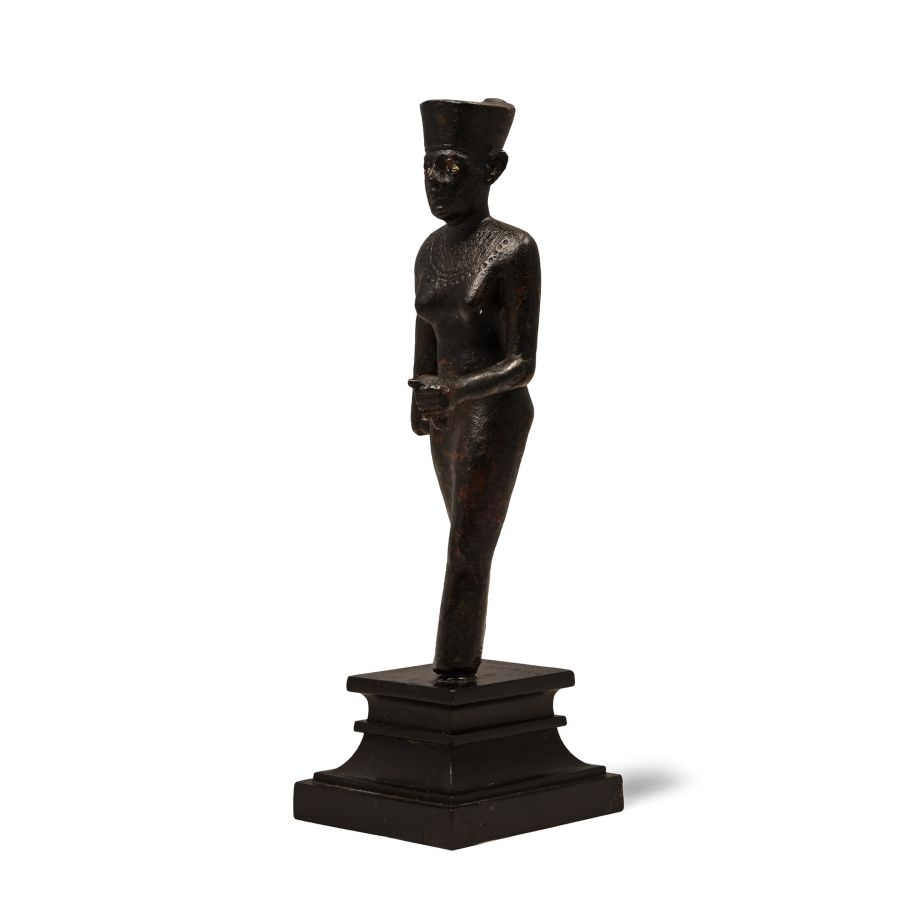
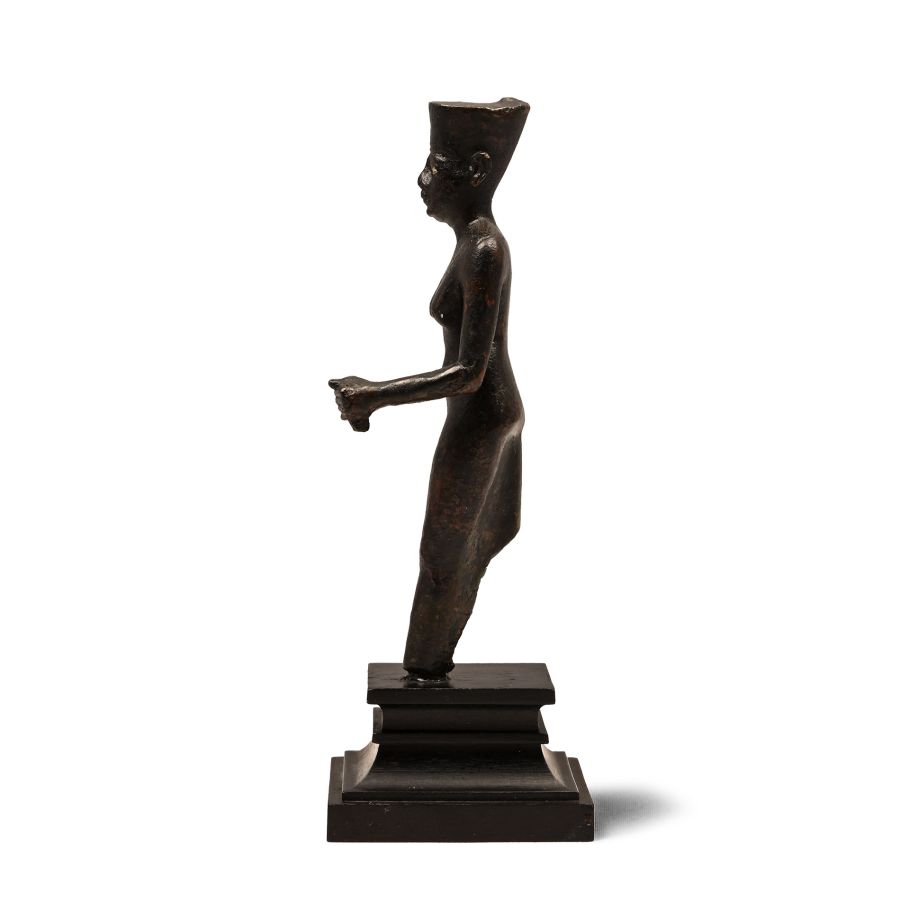
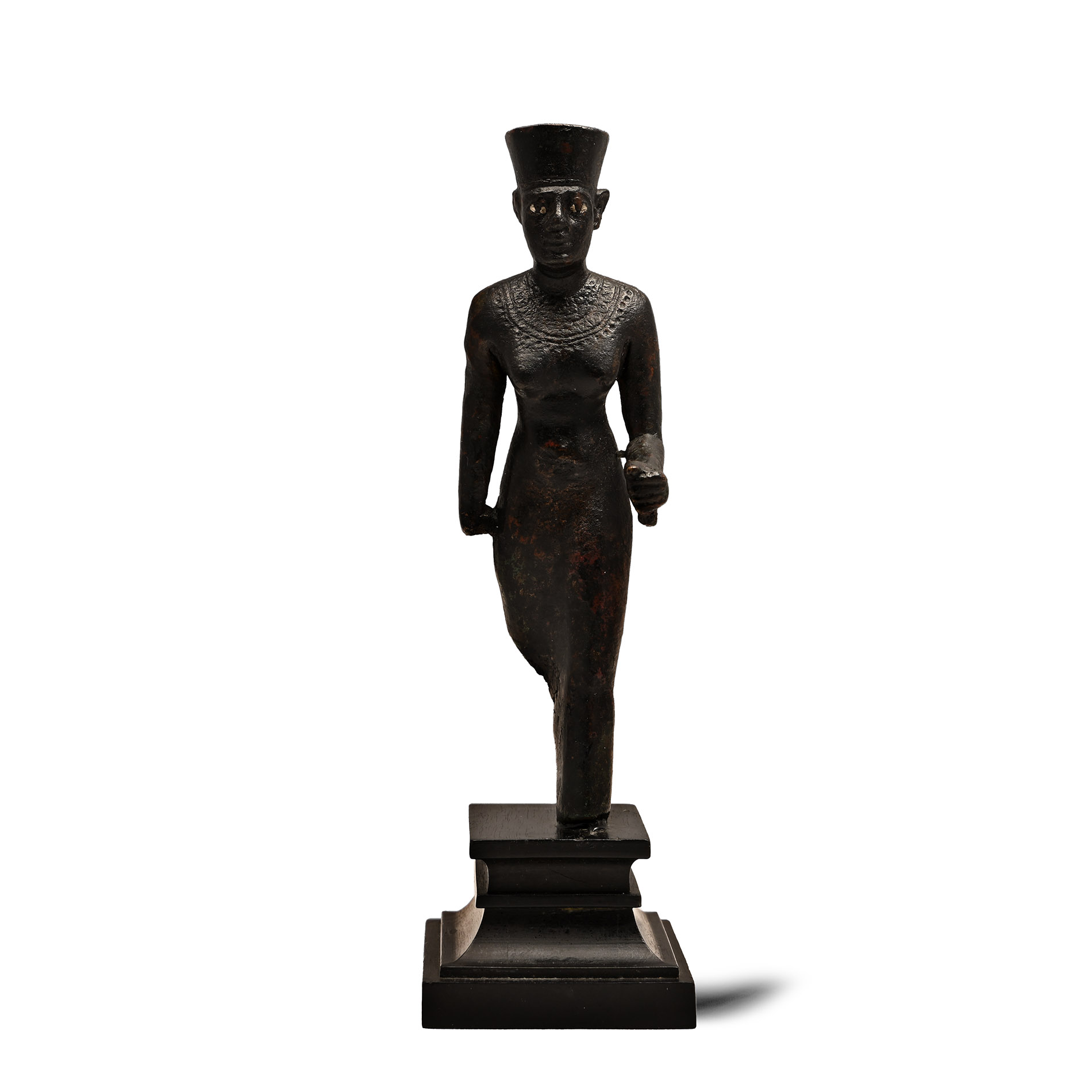
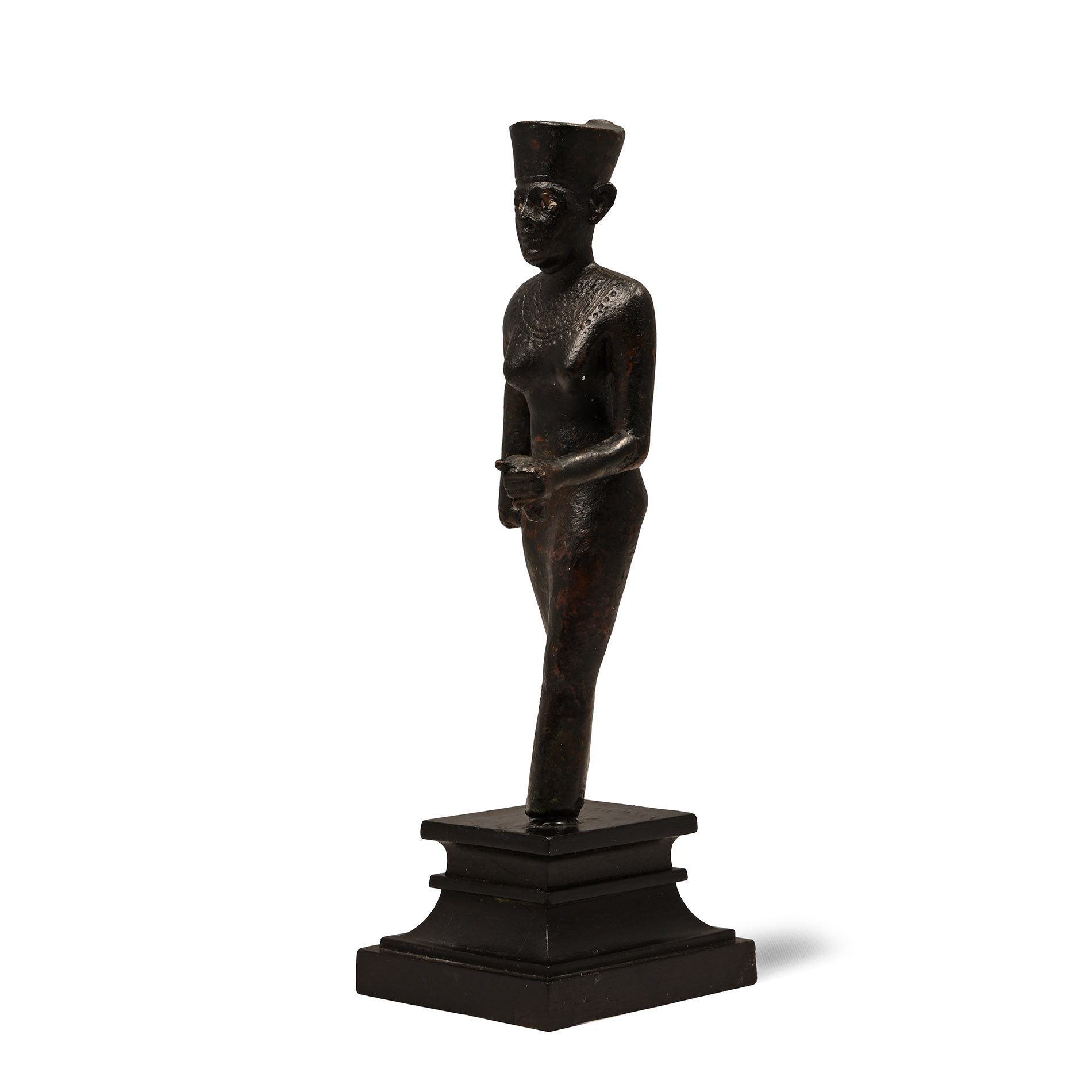
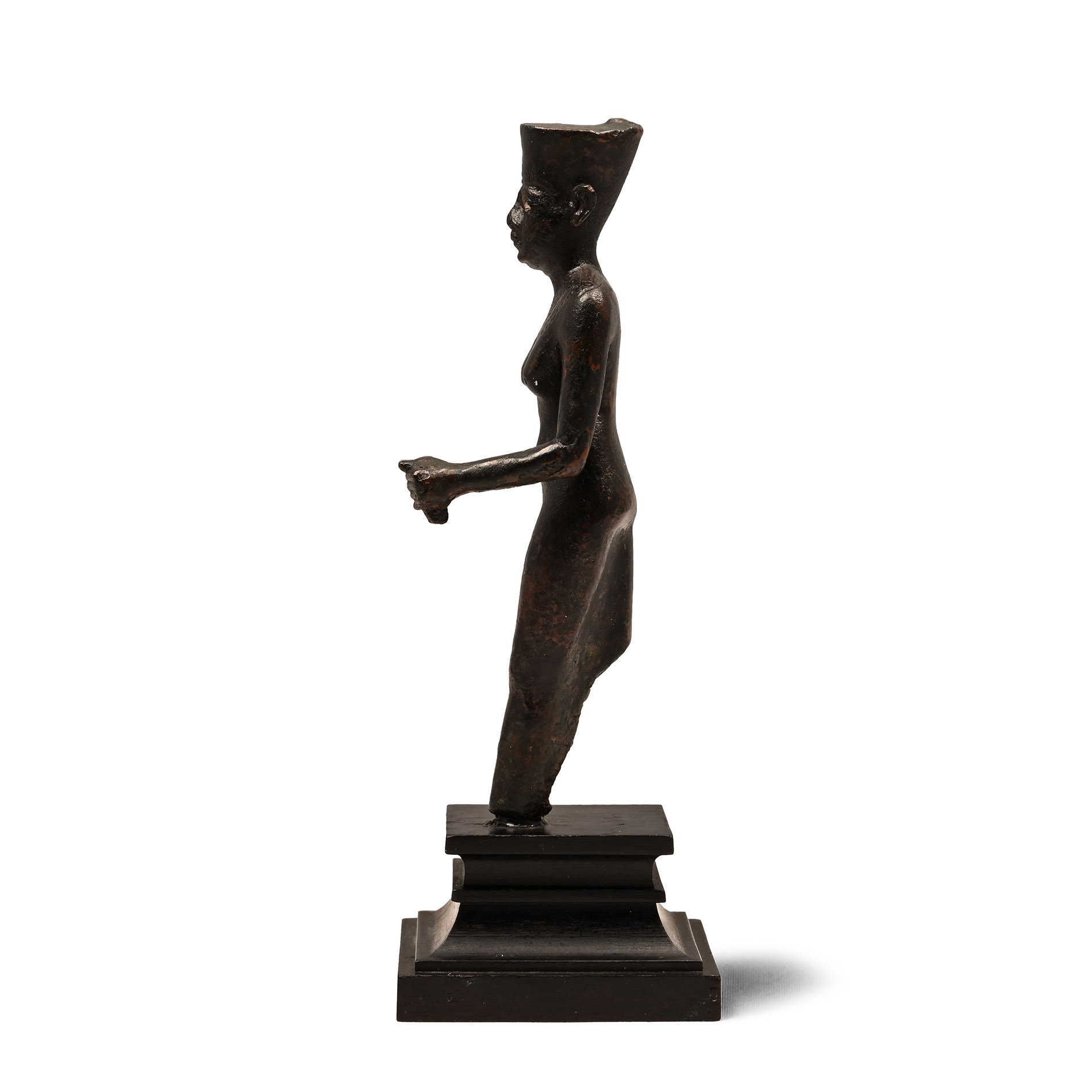
Egyptian Bronze Statue of Neith
LATE PERIOD, 664-332 B.C.
5 in. (162 grams total, 12.7 cm including stand).
Modelled in the round in a striding pose wearing a tight-fitting robe and sporting the Red (deshret) Crown of Lower Egypt; eyes inlaid with silver, an elaborate ornamental collar to the chest; the right arm hanging at the side, the left arm bent at the elbow with hand clenched to accept a staff, possibly a papyrus sceptre; mounted on a custom-made stand.
ProvenanceFrom a 1940s collection based on the base and remains of label verso.
From the Keane private collection, Kent, UK.
This lot has been checked against the Interpol Database of stolen works of art and is accompanied by search certificate number no.12479-229477.
This lot has been cleared against the Art Loss Register database, and is accompanied by an illustrated lot declaration signed by the Head of the Antiquities Department, Dr Raffaele D’Amato.
Cf. Daressy, G., Catalogue général des antiquités égyptiennes du Musée du Caire N° 38001-39384 Statues de divinités, Cairo, 1906, pl. XLVIII no.38954, for a complete example with an elaborate collar; Tiribilli, E., The bronze figurines of the Petrie Museum from 2000 BC to AD 400, GHP Egyptology 28, London, 2018, p.117, for a discussion of this statuette type.
FootnotesNeith is one of the oldest ancient Egyptian deities with roots in the Early Dynastic Period. She is often depicted as a woman wearing the Red Crown of Lower Egypt and carrying a sceptre, symbolising her divine power. As a warrior and mother figure, Neith embodies creation, wisdom, and warfare. Her cult rose in prominence during the Ramesside Period as she became linked with the sun god. The primary centre of her worship was the city of Sais in the western Nile Delta, which became a significant religious and political hub during the 26th Dynasty (664–525 B.C.). Kings of this era claimed her as their protector and identified with her in royal titles.
CONDITIONTimeLine Auctions follows a vetting process to ensure the authenticity and legality of all items, reinforcing our commitment to integrity and responsible trading. Each antiquity, antique, and coin lot undergoes thorough examination by a vetting committee of at least ten external specialists, professional trade association members, scientists, and archaeologists: Our Vetting Process
AUCTIONS:
TimeLine is a leading auction house specialising in antiquities, ancient art, collectables, natural history, coins, medals, and books. Our auctions offer museums, collectors, historians, and enthusiasts the opportunity to acquire unique and historically significant pieces.
-
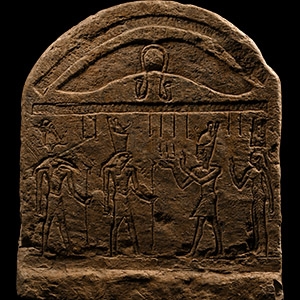
Egyptian Stone Stela with Pharaoh, Isis, Horus and Thoth
Ptolemaic Period, 3rd-2nd century B.C.Sold for (Inc. bp): £16,900
Round-topped stela with decoration on two registers; the lunette, featuring a winged sun disc with pendant uraei; the main panel with a frieze in sunk relief depicting the pharaoh wearing the double crown, facing left offering the hieroglyphic symbol for 'fields'; a goddess stands behind him, possibly Isis, wearing a tight-fitting robe and sporting a tall two-plumed headdress, with one hand raised in praise; facing the pharaoh is the falcon-headed god, possibly Horus or Her-wer, wearing a double-crown, and behind him stands the ibis-headed Thoth wearing the Atef crown, both gods hold a was-sceptre; repaired, mounted on a custom-made stand. 19.45 kg total, 55 cm including stand
Acquired in the mid-1980s-1990s. Private collection, Switzerland, thence by descent. Private collection, since the late 1990s. Accompanied by an academic report by Egyptologist Paul Whelan. This lot has been checked against the Interpol Database of stolen works of art and is accompanied by search certificate number no.12200-222172. This lot has been cleared against the Art Loss Register database, and is accompanied by an illustrated lot declaration signed by the Head of the Antiquities Department, Dr Raffaele D’Amato.
The overall tripartite composition is comparable to numerous stelae of the Ptolemaic Period and can be dated to the 3rd-2nd century B.C. The decorative lunette and/or sky bands and bold sunk relief winged sun disc are characteristic of this period, as is the fringed detailing of the female’s garment. The offering of the ‘field’ symbol is also a frequent depiction of the stelae of this period, which can be understood as a ‘catch-all’ device representing an offering of all the produce from the fields. Such stelae were often produced as stock products to which clients would have their names and other details added. Therefore, the stela is likely an example of one awaiting purchase. After the purchase, the hieroglyphic labels would be added to the figurative tableau, and a dedicatory text would be carved into the plain rectangle in the lower part. Sometimes, however, it appears that a purchaser could not afford the additional expense of a professionally engraved inscription, and so would scratch a short dedication in the lower panel as seen, for example, in the stela for Horudja from the Delta site of Tanis and now in the Musée du Louvre (inv. no. AF 11682). -
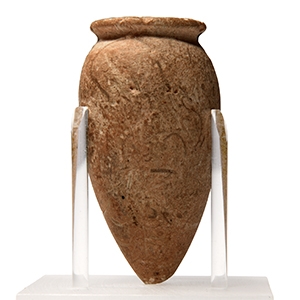
Egyptian Miniature Stone Alabastron
Late Old Kingdom, circa 2300 B.C.Sold for (Inc. bp): £260
The body with rounded shoulders, convex outer face and pointed base, everted rim; accompanied by a custom-made display base. 34.2 grams, 48 mm high (48.9 grams, 55 mm including stand)
Acquired in Europe before 1994. European collection. This lot is accompanied by an illustrated lot declaration signed by the Head of the Antiquities Department, Dr Raffaele D’Amato. -
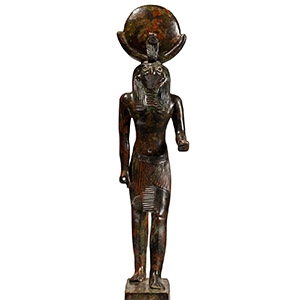
Large Egyptian Bronze Statue of Khonsu
Late Period, 26th Dynasty, 664-525 B.C.Sold for (Inc. bp): £23,400
Standing in advancing pose on a rectangular base; the god modelled with a disc representing the full-moon surmounting a crescent new moon atop his head and fronted by a uraeus, the falcon-head sports a finely striated tripartite wig and with beaded silver wire frames to the (once inlaid) eyes; wearing a broad wesekh collar; the left arm bent and fist drilled to grip a staff, right arm straight to the side with similar drilled fist; pleated shendyt kilt and belt to the hips; mounted on a tiered socle base. 896 grams total, 27 cm including stand
Very fine condition.
Smith family collection, Cambridge, UK since 1949. Private UK collection since 1978. Accompanied by a scholarly note by Egyptologist Paul Whelan. This lot has been checked against the Interpol Database of stolen works of art and is accompanied by search certificate number no.11033-183985. This lot has been cleared against the Art Loss Register database, and is accompanied by an illustrated lot declaration signed by the Head of the Antiquities Department, Dr Raffaele D’Amato.
The moon god Khonsu (whose name means 'wanderer', referring to the passage of the moon across the sky) is known as a blood-thirsty sky-deity in the Pyramid Texts. In New Kingdom Thebes, however, he was regarded as a far more benevolent deity, being the child of Amun and Mut, and provided with his own temple at Karnak. There, he was considered to control destiny. Khonsu can appear in human form with a side-lock of youth, wearing an enveloping garment, and holding royal regalia, and also as a falcon-headed man with the full moon and crescent new moon headdress, as with this fine example. In his falcon-headed form he frequently holds an ankh symbol and a was-sceptre, for which the hands of this piece were drilled to accept the god's well-known attributes.
