
Loading, please wait...
_900x900.jpg "Egyptian Bronze Sistrum Handle Finial")
_200x200.jpg "Egyptian Bronze Sistrum Handle Finial")
_900x900.jpg "Egyptian Bronze Sistrum Handle Finial")
_200x200.jpg "Egyptian Bronze Sistrum Handle Finial")
.jpg "Egyptian Bronze Sistrum Handle Finial")
.jpg "Egyptian Bronze Sistrum Handle Finial")
LOT 0024
Egyptian Bronze Sistrum Handle Finial
LATE PERIOD, 664-332 B.C.
4 1/4 in. (146 grams total, 10.7 cm including stand).
The bifacial upper part of a handle featuring Hathor, depicted with cow ears and wearing a heavy wig with characteristically curled lappet ends and a broad collar; on either side a uraeus, one of which is wearing the crown of Lower Egypt, the other the Upper Egyptian crown; remains of the sistrum cradle above.
Provenancewith Galerie Gunter Phuze, Kunst der Antike 4, Freiburg, 1982, no.335.
German private collection H. W. (1931-2018), acquired 1982.
Accompanied by a copy of an IADAA Interpol search certificate.
Accompanied by copies of the relevant Galerie Gunter catalogue pages.
Cf. Roeder, G., Ägyptische Bronzefiguren II, Berlin, 1956, pl.63 items g, i, and k, for three less fine examples of this type.
FootnotesThe sistrum was a rattle-like instrument played exclusively by women in religious ceremonies. The sound produced by the sistrum was believed to drive away evil and soothe a god's anger. Hathor is the daughter of the sun god Re, and in her role as a mother goddess is often depicted as a cow or with bovine characteristics as here. Hathor is also associated with love, music and dancing, and the sistrum is one of her sacred symbols.
CONDITIONTimeLine Auctions follows a vetting process to ensure the authenticity and legality of all items, reinforcing our commitment to integrity and responsible trading. Each antiquity, antique, and coin lot undergoes thorough examination by a vetting committee of at least ten external specialists, professional trade association members, scientists, and archaeologists: Our Vetting Process
AUCTIONS:
TimeLine is a leading auction house specialising in antiquities, ancient art, collectables, natural history, coins, medals, and books. Our auctions offer museums, collectors, historians, and enthusiasts the opportunity to acquire unique and historically significant pieces.
LOT 0024
Egyptian Bronze Sistrum Handle Finial
Estimate £1,000 - 1,400€1,160 - 1,620 (for guidance only)$1,350 - 1,890 (for guidance only)
-
.jpg)
Egyptian Steatite Cosmetic Palette
New Kingdom, 19th-20th Dynasty, 1292-1070 B.C.Estimate: £3,000 - 4,000 (+bp*)
Opening Bid: £1,500
Shallow bowl with rounded rim and openwork handle formed as two ducks resting with necks bent and heads draped to the rim; underside with wing, leg and tail detailing. 34.5 grams, 69 mm
Mary Alice Ryun, Fort Worth, Texas, prior to 1975; thence by descent. Sotheby's, New York, Antiquities and Islamic Art, 8 December 1995, lot 222; where acquired by the present owner. This lot has been checked against the Interpol Database of stolen works of art and is accompanied by search certificate no.11949-209610. -
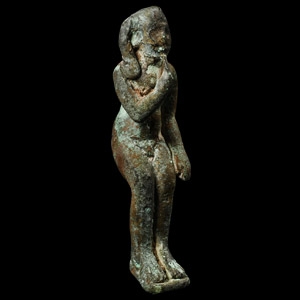
Egyptian Bronze Seated Harpocrates Figure
Late Period, 664-332 B.C.Sold for (Inc. bp): £182
With feet resting on a rectangular base, forefinger on the lips, prominent sidelock of youth. 30.7 grams, 68 mm
Ex Brigantia, York, UK, item no.12040. Private collection of Mr T.H., Norfolk, UK. Accompanied by a previous dealer's certificate of authenticity.
Harpocrates is the Greek rendering of the Egyptian Hor-pa-khered, which translates as 'Horus the Child'. This refers to Horus as the divine infant of Isis and Osiris. Wearing the amulet of Harpocrates could provide the wearer with the same protection that Isis gave to her beloved son. -
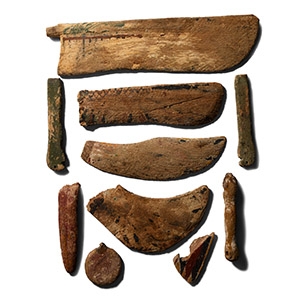
Egyptian Wooden Artefact Collection
Late Period, 664-332 B.C.Sold for (Inc. bp): £98
Comprising various items with remains of polychrome pigment, including a sun disk; an arm from a diorama; a wing of Isis; two scarab wings and others. 47 grams total, 3.6-18.5 cm
UK private collection. Acquired from Den of Antiquity, Cambridgeshire, UK, 2010. Property of a Nottinghamshire gentleman.
