
Loading, please wait...
_900x900.jpg "Egyptian Bronze Seated Cat Statuette")
_200x200.jpg "Egyptian Bronze Seated Cat Statuette")
.jpg "Egyptian Bronze Seated Cat Statuette")
LOT 0014
Egyptian Bronze Seated Cat Statuette
LATE PERIOD, 664-332 B.C.
2 1/8 in. (90 grams, 55 mm).
Bastet in crouching pose with her tail wrapped close to right side of her body, seated on a tongue-shaped base, with a suspension loop on the creature’s back.
ProvenanceAcquired on the UK art market, 1990s.
Private collection, New York, USA.
Cf. Petrie, W.M.F., Amulets. Illustrated by the Egyptian Collection in University College, London, 1914, pl. XXXIX, nos.224e-d, for similar cat figurines.
CONDITIONTimeLine Auctions follows a vetting process to ensure the authenticity and legality of all items, reinforcing our commitment to integrity and responsible trading. Each antiquity, antique, and coin lot undergoes thorough examination by a vetting committee of at least ten external specialists, professional trade association members, scientists, and archaeologists: Our Vetting Process
AUCTIONS:
TimeLine is a leading auction house specialising in antiquities, ancient art, collectables, natural history, coins, medals, and books. Our auctions offer museums, collectors, historians, and enthusiasts the opportunity to acquire unique and historically significant pieces.
LOT 0014
Egyptian Bronze Seated Cat Statuette
Estimate £600 - 800€700 - 930 (for guidance only)$810 - 1,080 (for guidance only)
-
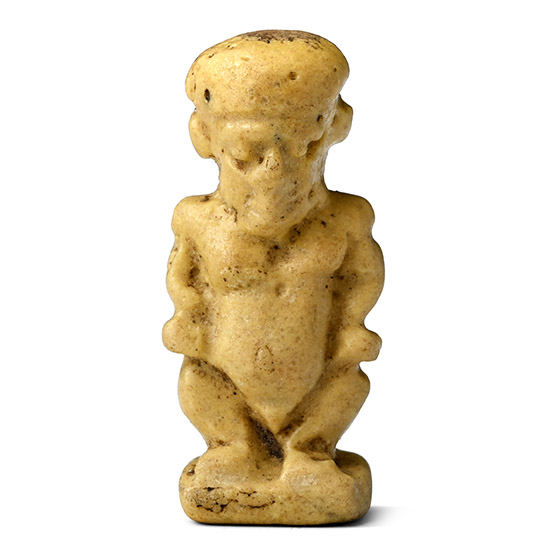
Egyptian Yellow Faience Pataikos Amulet
Late Period, 664-332 B.C.Sold for (Inc. bp): £130
Depicted nude and standing on a rectangular base, with a large head, and short arms resting above his bendy legs. 4.87 grams, 32 mm
From an early 20th century UK collection. Accompanied by a previously illustrated catalogue card with provenance.
Herodotus mentions Pataikos as a dwarf-like depiction of Ptah, although the ancient Egyptian name of the god remains unclear. These small amulets symbolise Ptah’s immense magical power, which helps to protect the wearer from dangerous creatures such as snakes and crocodiles. The role of the deity in the funerary sphere is explained in Spell 164 of the Book of the Dead, where Pataikos is invoked to safeguard the deceased’s heart against attacks by enemies and against the decay of the body. -
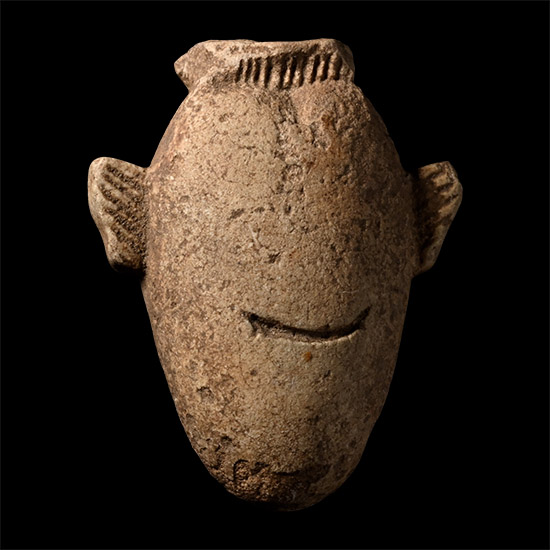
Large Egyptian Faience Heart Amulet
Late Period, 664-332 B.C.Sold for (Inc. bp): £117
Modelled in the round with a piriform body and two lateral projections with striations. 7.66 grams, 30 mm
Ex N. Thomas private collection, UK, 1980s-1990s. Accompanied by a previous dealer's sales ticket. -
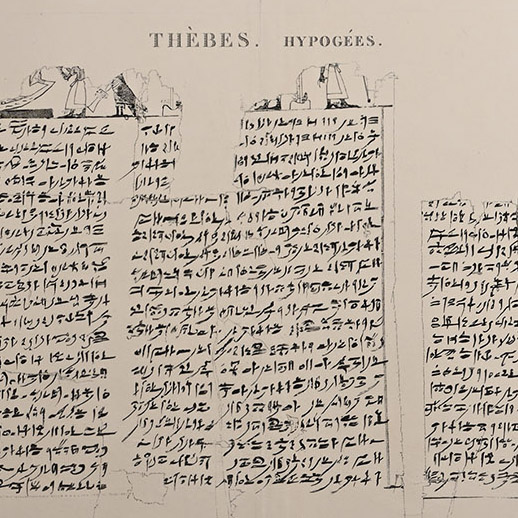
Very Large Egyptian Expedition Lithograph of the Hypogees Papyrus Manuscript from Thebes
Early 19th century A.D.Estimate: £80 - 100 (+bp*)
Opening Bid: £40
Proof etching on laid paper of plate 71 from Vol .II of Description de l'Égypte : ou, Recueil des observations et des recherches qui ont été faites en Égypte pendant l'expédition de l'armée française entitled Thèbes. Hypogées. Manuscrit sur papyrus. 264 grams, 102 x 69 cm
From the collection of a North American priest. Acquired between 1981-1996. Property of a North American collector.
Produced between February 1802 and 1830 on the orders of Napoleon Bonaparte; published between 1809 and 1828. Just 1,000 copies were distributed to various institutions, printed on laid paper with an 'Égypte ancienne et moderne' watermark. The book is subtitled Recueil des observations et des recherches qui ont été faites en Égypte pendant l’expédition de l’Armée française, publié par les ordres de Sa Majesté l’Empereur Napoléon le Grand (Gathering of observations and discoveries which were made in Egypt during the expedition of the French army, published on the orders of His Majesty the Emperor Napoleon the Great). It was the world's first encyclopedia devoted exclusively to the remains of ancient Egypt. The plates of this book are the first to present the archaeological sites of Thebes (Luxor). The papyrus manuscript was recovered from an underground tomb chamber (hypogeum).
