
Loading, please wait...
_900x900.jpg "Egyptian Bronze Oxyrhynchus Fish Figure")
_200x200.jpg "Egyptian Bronze Oxyrhynchus Fish Figure")
.jpg "Egyptian Bronze Oxyrhynchus Fish Figure")
LOT 0037
Egyptian Bronze Oxyrhynchus Fish Figure
LATE PERIOD, 664-332 B.C.
3 3/8 in. (163 grams, 85 mm wide).
A bronze votive oxyrhynchus fish on a sledge base; the fish with inlaid eyes (now missing), hatched dorsal fin, hatched and engraved usekh collar, disc and horned crown fronted by sacred uraeus; suspension loop behind.
ProvenanceAcquired 1980s.
Private collection of L.H., Staffordshire, UK.
Property of a Sussex, UK, teacher.
Cf. The Metropolitan Museum, New York, accession number 04.2.660, for a comparable example.
FootnotesThe oxyrhynchus fish was sacred to the goddess Hathor, and was often depicted wearing her crown on its head, an image that may have reproduced an actual temple cult statue. It was also connected to the myth of god Osiris, believed to have eaten his penis after god Seth had dismembered and scattered the god's body. The fish was worshipped under the name Medjed.
CONDITIONTimeLine Auctions follows a vetting process to ensure the authenticity and legality of all items, reinforcing our commitment to integrity and responsible trading. Each antiquity, antique, and coin lot undergoes thorough examination by a vetting committee of at least ten external specialists, professional trade association members, scientists, and archaeologists: Our Vetting Process
AUCTIONS:
TimeLine is a leading auction house specialising in antiquities, ancient art, collectables, natural history, coins, medals, and books. Our auctions offer museums, collectors, historians, and enthusiasts the opportunity to acquire unique and historically significant pieces.
-
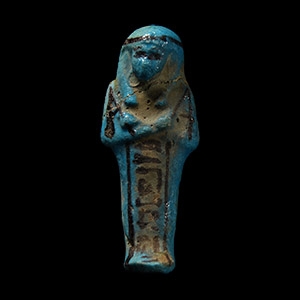
Egyptian Deep Blue Glazed Shabti of Pa-di-Khonsu-iy
Third Intermediate Period, 21st Dynasty, 1081-931 B.C.Sold for (Inc. bp): £780
A bright blue glazed worker shabti modelled on a rectangular base, arms crossed over the chest, detailing in black to the wig and eyes, holding a pair of hoes, a seed bag to the back, the hair tied with a seshed headband; a vertical column of hieroglyphs to the front of the body naming the wab-priest Pa-di-Khonsu-iy; repaired. 76 grams, 98 mm high
From a Worcester deceased estate. Property of a Cambridgeshire gentleman. Accompanied by an academic report by Egyptologist Paul Whelan.
As a wab-priest, Pa-di-Khonsu-iy would have assisted a higher-ranking hem-priest with the general maintenance and ritual activities in a temple, likely located either in Thebes in Upper Egypt or Tanis in the Delta. -
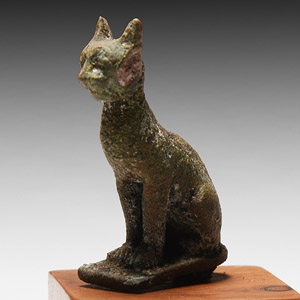
Egyptian Bronze Goddess Bastet as Seated Cat
Late Period-Ptolemaic Period, 664-30 B.C.Sold for (Inc. bp): £975
A bronze figure of the cat goddess Bastet, squatting poised and alert with her tail wrapped close to right side of her body, seated on a tongue-shaped base, short lug below; accompanied by a custom-made display base. 137 grams total, 10 cm high including stand
Acquired 1980s. Private collection of L.H., Staffordshire, UK. Property of a Sussex, UK, teacher.
Bastet was a powerful goddess of Lower Egypt, one who was protective and could bring about great prosperity. Cat statuettes were among some of the most common zoomorphic dedications of the Late and Ptolemaic Periods. Small statuettes like this one would have been dedicated as offerings to temples or deposited in catacombs alongside cat mummies, as at the extensive catacombs at Bubastis and Saqqara. Sometimes larger hollow examples held a cat mummy inside. -
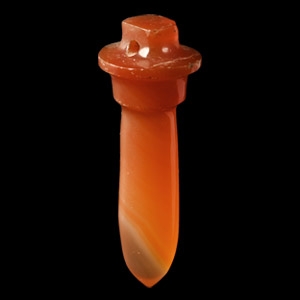
Egyptian Carnelian Papyrus Amulet
New Kingdom, 19th Dynasty, 1296-1186 B.C.Sold for (Inc. bp): £572
A carnelian amuletic papyrus stalk pendant, colour graduated along the stem. 2.4 grams, 29 mm
Private collection, acquired 1999.
