
Loading, please wait...
_900x900.jpg "Egyptian Bronze Osiris Statuette")
_200x200.jpg "Egyptian Bronze Osiris Statuette")
.jpg "Egyptian Bronze Osiris Statuette")
LOT 0052
Egyptian Bronze Osiris Statuette
LATE PERIOD, 664-332 B.C.
6 in. (185 grams total, 15.4 cm including stand).
Standing figure in mummiform stance, wearing the conical Atef crown with flanking ostrich plumes and frontal uraeus, holding the crook (heka) and flail (nekhakha) regalia; mounted on a display stand.
ProvenanceProperty of a deceased gentleman's collection, 1980s.
Ex John Nicholson Auction, Haslemere, Surrey, UK.
Cf. Tiribilli, E., The bronze figurines of the Petrie Museum from 2000 BC to AD 400, GHP Egyptology 28, London, 2018, p.89, no.118, for a similar example.
CONDITIONTimeLine Auctions follows a vetting process to ensure the authenticity and legality of all items, reinforcing our commitment to integrity and responsible trading. Each antiquity, antique, and coin lot undergoes thorough examination by a vetting committee of at least ten external specialists, professional trade association members, scientists, and archaeologists: Our Vetting Process
AUCTIONS:
TimeLine is a leading auction house specialising in antiquities, ancient art, collectables, natural history, coins, medals, and books. Our auctions offer museums, collectors, historians, and enthusiasts the opportunity to acquire unique and historically significant pieces.
-
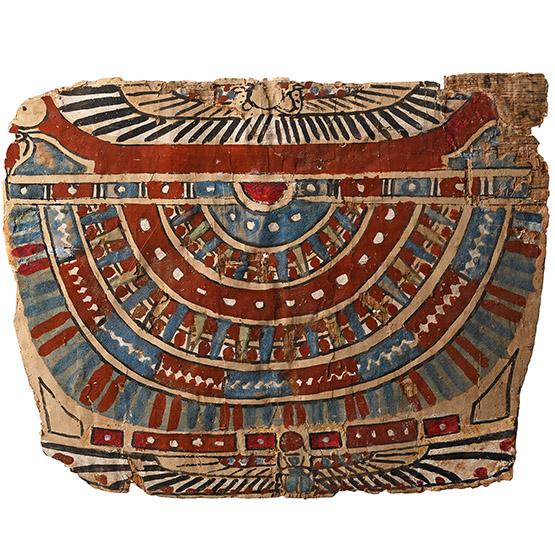
Egyptian Cartonnage Panel with Pectoral
Late Period-Ptolemaic Period, circa 664-30 B.C.Estimate: £1,800 - 2,400 (+bp*)
Opening Bid: £900
A rectangular cartonnage panel with bands of triangles, teardrops and other motifs in white, red, blue and pale green; winged scarab to the bottom, lower portion of a winged sun disc flanked by uraei to the top; mounted on a custom-made stand. 2.06 kg total, 31.4 cm wide including stand
Ex early 20th century collection, London, UK. This lot has been checked against the Interpol Database of stolen works of art and is accompanied by search certificate number no.13096-249409
This piece was probably part of a set of cartonnage trappings placed on the mummy. -
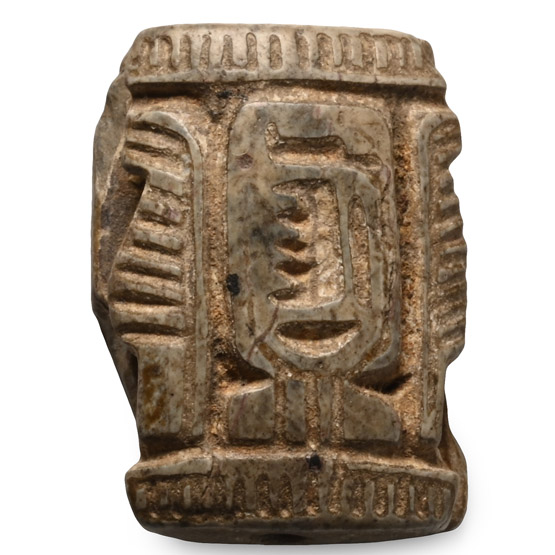
Egyptian Steatite Bifacial Amulet
Late Period, 664-332 B.C.Sold for (Inc. bp): £78
A double-sided rectangular amulet; one side features a central cartouche with the hieroglyphic name of the god “Amun” and a neb sign, flanked by two Maat feathers, all framed by a hatched border at the top and bottom; the other side depicts the reclining ram of Amun-Re with the seated figure of Maat in front, and the word "Amun" in hieroglyphs above the ram; drilled for suspension. 2.26 grams, 18 mm
Ex Constable collection, 1990s. Ex P. Morris collection.
An amulet with a similar overall design was discovered in a Ramesside-period tomb at Tell el-Retaba, an important production centre involved in trade with Syria-Palestine and protected by a fortress (Petrie, W.M.F., Duncan, J.G., Hyksos and Israelite Cities, London, 1906, pl. XXXIV, Tomb 8). -
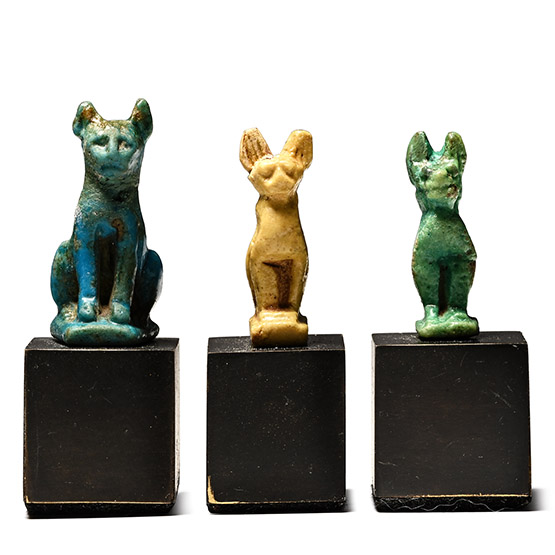
Egyptian Faience Bastet Cat Amulet Collection
New Kingdom, 1550-1070 B.C. and laterEstimate: £1,200 - 1,700 (+bp*)
Opening Bid: £600
Pale yellow, turquoise, and blue faience seated cat figures, each shown on a base plinth and with a suspension loop behind the head. 83 grams total, 47-52 mm including stands
Collection of a Lady, circa 1940. From a specialist collection.
In ancient Egypt, the cat was revered as the sacred animal of the goddess Bastet, whose main cult centre was Bubastis in the Nile Delta. Although cats were once part of folk customs, their formal worship expanded across Egypt during the Late Period. Bastet was closely connected to lion-headed goddesses such as Sekhmet, Tefnut, and Pakhet, and the cat itself became linked to solar imagery: the Book of the Dead depicts the sun god as a Great Cat defeating Apophis beneath the sacred Ished Tree. The cat could also represent the Eye of the Sun or, more commonly in Bastet’s case, the Eye of the Moon. Mummified cats were often offered as votive offerings, and some were decorated with finely crafted bronze heads to emphasise their divine likeness.
