
Loading, please wait...
_900x900.jpg "Egyptian Bronze Kneeling Priest Statuette")
_200x200.jpg "Egyptian Bronze Kneeling Priest Statuette")
_900x900.jpg "Egyptian Bronze Kneeling Priest Statuette")
_200x200.jpg "Egyptian Bronze Kneeling Priest Statuette")
.jpg "Egyptian Bronze Kneeling Priest Statuette")
.jpg "Egyptian Bronze Kneeling Priest Statuette")
LOT 0013
Egyptian Bronze Kneeling Priest Statuette
LATE PERIOD, CIRCA 664–332 B.C.
3 in. (54 grams total, 76 mm including stand).
The male figure of a kneeling supplicant with back pillar inscribed with hieroglyphic text: 'Neith gives life [to] ...'.
ProvenancePrivate collection S., Freiburg im Breisgau, Germany, acquired in the first half of the 20th century.
Accompanied by a copy of an Art Loss Register certificate number S00140657, dated 23 October 2018.
Cf. Schulz, R. and Seidel, M., Egyptian Art. The Walters Art Museum, London, 2009, pp.114-115, obj.45, for a comparable figure kneeling before the figure of Anubis.
FootnotesThis figure was likely attached to a separately cast base and positioned kneeling before a larger figure of the goddess Neith. Such objects were donated to temples to secure the god or goddess's protection for the donor, represented by the kneeling figure.
CONDITIONTimeLine Auctions follows a vetting process to ensure the authenticity and legality of all items, reinforcing our commitment to integrity and responsible trading. Each antiquity, antique, and coin lot undergoes thorough examination by a vetting committee of at least ten external specialists, professional trade association members, scientists, and archaeologists: Our Vetting Process
AUCTIONS:
TimeLine is a leading auction house specialising in antiquities, ancient art, collectables, natural history, coins, medals, and books. Our auctions offer museums, collectors, historians, and enthusiasts the opportunity to acquire unique and historically significant pieces.
LOT 0013
Egyptian Bronze Kneeling Priest Statuette
Estimate £1,500 - 2,000€1,740 - 2,320 (for guidance only)$2,030 - 2,700 (for guidance only)
-
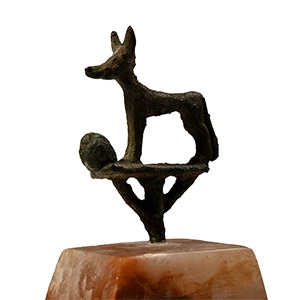
Egyptian Bronze Anubis Finial
Late Period-Ptolemaic Period, 664-30 B.C.Sold for (Inc. bp): £572
Standing before an enigmatic balloon-like object on a rectangular base with two supports flanking a short shank; mounted on a custom-made stand. 377 grams total, 12.5 cm high including stand
Believed to have been collected (1899-1914) and in an early 20th century collection, with some references to Psamtik I, and a German funded expedition. Ex Ludwig Borchardt, Heliop. Private collection of Mr T.H., Norfolk, UK. Accompanied by a handwritten note from Ludwig Borchardt.
Wepwawet, the canine god, is strongly linked with Abydos and kingship. His name means 'Opener of the Ways' and may have had military connotations as someone who clears the path for his king. In funerary texts, Wepwawet guided the dead through the Underworld. The image of the god on a standard, as seen in this example, was carried in processions associated with Osiris and kingship. The balloon-like object, known as shed-shed, is mysterious but may have symbolised the royal placenta, which was considered the king's 'double'. -
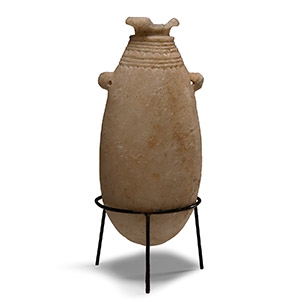
Egyptian Decorated Alabaster Alabastron
Circa 500 B.C.Sold for (Inc. bp): £390
Lentoid in section with pierced lateral lugs at the shoulder, circumferential banding at the neck with dentilled detailing; supplied with a custom-made stand. 281 grams total, 15 cm high including stand
Private collection, Germany, 1990s-2000s. -
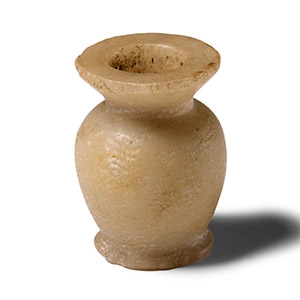
Egyptian Alabaster Cosmetic Vessel
Middle Kingdom, 12th Dynasty, circa 1985-1773 B.C. or laterSold for (Inc. bp): £286
With globular body and flared trumpet-shaped mouth; textile fragment inside. 40.8 grams, 38 mm
From the Peter Negus collection. Ex R. Gill Esq. collection, Wimbledon, London, UK. Ex Artemission, London SW5, UK. Private collection of Mr T.H., Norfolk, UK. Accompanied by a previous dealer's certificate of authenticity and invoice.
