
Loading, please wait...


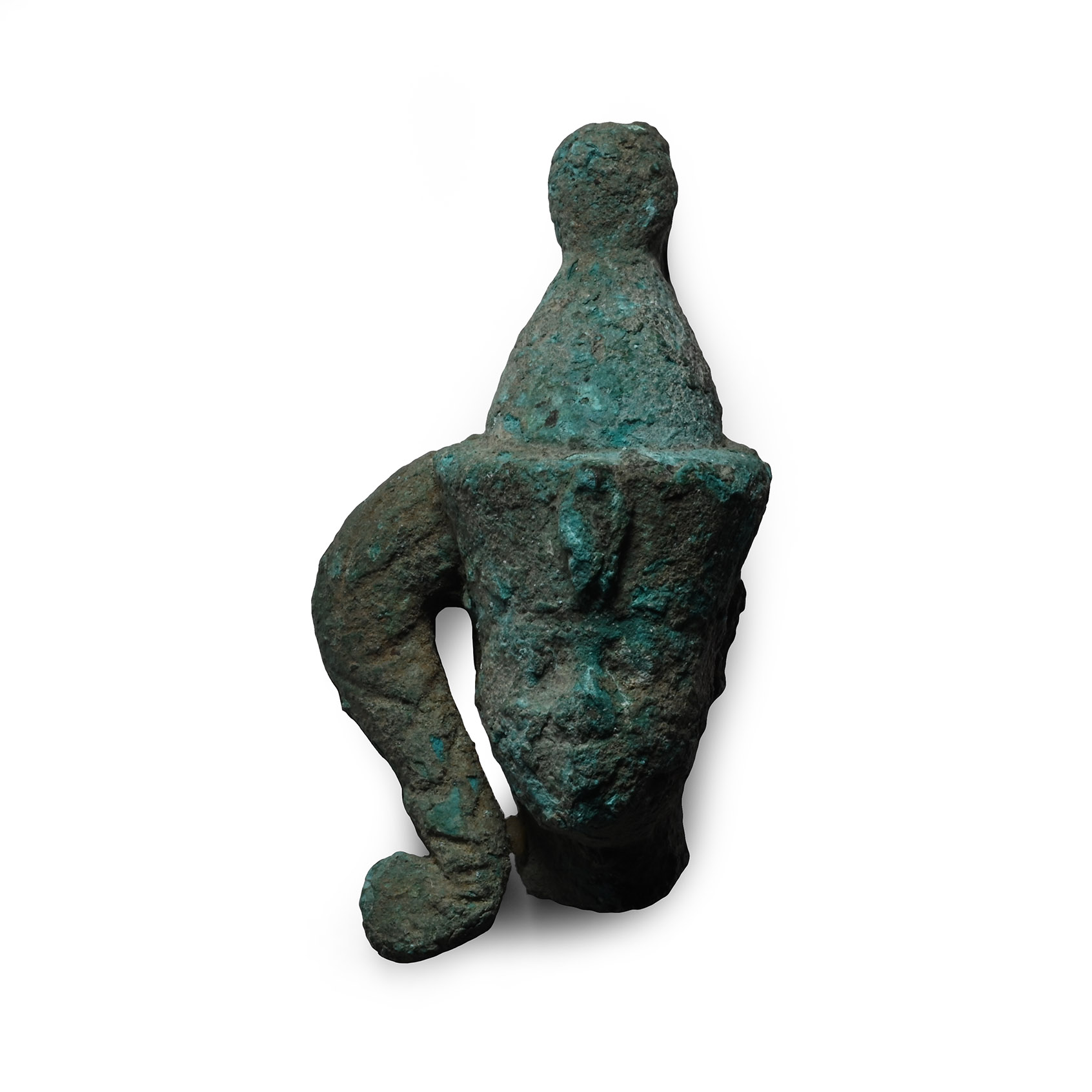
LOT 0465
Egyptian Bronze Head of Harpocrates
LATE PERIOD, CIRCA 664-332 B.C.
2 3/8 in. (86.5 grams, 60 mm).
Head from a statuette of Harpocrates, wearing the Pschent crown fronted by uraeus, sporting the large plaited sidelock above the right ear.
ProvenanceAcquired in the mid 1980s-1990s.
Private collection, Switzerland, thence by descent.
Private collection, since the late 1990s.
Cf. Roeder, G., Ägyptische Bronzefiguren II, Berlin, 1956, pl.15e, for a similar head on a complete statuette.
FootnotesHarpocrates is the Greek rendering of the Egyptian Hor-pa-khered, meaning 'Horus the Child'. This title refers to Horus as the divine infant of Isis and Osiris. Wearing the amulet of Harpocrates was believed to offer the same protection that Isis gave her beloved son.
CONDITIONTimeLine Auctions follows a vetting process to ensure the authenticity and legality of all items, reinforcing our commitment to integrity and responsible trading. Each antiquity, antique, and coin lot undergoes thorough examination by a vetting committee of at least ten external specialists, professional trade association members, scientists, and archaeologists: Our Vetting Process
AUCTIONS:
TimeLine is a leading auction house specialising in antiquities, ancient art, collectables, natural history, coins, medals, and books. Our auctions offer museums, collectors, historians, and enthusiasts the opportunity to acquire unique and historically significant pieces.
-
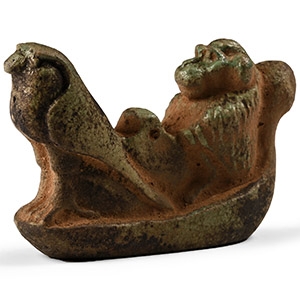
Egyptian Faience Thoth and Horus in a Boat
Late Period, 664-332 B.C.Sold for (Inc. bp): £1,235
Modelled in the round, comprising a small barque with a seated baboon and a falcon, possibly Thoth and Horus, with a slot to the underside. 35.9 grams, 64 mm
From the collection of a gentleman, acquired on the London art market in the 1990s.
In Egyptian mythology, Thoth restored the eye of Horus, suggesting that this may be the theme of the figurine's composition. Alternatively, the composition may be a condensed depiction of the funerary vignette, which shows the falcon form of the sun god Re in his solar barque flanked by baboons in an attitude of praise. The slot in the underside suggests it was once attached to a separate base. -

Egyptian Bone Ram-Headed Boat with Two Deities
Late Period, 664-332 B.C.Sold for (Inc. bp): £624
Carved in the round reed boat with ram-headed prow, altar amidships surmounted by a horned sun disc and flanked by two baboons standing in adoration; repaired. 10.4 grams, 55 mm
From the collection of a gentleman, acquired on the London art market in the 1990s.
This represents a condensed version of a two-dimensional funerary scene of the sun god Re, here represented by the horned disc, in his solar barque, flanked by baboons in an attitude of praise. The boat's ram-headed prow possibly alludes to Re's transformation into a ram during his night-time journey through the Underworld. -
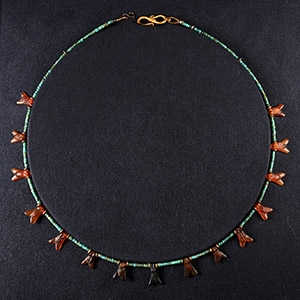
Egyptian Necklace with Fly Beads
New Kingdom, 18th Dynasty, 1550-1350 B.C. and laterSold for (Inc. bp): £1,430
Group of restrung annular turquoise beads with gilt-metal interstitial collars and carnelian fly amulets; S-hook and eye closure; with custom display box. 10.45 grams, 48.5 cm long
Ex Swiss collection, kept in London since the 1980s. Accompanied by a copy of a previous illustrated catalogue page.
Since Egyptian artists often depicted fly whisks in the hands of pharaohs and high officials, one might assume that flies were simply a nuisance. However, the Egyptians held flies in high regard due to their quick speed, reactions, and persistence. Small fly amulets first appeared in burials during the Naqada II Period, c. 3200 B.C. These amulets grew in popularity, and the materials used to make them expanded during the New Kingdom, including gold, silver, lapis lazuli, carnelian, amethyst, faience, and bone. Fly amulets were believed to protect against insect bites and to ward off troublesome airborne creatures through apotropaic magic. Some believe they may have even been intended to symbolise the fly’s fecundity. Additionally, pharaohs would bestow gold fly-shaped pendants as military awards to honour the bravery and fly-like persistence of soldiers in battle.
