
Loading, please wait...
LOT 0050
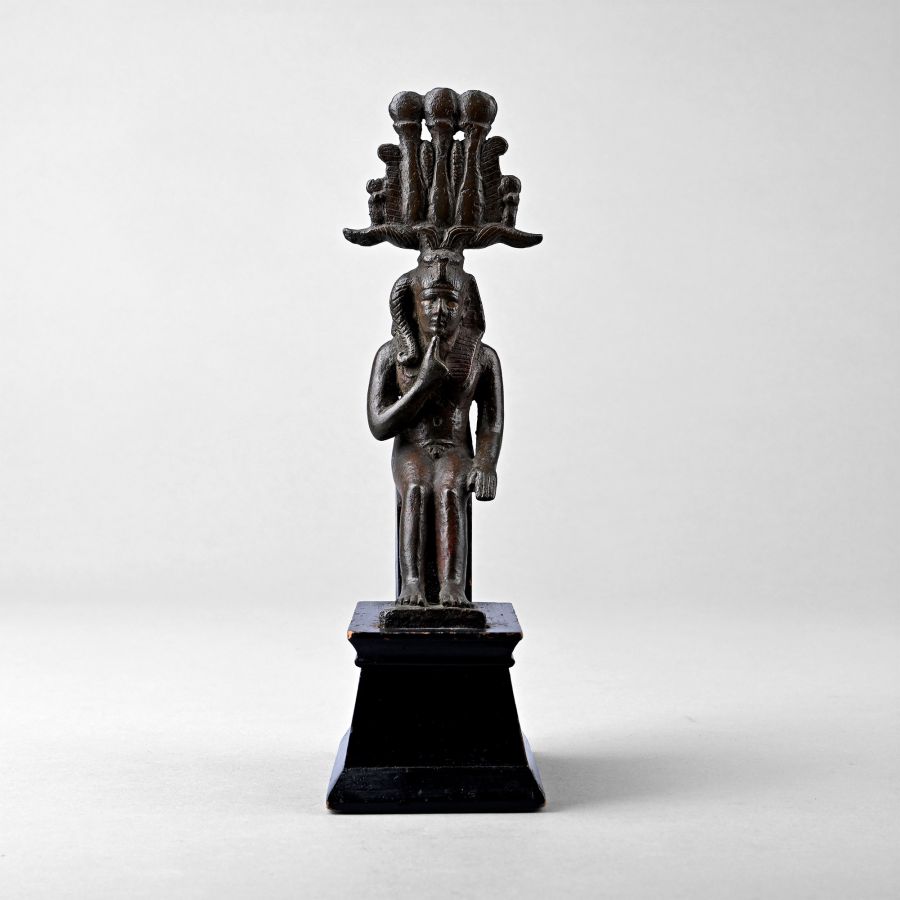
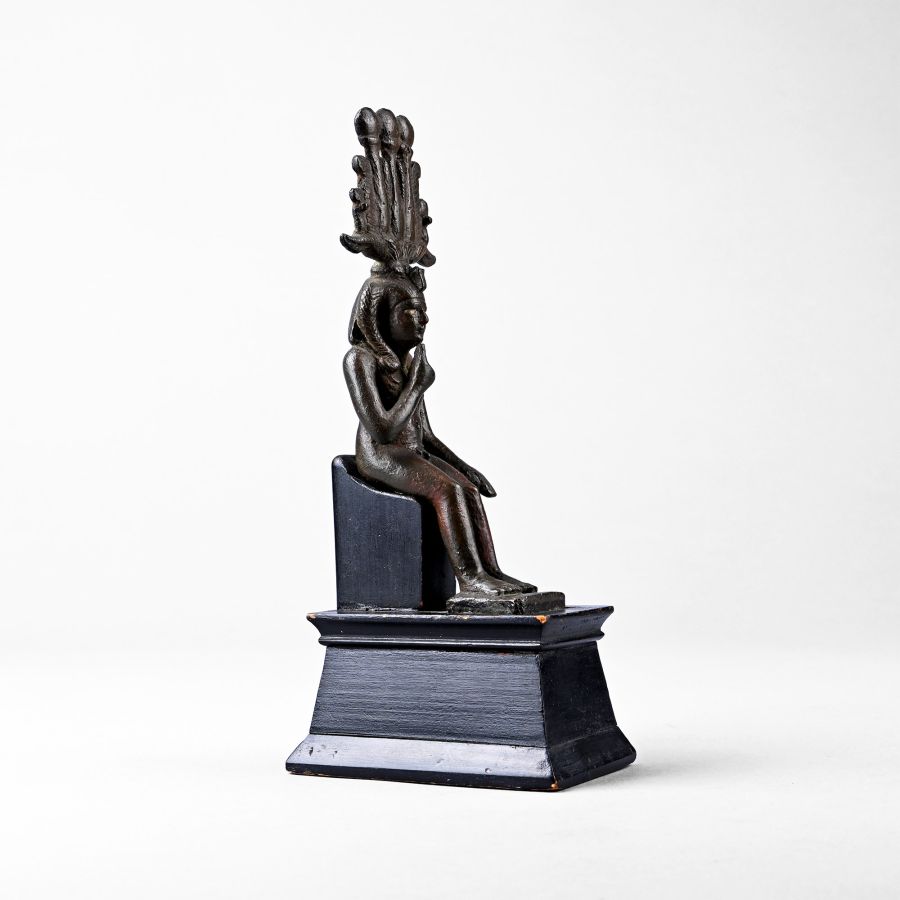
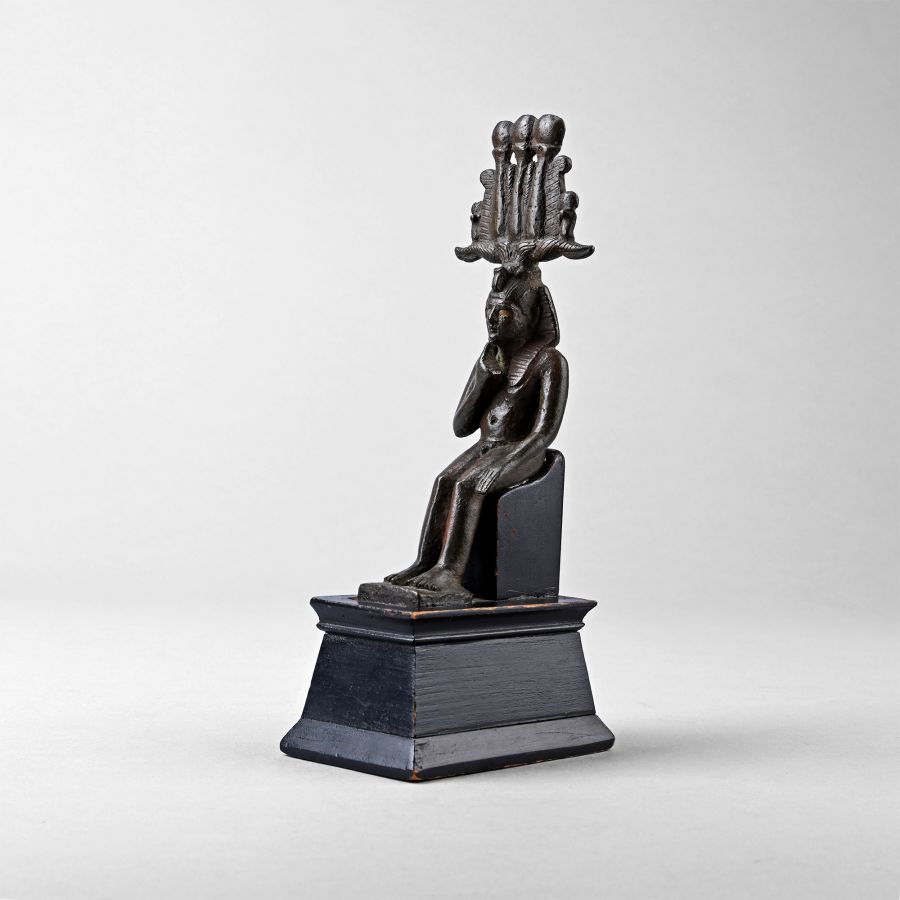
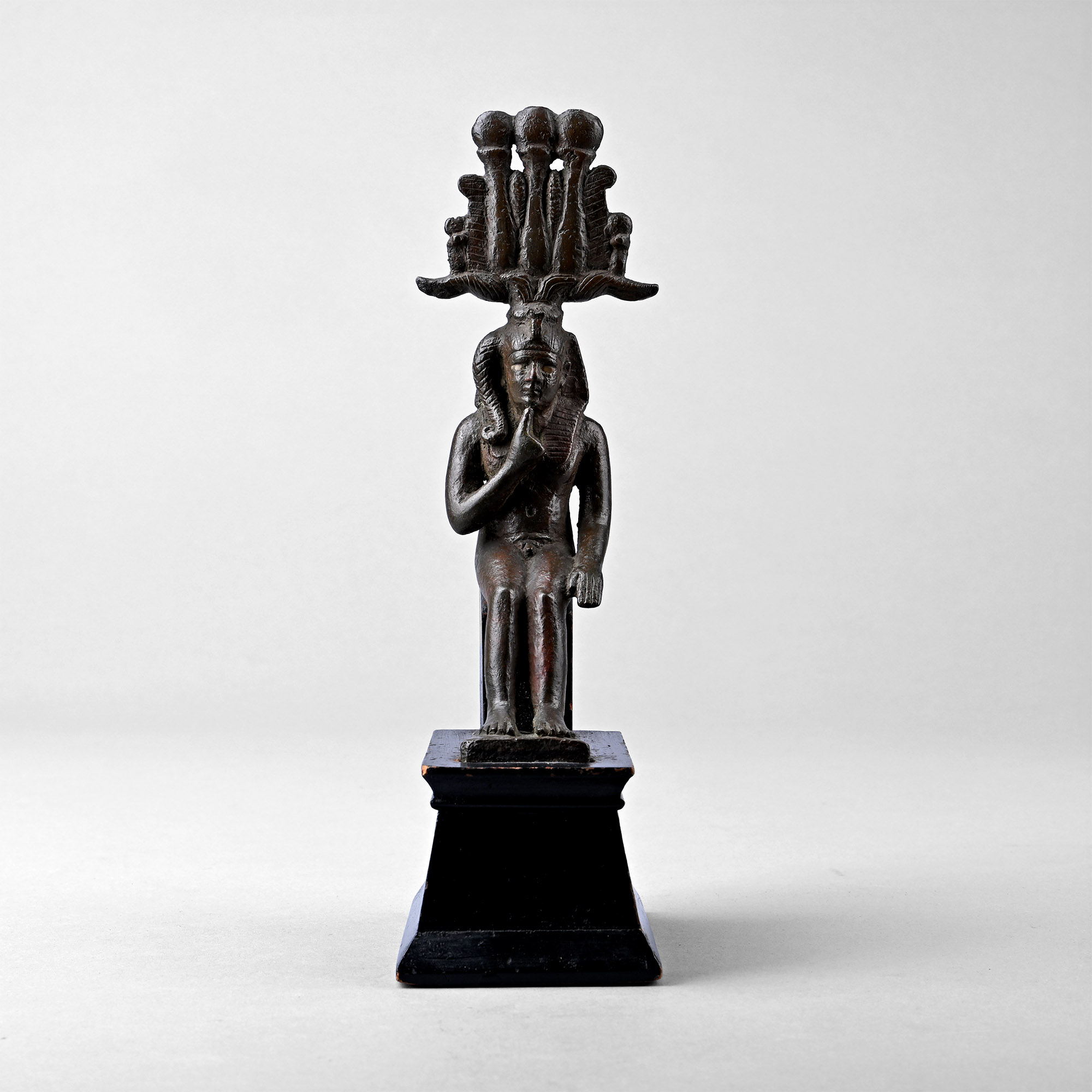
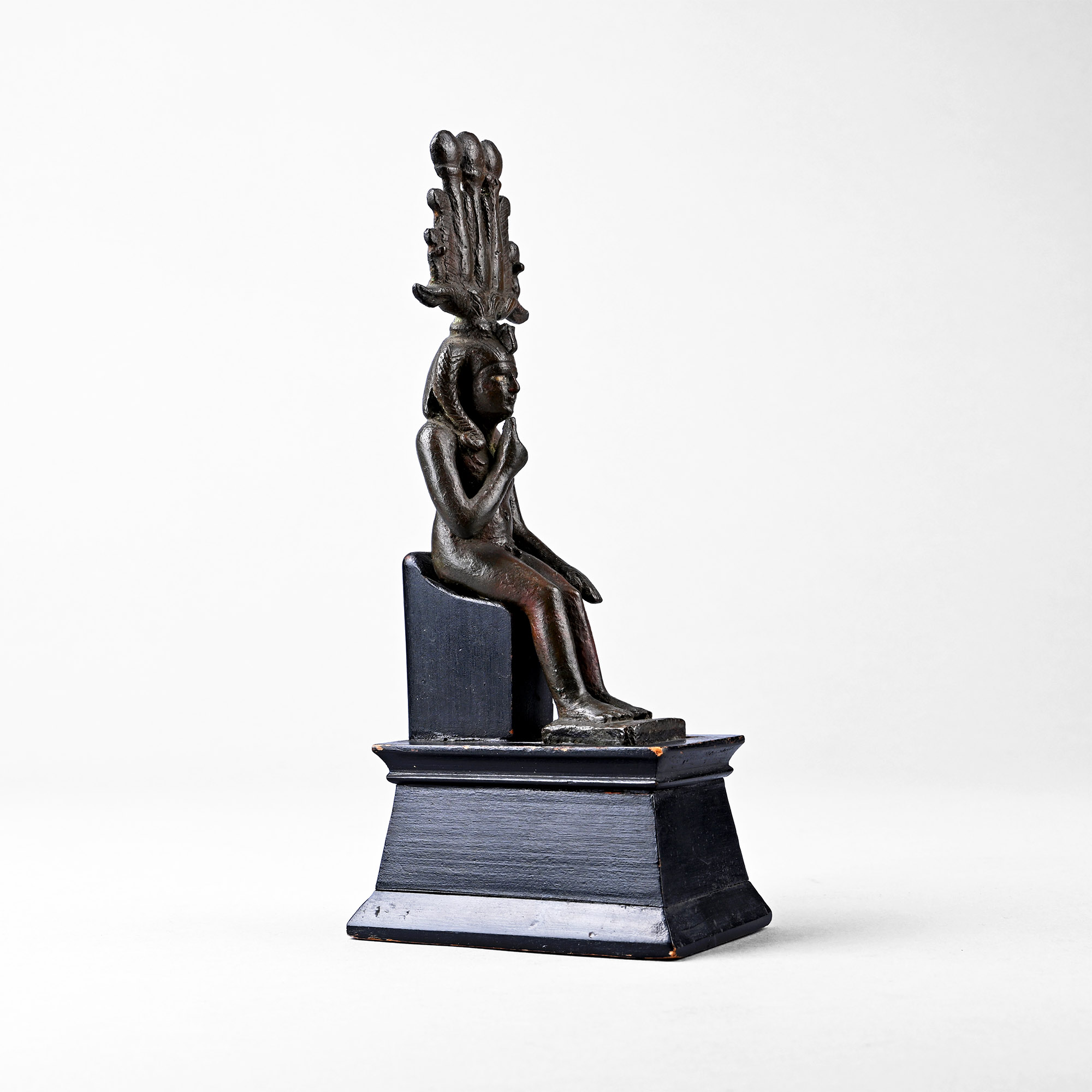
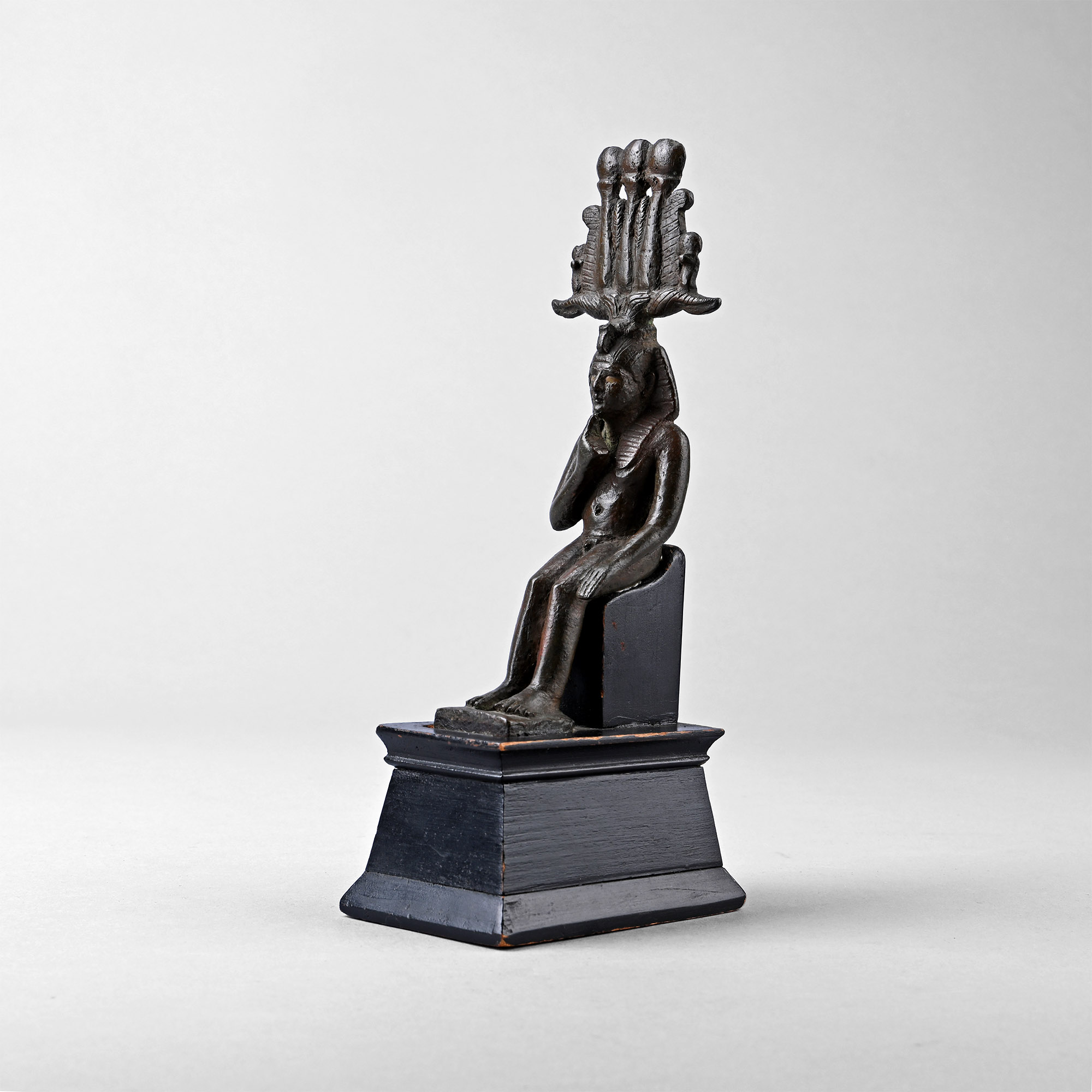
Egyptian Bronze Harpocrates Statue
26TH DYNASTY, 664-525 B.C.
7 3/4 in. (480 grams total, 19.8 cm including stand).
Modelled in the round, shown nude, seated with his left arm by his side and his right forefinger on his chin, wearing a sidelock of youth, nemes headdress surmounted by an elaborate hem-hem crown; mounted on a custom-made stand with dealer's label to underside.
ProvenanceEx Fitzthum collection, Vermont, New England.
Acquired New York, USA, 2000.
Acquired from Royal Athena Galleries, New York, USA, 20 March 2008.
Ex Keane collection, UK.
Accompanied by a copy of the original Royal Athena Galleries invoice no.11164.
This lot has been checked against the Interpol Database of stolen works of art and is accompanied by search certificate number no.13272-252852.
Cf. Roeder, G., Ägyptische Bronzefiguren II, Berlin, 1956, pl. 20g, for a similar example.
FootnotesHarpocrates is the Greek equivalent of the Egyptian name Hor-pa-khered, which means ‘Horus the Child’. This name refers to Horus as the divine infant of Isis and Osiris. Wearing an amulet of Harpocrates was believed to provide the same protection that Isis granted to her beloved son. Larger bronze statuettes were probably votive offerings to Harpocrates, intended to secure his favour and protection.
CONDITIONTimeLine Auctions follows a vetting process to ensure the authenticity and legality of all items, reinforcing our commitment to integrity and responsible trading. Each antiquity, antique, and coin lot undergoes thorough examination by a vetting committee of at least ten external specialists, professional trade association members, scientists, and archaeologists: Our Vetting Process
AUCTIONS:
TimeLine is a leading auction house specialising in antiquities, ancient art, collectables, natural history, coins, medals, and books. Our auctions offer museums, collectors, historians, and enthusiasts the opportunity to acquire unique and historically significant pieces.
LOT 0050
Egyptian Bronze Harpocrates Statue
Estimate £5,000 - 7,000€5,800 - 8,120 (for guidance only)$6,750 - 9,450 (for guidance only)
-
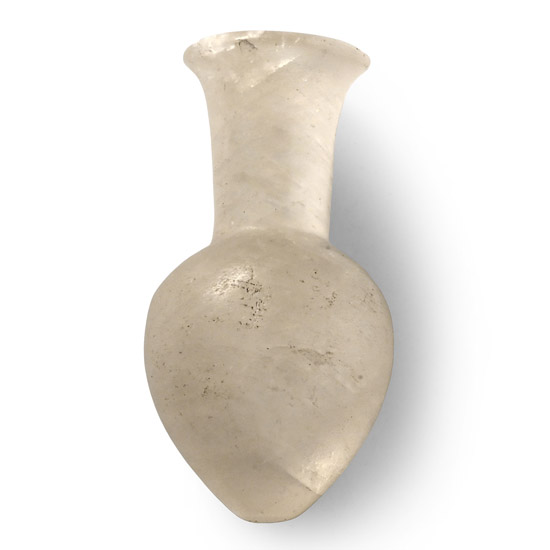
Egyptian Rock Crystal Piriform Vessel
Old Kingdom, 5th-6th Dynasty, circa 2500-2200 B.C.Estimate: £2,500 - 3,500 (+bp*)
Opening Bid: £1,200
Model amphora with trumpet-shaped mouth and piriform body; shallow socket above. 55 grams, 59 mm
with Archaeologia, Switzerland, before 1983. Ex private North American collection. London private collection, 2016. This lot has been checked against the Interpol Database of stolen works of art and is accompanied by a search certificate number no.13231-249997.
This model vessel was probably linked to the "Opening of the Mouth" ritual, which revived the deceased. -
.jpg)
Egyptian Green Glazed Somtous Seated on Lotus Flower
Late Period, circa 664-332 B.C.Sold for (Inc. bp): £780
Modelled in the round, the nude seated figure of the child Somtous, with one hand to his lips and a prominent sidelock, emerging from a lotus flower; mounted on a custom-made stand. 39.76 grams total, 68 mm high including stand
Noriuchi Horiuchi, Tokyo, Japan, 1993. Private collection, London, UK.
The earliest attestations of the cult of Somtous, known as Sematawy in ancient Egyptian, date back to the New Kingdom, although it became particularly popular during the Late Period. Associated with Horus (Horsomtous), the symbol of the child emerging from the lotus represented the (re)birth of the sun god. Thus, Somtous was regarded as a life-giving amuletic symbol, sometimes even referred to as 'Sematawy the child who gives life.' -
.jpg)
Egyptian Wooden Stele for Pa-di-Amun-(em)-ipat with Ra-Horakhty
Late Period-Ptolemaic Period, 664-30 B.C.Sold for (Inc. bp): £20,800
Arch-topped and composed of two vertical boards, coated with gesso and skilfully painted on one side; the lunette decorated with a winged sun-disc and two pendant uraei; the central vignette depicting the deceased worshipping the falcon-headed god Ra-Horakhty with the Four Sons of Horus standing behind, each with their name written above; the lower register with six lines of hieroglyphic text providing an offering formula for the benefit of the deceased: Transliteration of the hieroglyphs: 1) ḥtp-dı-͗nsw rꜤ-ḥr-Ꜣḫtı͗nṯr Ꜥ nb pt sḥḏ [.....] wsır͗ ẖntt [ım͗ntt?] 2) nṯr Ꜥ nb Ꜣbḏw dı⸗͗f pr.t-ḫrw t ḥnḳt kꜢ Ꜣpd [....] ḫt nb(t) (n) fr(t) wꜢbt […] 3) ḫt nbt nḏm dı⸗͗f ḥtpw ḏfꜢw [...]f ḫꜢ m t dı⸗͗f ḫꜢ m 4) ḥnḳt dı⸗͗f ẖꜢ ır͗p [...] dı⸗͗f ḫꜢ m ı͗[...] dı⸗͗f ḫꜢ ı(͗Ꜣ)r(r)t dı⸗͗f 5) m snṯr ḥr ḫꜢwt [...] ḳrs nfr ḥr ım͗nt nfr 6) n [..] wsır͗ [......] pꜢ-dı-͗ım͗n(m) ıp͗ Ꜣ.t ms (n) ḫꜢ [....] Translation: 1) An offering that the king and Ra-Horakhty, Great God, Lord of Heaven, the illuminated [...] Osiris Foremost [of the West?] 2) Great God, Lord of Abydos (that) he may give a voice-offering (of) bread, beer, oxen, and fowl […] everything good and pure […] 3) everything sweet, he gives offerings of provisions […] a thousand of bread, he gives a thousand of 4) beer, he gives a thousand of wine […], he gives a thousand of vines, he gives a thousand of 5) incense on the altar […] a good burial in the beautiful West 6) for […] the Osiris[…] Pa-di-Amun-(em)-ipat born (to) Kha[…]; on the verso, an old handwritten collection label reading: 'From Harding & Sm[ith] Collection Sale Sotheby 2 Nov 1922 L.N. 234. A families [sic] stele, arched top, with the deceased worshipping a standing Horus attended by the four Children of Horus and six horizontal lines of inscription in colour. SP/10a'; mounted in a custom-made wooden frame. 1.94 kg, 45 cm high
From the collection of the late W. Harding Smith (1848-1922). with Sotheby, Wilkinson & Hodge, 34 & 35 New Bond Street, 2 November 1922, no.234. Old handwritten label to verso reading 'From Harding & Sm[ith] Collection collection Sale Sotheby 2 Nov 1922 L.N.234...' Accompanied by an academic report by Egyptologist Paul Whelan. Accompanied by a copy of the 1922 Sotheby, Wilkinson & Hodge catalogue pages. This lot has been checked against the Interpol Database of stolen works of art and is accompanied by search certificate number no.13251-253195.
The syncretism of two strong gods, Re and Horus, is one of the most significant events in Egyptian mythology, and it appears to have had a substantial iconographic impact on Egyptian history. Re's power was augmented by this, which consisted of a falcon-headed man crowned with a sun disc; in the mornings, Re was combined with Horus to become Re-Horakhty.
